How to Organize a Pantry With Deep Shelves: Zones, Bin Sizes and Fit Checks
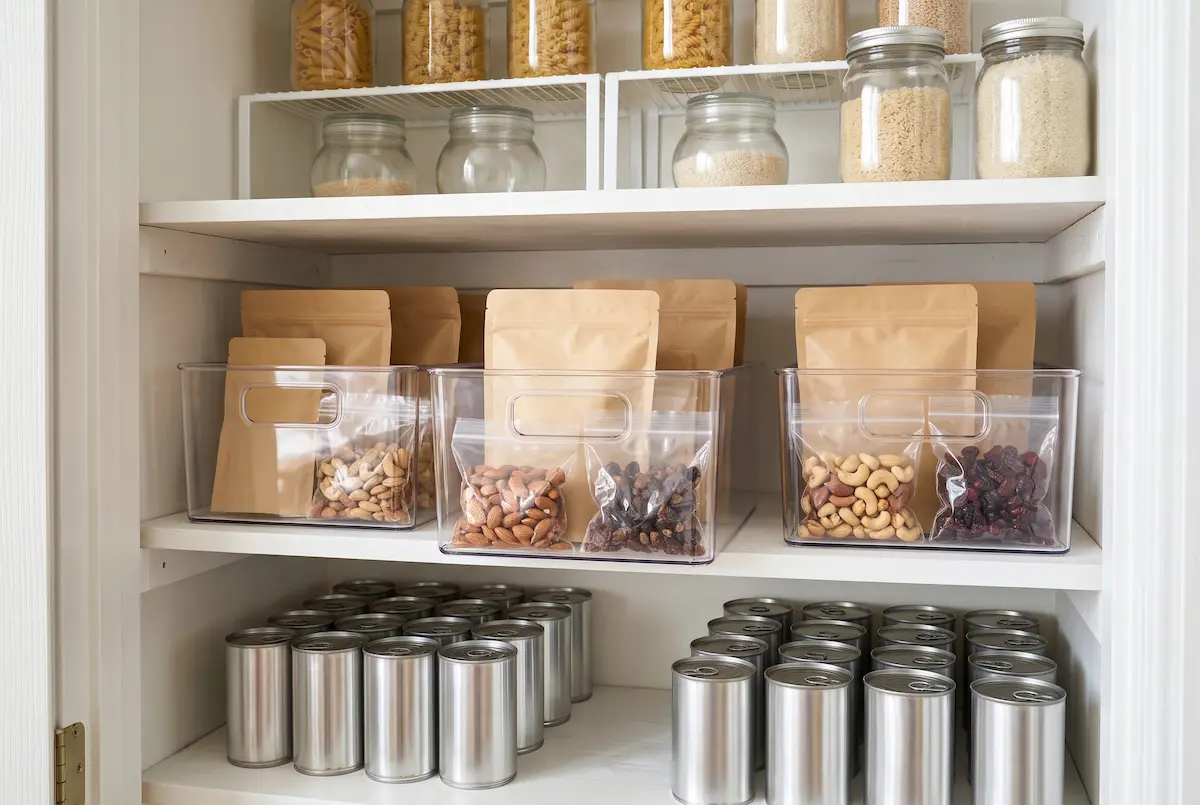
Short answer: Measure each shelf’s real depth and the gap to the shelf above. Then store food in front-to-back lanes or in bins that slide out like drawers, with each bin about ½ inch shorter than the shelf. Put new groceries behind older ones, and keep the back of the shelf for backstock, not daily items.
Deep pantry shelves hold a lot. The trouble is that you can only see the first row, so the cans and boxes behind it get forgotten, expire, or get bought twice. So learning how to organize a pantry with deep shelves is mostly about size: once the bins and rows match the depth of the shelf, the back of the shelf comes forward when you pull.
This guide is about food shelves in a pantry closet or a tall pantry cabinet. If your problem is a deep base cabinet full of pots and pans, our guide on how to organize kitchen cabinets covers that.
What Counts as a Deep Pantry Shelf
Design references put typical pantry shelves at 14 to 16 inches deep, with higher shelves often cut back to 10 to 12 inches. One design guide calls 14 inches ideal and 16 inches the maximum for a shelf that is easy to reach into.
So a shelf starts to feel deep at about 16 inches, and it gets harder from there. These are the depths you are most likely to find:
| Where the shelf is | Depth you may find | Source |
|---|---|---|
| Wire shelving in a pantry closet | 12 or 16 in (some lines also 9 and 20 in) | ClosetMaid wire brochure |
| Built-in wood pantry shelves | 14 to 16 in typical | Dimensions.com |
| Tall pantry cabinet | 12 or 24 in options | KraftMaid |
Treat these as starting points. A 24-inch cabinet loses some depth to the door and back panel, and a “16-inch” wire shelf may not measure exactly 16 inches. The number that matters is the one you measure.
Measure the Shelf Before You Buy Bins
You need four numbers for each shelf. Write them on your phone before you shop.
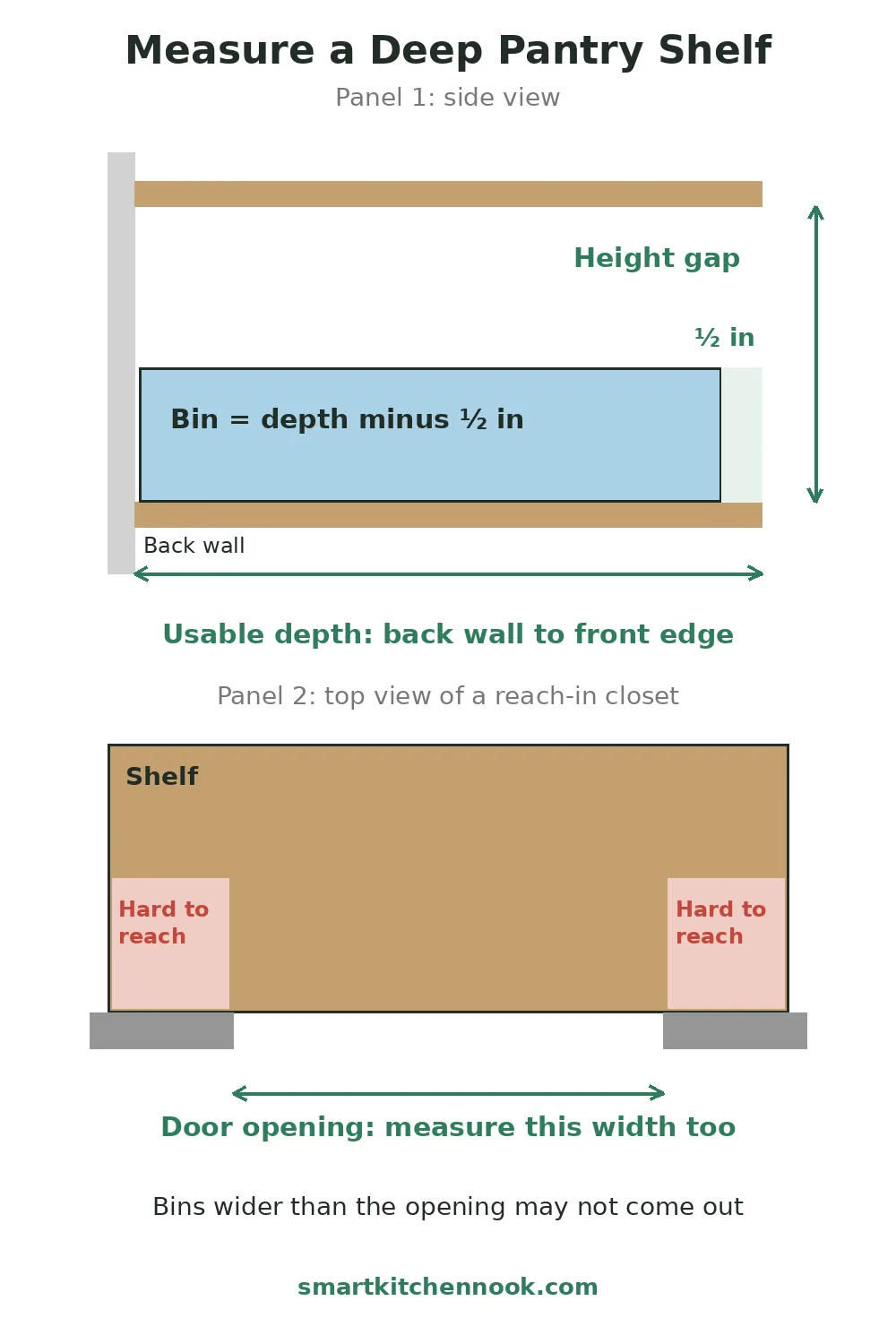
- Usable depth. Measure from the back wall to the front edge of the shelf. If a door, hinge or face frame sits in front of the shelf, measure to the inside of that instead.
- Height gap. Measure from the shelf surface to the underside of the shelf above. This decides whether a riser or a stacked bin will fit.
- Width at the door. In many reach-in pantry closets, the door opening is narrower than the shelves. Measure the opening, not only the shelf, or a wide bin may not come out.
- Shelf surface. Note whether it is solid wood or wire. Small items tip on wire, and screw-in slides need a solid surface.
If you want a step-by-step method for depth, door frames and hinge clearance, see how to measure kitchen cabinets for organizers. The same steps work for pantry cabinets.
Match Bin Depth to Shelf Depth
Our rule of thumb (not a standard) is to buy bins about ½ inch shorter than the usable depth. That leaves room to slide the bin out without catching the back wall or the door frame.
Bin depths are easy to find in listings. For example, one common clear pantry bin is 6 inches wide, 16 inches deep and 5 inches tall. A 16-inch bin like that needs about 16½ inches of usable depth by our rule, so it can be too long for a shelf sold as “16 inches.”
Here is how that plays out. The figures in this table are illustrative, worked from our ½-inch rule. Your own measurement decides.
| Usable depth you measured | Longest single bin (our rule) | Two-row option |
|---|---|---|
| 12 in | about 11½ in | One row only |
| 14 in | about 13½ in | One row only |
| 16 in | about 15½ in | One row, or a short bin in front of a riser |
| 20 in | about 19½ in | Two bins about 9½ in deep each |
| 22½ in (illustrative 24-in cabinet after door and back) | about 22 in | A 16-in bin plus a 6-in strip at the back |
When to use one long bin: for small loose items that get lost, like seasoning packets, snack bars and drink mixes. A full-depth bin with a handle works like a drawer. You pull it out, look down into it, and push it back.
When to use two rows: for things you buy in bulk. The front bin holds what you are using now. The back bin holds the extras. When the front bin runs low, swap them.
Use Lanes for Cans and Jars
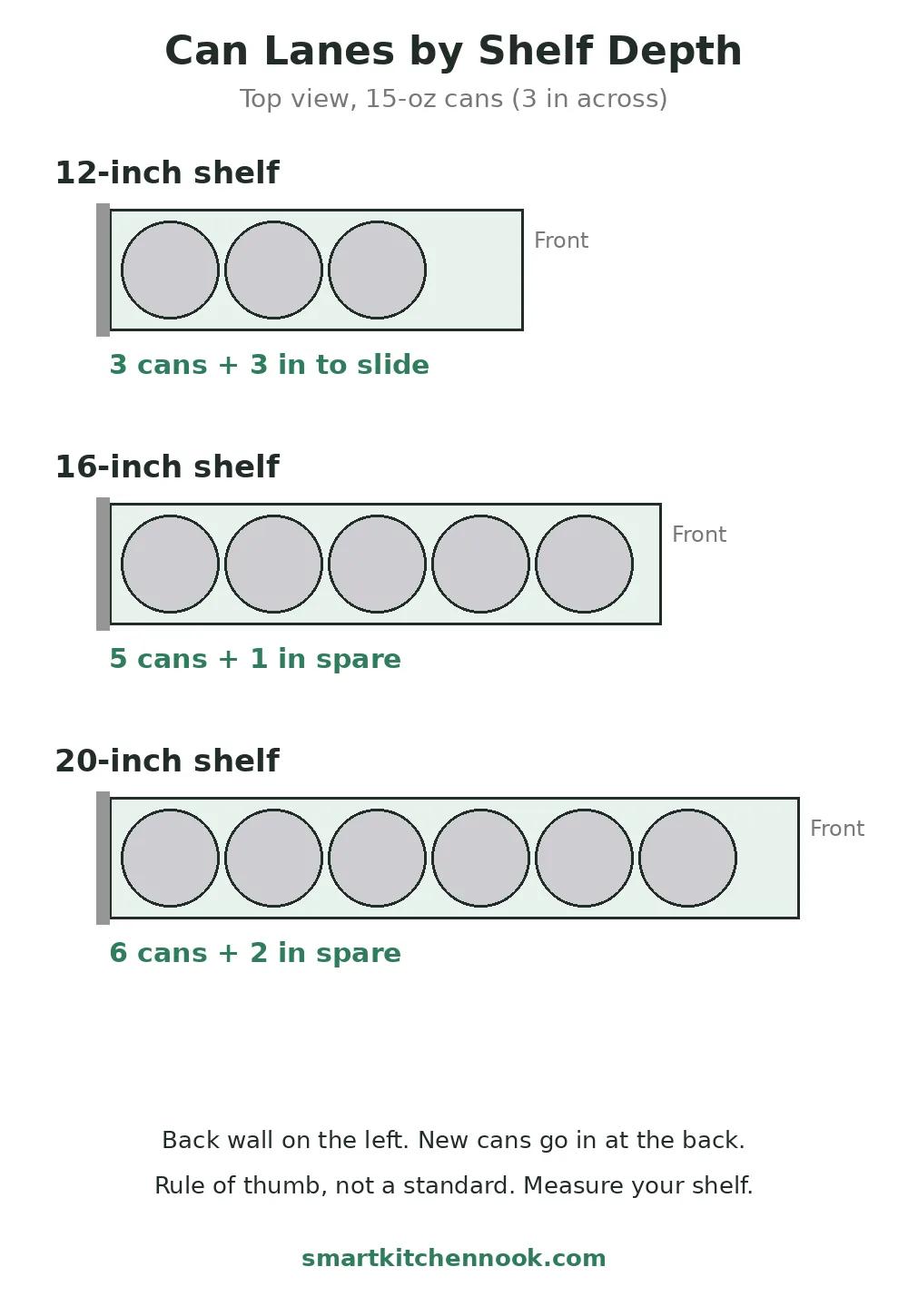
Cans do better in lanes than in bins. A lane is a single-file row from front to back with one kind of item in it, so the front can tells you what is behind it. Members of a home forum thread about a 2-foot-deep pantry closet suggested the same idea: line up identical items single file, with one facing forward.
A standard 15-ounce can (the #300 size) is 3 inches across and 4 7/16 inches tall. That makes lane math easy:
- 12-inch shelf: 4 cans fill it exactly. With some room to slide, plan on 3.
- 16-inch shelf: 5 cans use 15 inches and leave 1 inch spare.
- 20-inch shelf: 6 cans use 18 inches.
These counts are for #300 cans only; other can sizes differ. The point is to know how many cans a lane holds before you shop. If your family uses 2 cans of beans a week, a 5-can lane is about a two-and-a-half-week supply, and anything past that belongs somewhere else.
Rotate Food Front to Back
A deep shelf hides old food by design, so give it a restocking rule. Michigan State University Extension recommends first-in, first-out: when you add food to a pantry, put the most recently purchased items behind the existing ones, and mark the date on top of the package so the oldest is easy to spot.
Lanes and two-row bins make this easy to keep up. New cans go in at the back of the lane. New boxes go into the back bin.
Keep in mind what the dates mean. The USDA’s Food Safety and Inspection Service says that, except for infant formula, dates on food are not an indicator of safety; they are about quality. The same page advises throwing out cans that are dented, rusted or swollen. A quick look during restocking is a good time to catch those.
Fit Checks for Risers, Pull-Outs and Turntables
Each organizer that “brings the back forward” has a size limit. Check these numbers before buying.
| Organizer | What to check | Example from a listing |
|---|---|---|
| Shelf riser | Shelf depth and the height gap above | A riser set lists fits spaces at least 16 in wide and 10 in deep; large shelves 9.85 in deep and 5.75 in tall |
| Screw-in pull-out tray | Minimum interior depth and a solid surface to screw into | A 10-in-deep tray lists a 10-in minimum interior depth, secured with four screws |
| Pull-out wire basket | Minimum opening width, depth and height | One basket lists a 22-in minimum depth and mounts to the cabinet floor only |
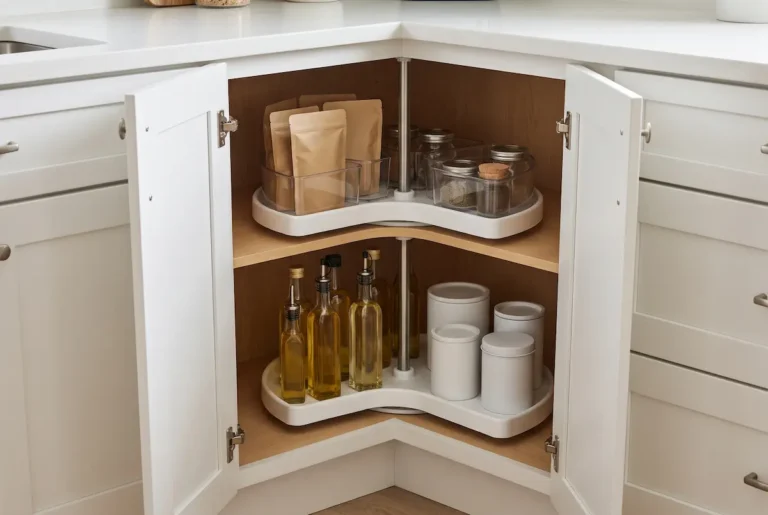
| Turntable | Diameter vs. shelf depth | See our lazy susan size guide |
Riser height math. Using the riser above (5.75 inches tall) with a 15-ounce can on top (4 7/16 inches), the stack is about 10¼ inches. Add our ½ inch for lifting, and the shelf gap needs roughly 10¾ inches. One design guide suggests 6 to 8 inches between can shelves, and a riser with cans on top will not fit a gap that short.
Riser depth math. On a 16-inch shelf, a 9.85-inch riser at the back leaves about 6 inches in front. That is room for a 2-can lane or a row of jars. Put the riser at the back and the shorter items in front, so you can see over them.
Pull-outs on wire shelves. Screw-in slides need something solid to screw into. Wire shelving does not have that, so on wire shelves, bins with handles are the pull-out.
Renter-Friendly Options
Most deep-shelf fixes need no tools: bins, lanes, risers and turntables all sit on the shelf and leave with you.
Screw-in trays and floor-mounted pull-out baskets are different. They put holes in a shelf or cabinet floor that you do not own, so ask your landlord before installing one. If you want light at the back of a dark shelf, a battery light with adhesive is an option, but adhesive can pull paint or finish, so test it somewhere hidden first. For more ideas that leave no marks, see our list of no-drill kitchen storage ideas for renters.
Small Pantry or Tall Pantry Cabinet With Deep Shelves
A small pantry often means a tall cabinet instead of a closet. Tall pantry cabinets come in 12-inch and 24-inch depths, and they need different plans.
- 12-inch cabinet: This depth is not the problem. One row of bins or a 3-can lane per shelf is enough. Use the height instead, with a riser where the gap allows.
- 24-inch cabinet: This is the hard one. Split each shelf into a front bin you use daily and backstock behind it. If you own the cabinet, a pull-out basket that matches the interior depth turns each shelf into a drawer. The one in the table above needs at least 22 inches.
In a small pantry, keep the deep middle shelves for the food you cook with most. Put light bulk items, like paper towels or extra cereal, on the top shelf, and heavy items like canned goods, oils and bags of flour or rice low, where you are not lifting them over your head.
Mistakes That Make Deep Shelves Worse
- Buying bins by the shelf’s sold depth. A shelf sold as 16 inches can measure a little less. Measure, then subtract ½ inch.
- Forgetting the door opening. If the door is narrower than the shelf, a bin in the side corner may not come out straight.
- Adding a riser to a short gap. Check the height math first. On a 6- to 8-inch gap, the riser takes space and adds nothing you can reach.
- Mixing items in one lane. One lane, one item. Two kinds of soup in one lane means the back can is a guess.
- Filling every inch. One home cook who reorganized a deep pantry chose to pull the organizers to the front and leave the back empty. An empty back strip is better than a strip full of forgotten food.
FAQ
How deep should pantry shelves be?
One design guide calls 14 inches ideal and 16 inches the maximum for easy reach, with higher shelves narrower, down to 10 inches. If yours are deeper, use bins as drawers and lanes for cans.
What should go in the back of deep pantry shelves?
Backstock of the same item that sits in front, and things you use a few times a year. Daily items stay in the front few inches.
Are pull-out shelves worth it in a pantry?
They help most on solid shelves 20 inches deep or more, where reaching the back is hard. Check the listed minimum depth first, and get landlord approval if you rent. On wire shelves, handled bins are the simpler choice.
How do I organize a narrow and deep pantry?
Use full-depth bins about ½ inch shorter than the shelf, one category per bin, and label the front. Narrow shelves suit single-file lanes, because there is room for only a few rows across.
How We Put This Guide Together
This guide is based on published design references for pantry shelf depths (Dimensions.com, Hunker), manufacturer information (KraftMaid, ClosetMaid), retailer product listings for bins, risers and pull-outs, food storage guidance from Michigan State University Extension and the USDA Food Safety and Inspection Service, and common problems people describe in organizing forums. We did not test these products. The ½-inch slide rule and the lane counts are our own rules of thumb, worked from listed dimensions. Product listings change, so check the current size on any organizer before you buy.