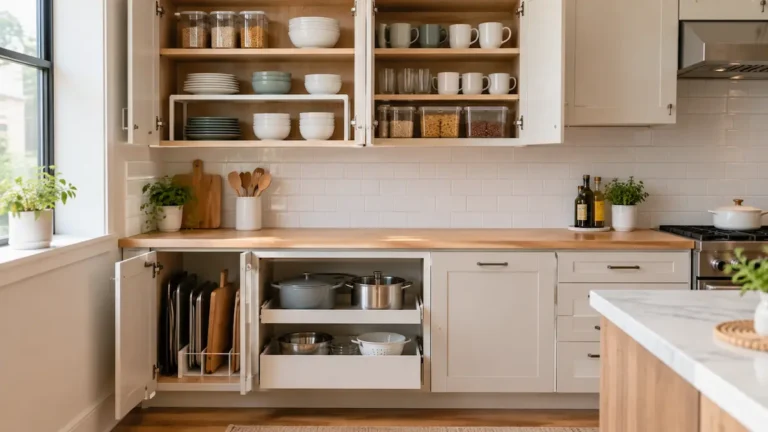
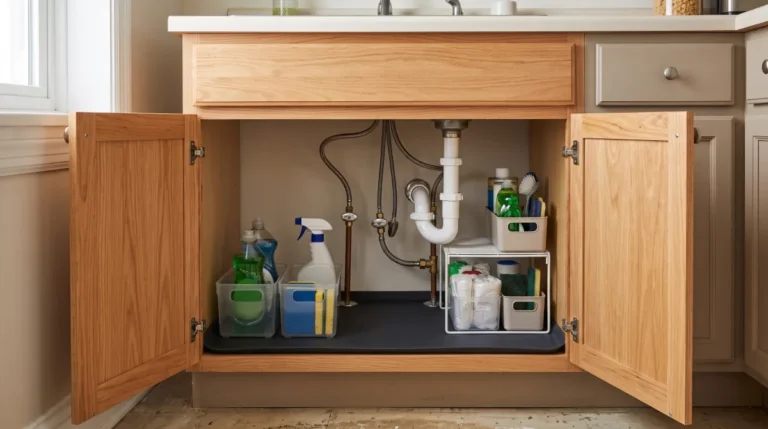
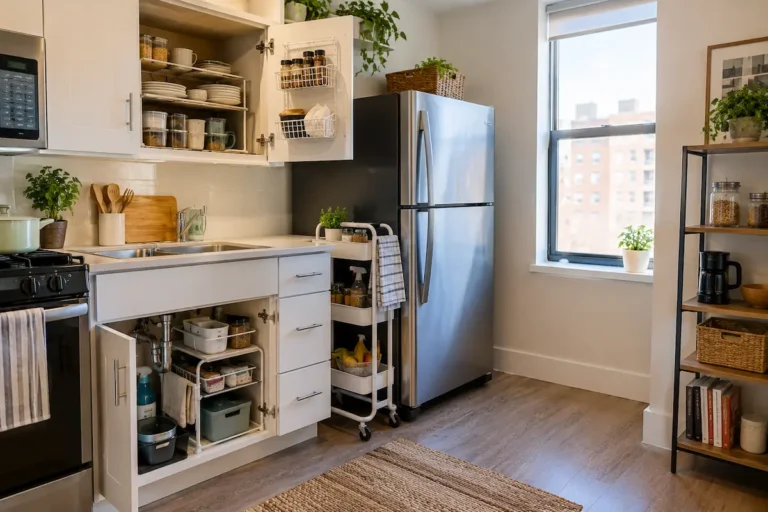
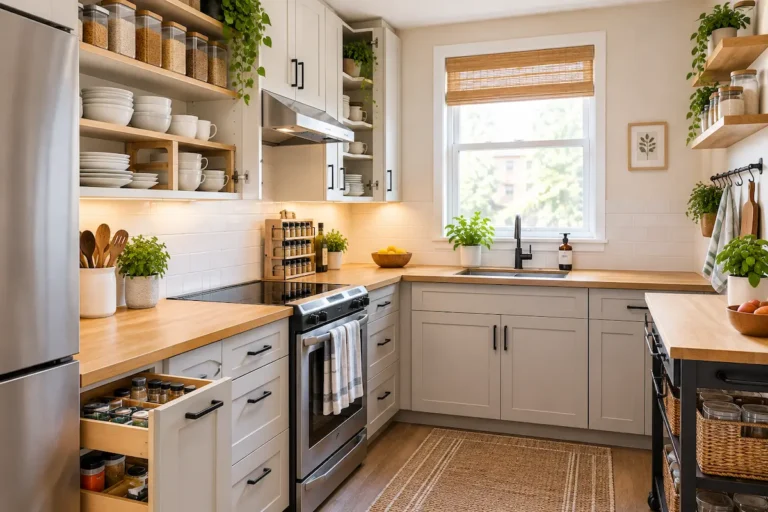
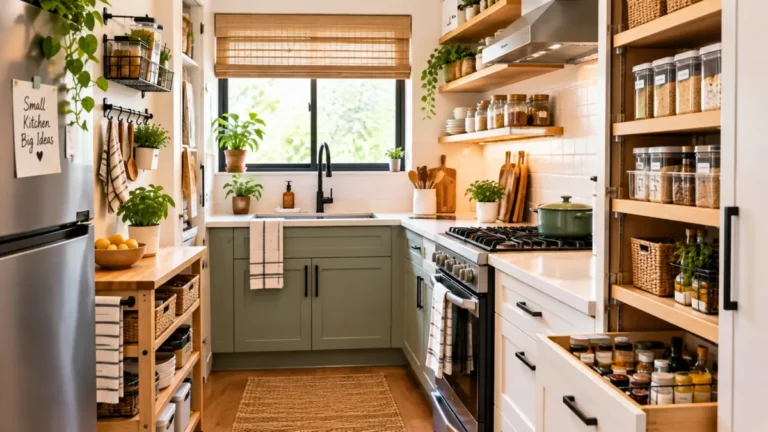
Kitchen Wall Storage Ideas That Actually Save Space
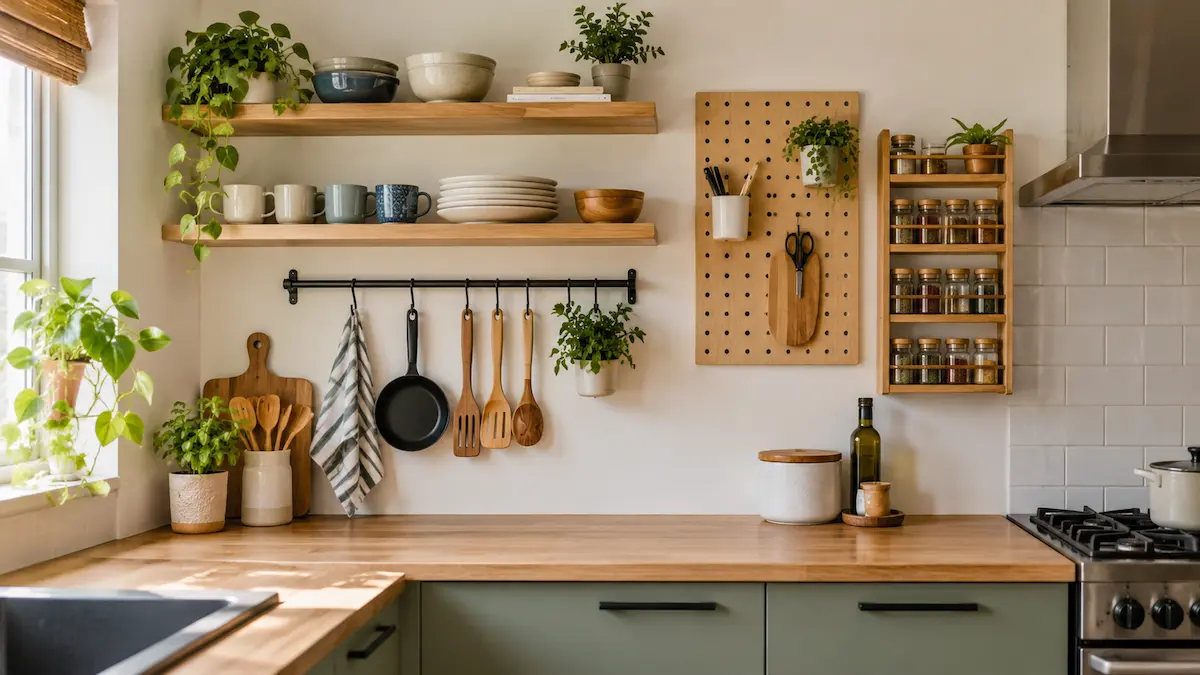
If your kitchen feels short on storage, look at the walls before buying another cabinet or storage cart.
An empty wall can become useful storage for cooking utensils, spices, mugs, pots, pans, knives, or everyday kitchen supplies. The key is choosing the right type of wall storage for the space you have—and avoiding a setup that simply moves the clutter from your counter to your wall.
In this guide, you’ll find practical kitchen wall storage ideas for different kitchen layouts, including small kitchens and rental kitchens. You’ll also learn how to choose between shelves, rails, pegboards, hooks, magnetic storage, and other options.
If you’re looking for broader ways to organize the entire kitchen, our Kitchen Storage Ideas guide covers storage solutions beyond the walls.
Why Kitchen Wall Storage Can Make a Big Difference
Kitchen walls are often underused because most storage planning focuses on cabinets, drawers, and countertops.
But a well-planned wall storage system can put frequently used items within easy reach while freeing up valuable cabinet and counter space.
For example:
- A rail with hooks can hold utensils you use every day.
- A narrow shelf can keep spices off the counter.
- A magnetic rack can organize knives without using a drawer.
- A pegboard can adapt as your storage needs change.
- A wall-mounted shelf can provide a home for mugs, dishes, or small containers.
- A pot rack can move bulky cookware out of crowded cabinets.
The important part is not filling every empty section of wall.
Good wall storage gives specific items a specific home without making the kitchen feel visually crowded.
12 Practical Kitchen Wall Storage Ideas
1. Install a Floating Shelf
A floating shelf is one of the simplest ways to turn unused wall space into storage.
Use one for items that look reasonably tidy when displayed, such as:
- Mugs
- Small bowls
- Jars
- Cookbooks
- Frequently used ingredients
- Decorative kitchen items
For a small kitchen, a relatively shallow shelf can be more practical than a deep one because it adds storage without projecting too far into the workspace.
Avoid putting too many unrelated items on the shelf. A shelf packed with containers, appliances, dishes, and decorations can quickly become another clutter zone.
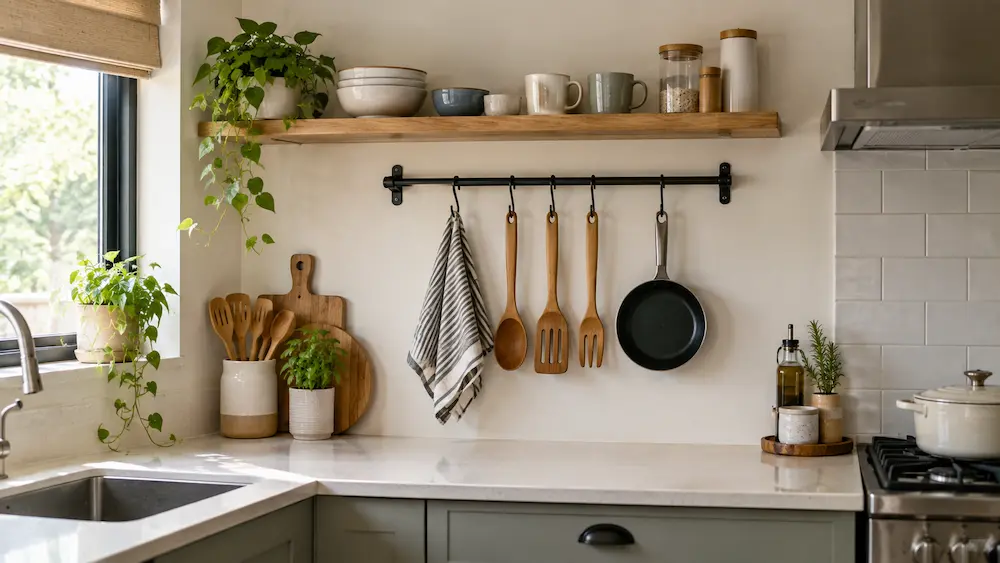
2. Use a Wall Rail With Hooks
A wall rail is useful when you want frequently used kitchen tools to stay visible and easy to grab.
Depending on the system, hooks can hold:
- Measuring cups
- Ladles
- Whisks
- Scissors
- Small strainers
- Kitchen towels
- Mugs
Rail systems can also be expanded with baskets, containers, or shelves. IKEA’s current KUNGSFORS range, for example, combines rails, shelves, hooks, containers and other accessories into a configurable wall-storage system.
The best location is usually close to the area where you’ll actually use the items.
3. Try a Kitchen Pegboard
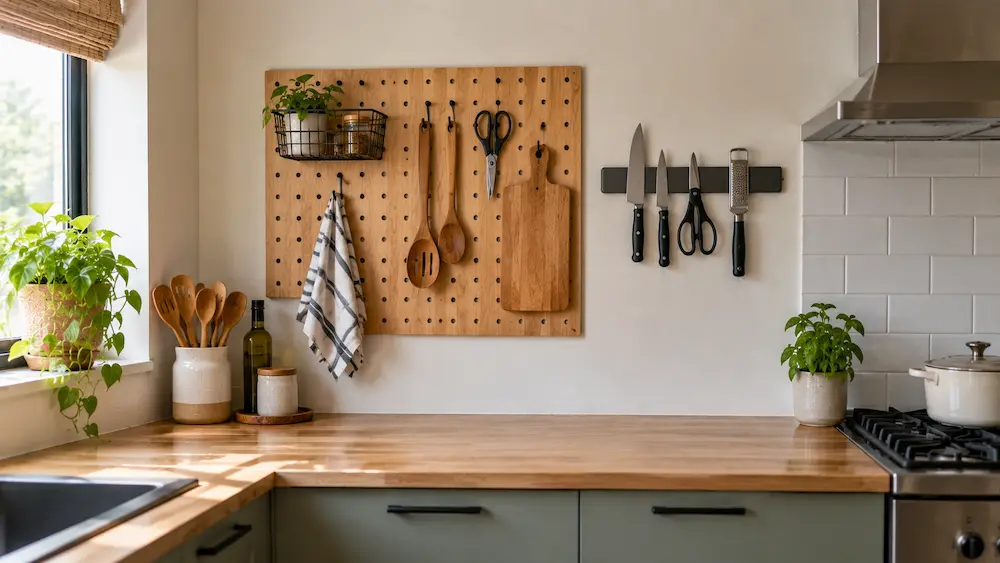
A pegboard can work particularly well when your storage needs change frequently.
Instead of fixing every item into one permanent position, you can rearrange hooks, shelves, or containers as your kitchen habits change.
A pegboard can hold:
- Utensils
- Small baskets
- Measuring tools
- Cutting boards
- Kitchen scissors
- Lightweight pans
- Small containers
It’s especially useful when you want flexible storage rather than a fixed shelf layout.
4. Add Magnetic Kitchen Storage
Magnetic storage can make use of wall space without requiring a traditional shelf.
Common uses include:
- Knife storage
- Small metal containers
- Measuring tools
- Kitchen clips
- Lightweight accessories
A magnetic knife rack can be particularly useful when a knife drawer is already crowded.
However, placement matters. Keep sharp tools away from areas where children can easily reach them, and make sure the storage system is securely installed.
5. Install a Narrow Spice Shelf
If spice containers are taking over a countertop or cabinet shelf, a narrow wall-mounted spice shelf can make better use of vertical space.
This works especially well on:
- A narrow wall beside a cabinet
- A small section above a counter
- A wall near the cooking area
- A narrow gap that is otherwise difficult to use
Keep only the spices you actually reach for regularly in the most convenient location. A wall doesn’t need to become a display for every spice you own.
6. Put Pots and Pans on the Wall
Large cookware can consume a surprising amount of cabinet space.
If your kitchen layout allows it, a sturdy wall-mounted rack or rail with appropriate hooks can move some pots and pans out of a crowded cabinet.
This works best when:
- The wall can support the installation.
- The cookware is securely hung.
- The rack is positioned away from busy walkways.
- The cookware doesn’t interfere with cabinets, doors, or cooking surfaces.
For heavy cookware, always follow the mounting instructions and weight limits of the specific storage product.
7. Create a Simple Mug Station
Mugs are easy to organize with a small shelf, rail, or hooks underneath a shelf.
A mug station can work particularly well near:
- The coffee maker
- A breakfast area
- A beverage station
- A small section of unused wall
Instead of storing every mug you own in the most accessible position, keep your everyday mugs within easy reach and store less frequently used pieces elsewhere.
8. Use Wall-Mounted Baskets
Baskets can turn a blank wall into useful storage for smaller or awkwardly shaped items.
Depending on the design, they can hold:
- Produce
- Towels
- Small kitchen supplies
- Packaged foods
- Reusable bags
- Cleaning accessories
Open baskets make items easy to grab, while covered storage can help reduce visual clutter.
Choose the location carefully if you plan to store food. Avoid placing food storage where heat, moisture, grease, or cleaning chemicals could create problems.
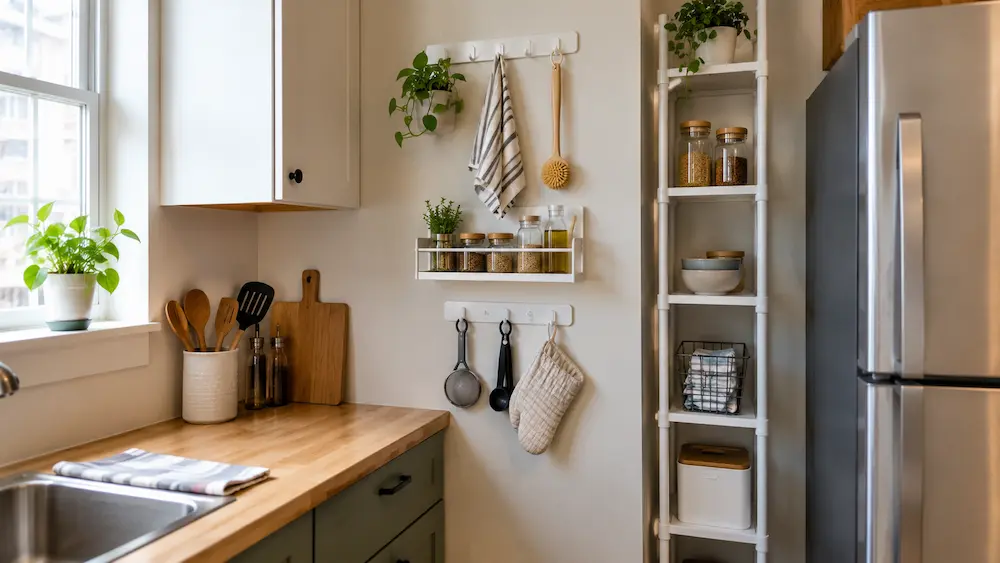
9. Use the Narrow Wall Beside a Cabinet or Refrigerator
Small gaps are easy to overlook.
A narrow wall section beside a cabinet, refrigerator, or tall pantry may be wide enough for a slim shelf, rail, hooks, or vertical organizer.
This is one of the most useful approaches for a small kitchen because it focuses on previously wasted space rather than trying to add storage everywhere.
Before installing anything, check:
- Available width
- Available depth
- Door clearance
- Refrigerator clearance
- Walking space
- Nearby switches or outlets
A few inches of usable wall space can be valuable, but only if the storage doesn’t interfere with how the kitchen functions.
10. Use the Wall Above the Counter Carefully
The wall above a countertop is an obvious storage location, but it needs more planning than it first appears.
A shelf or rail can work well for frequently used items, but don’t install storage so low that it becomes an obstacle while preparing food.
Think about the full working area:
counter → person working → wall storage
There should be enough room for normal cooking movements without bumping into shelves, hooks, or hanging cookware.
11. Add a Wall-Mounted Dish or Drying Solution
In some kitchens, a wall-mounted dish rack can make use of vertical space that would otherwise remain empty.
This can be particularly useful when countertop space is limited.
Before choosing one, consider:
- How much dishware it holds
- How water is collected or drained
- Whether the wall can support it
- How easily the rack can be cleaned
- Whether it interferes with cabinets or windows
Moisture management matters here more than it does with a simple decorative shelf.
12. Use the Side of a Cabinet for Vertical Storage
The side panel of a cabinet can sometimes provide an overlooked storage surface.
Depending on the cabinet construction and available clearance, you may be able to use:
- Hooks
- A small rail
- A magnetic organizer
- A narrow basket
- A slim shelf
This can be especially useful in kitchens where the main walls are already occupied.
Just make sure the storage doesn’t interfere with cabinet doors, drawers, or walkways.
Small Kitchen Wall Storage Ideas
Small kitchens benefit from wall storage, but more storage isn’t automatically better.
The goal is to use vertical space while keeping the room visually and physically open.
A few strategies work particularly well:
Use narrow storage
A shallow shelf or slim rail can provide useful storage without taking over the wall.
Store everyday items vertically
Put frequently used utensils, mugs, spices, or tools where they’re easy to reach.
Use awkward wall sections
Look at the areas beside cabinets, refrigerators, doors, and other fixed features.
Avoid filling every wall
Leaving some empty wall space can make a small kitchen feel less crowded.
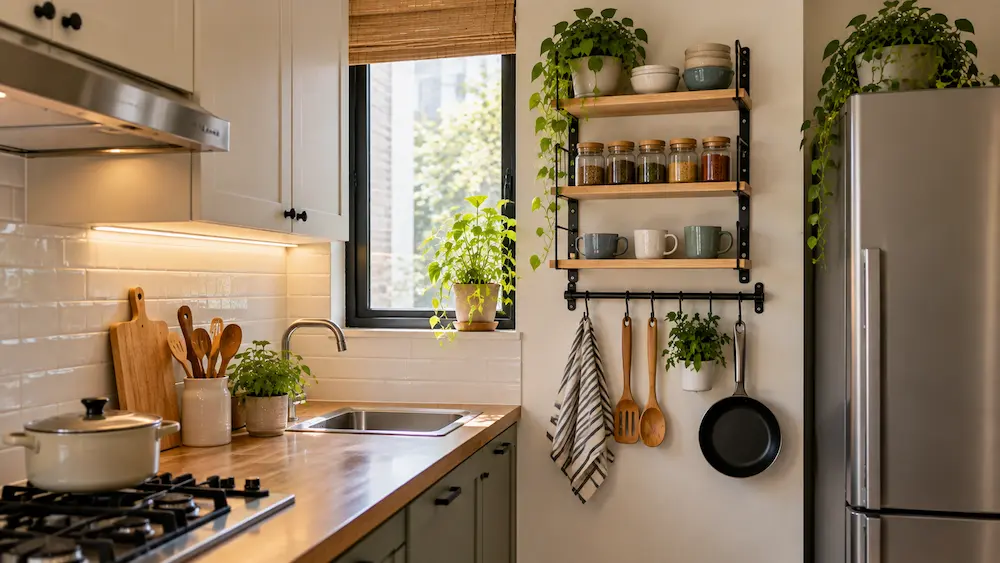
Choose one storage system when possible
A collection of unrelated hooks, baskets, shelves, and racks can look messy. A coordinated system often creates a cleaner appearance.
If your entire kitchen needs a more systematic approach, see our Small Kitchen Organization Ideas guide for ideas covering cabinets, counters, drawers, and the overall kitchen layout.
Renter-Friendly Kitchen Wall Storage
Renters have an additional problem: adding storage without creating unnecessary damage.
Before choosing a wall-storage product, check your lease and understand what your landlord allows.
Possible options include:
- Removable adhesive organizers
- Tension-based solutions
- Freestanding storage placed against a wall
- Existing hooks or rails
- Lightweight systems designed specifically for removable installation
However, “no-drill” does not automatically mean “safe for every wall.”
Adhesive products have weight limits and surface requirements. Paint condition, wall texture, humidity, and the manufacturer’s installation instructions can all affect how well they work.
For more renter-focused ideas, see our No-Drill Kitchen Storage Ideas for Renters guide.
How to Choose the Right Kitchen Wall Storage
Before buying anything, start with the problem you’re trying to solve.
| What needs storage? | Storage type to consider |
|---|---|
| Cooking utensils | Rail + hooks |
| Spices | Narrow shelf or spice rack |
| Knives | Magnetic knife rack |
| Pots and pans | Heavy-duty rack or rail |
| Mugs | Hooks or small shelf |
| Small containers | Pegboard or wall basket |
| Mixed everyday items | Rail or modular wall system |
| Limited wall width | Narrow shelf or slim rail |
| Frequently changing items | Pegboard |
This approach is usually more useful than choosing a product first and then trying to find something to put in it.
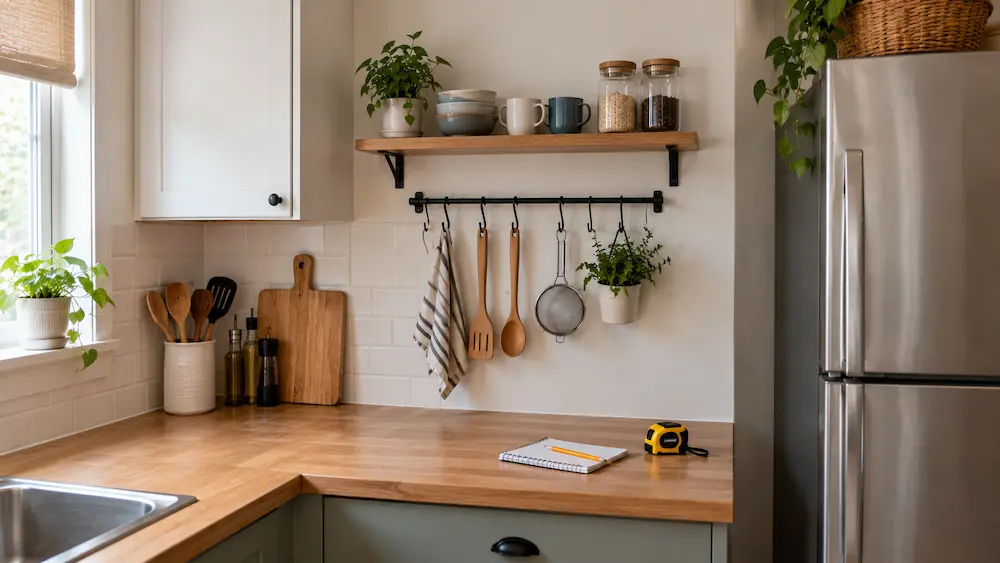
Check the dimensions
Measure the wall before ordering anything.
At minimum, check:
- Width
- Height
- Depth
- Distance from the counter
- Nearby cabinet doors
- Nearby appliances
- Walking clearance
A storage product that technically fits the wall may still be inconvenient if it blocks a cabinet door or extends too far into the workspace.
Check the mounting method
Different walls require different installation approaches.
Depending on the product and wall construction, installation may involve anchors, screws, studs, or other hardware.
Do not assume that a product’s advertised weight capacity applies to every wall or mounting method.
Always follow the manufacturer’s installation instructions.
Think about cleaning
Kitchen walls can collect grease, dust, steam, and food particles.
For storage located near a stove or prep area, choose materials and designs that can be cleaned easily.
Open shelves with many small objects can require more frequent cleaning than a simpler rail-and-hook arrangement.
If you’re also organizing the storage behind cabinet doors, see our guide on how to organize kitchen cabinets for a practical system for planning cabinet zones and everyday items.
Where Should You Put Kitchen Wall Storage?
The best location depends on what you’re storing.
Near the cooking area
Useful for:
- Utensils
- Spices
- Pot holders
- Frequently used cookware
Near the coffee station
Useful for:
- Mugs
- Coffee accessories
- Small containers
Near the prep area
Useful for:
- Measuring tools
- Cutting boards
- Kitchen towels
- Frequently used utensils
Beside the refrigerator
Useful for:
- Narrow shelves
- Shopping lists
- Small baskets
- Lightweight accessories
Above or beside the counter
Useful for:
- Everyday kitchen items
- Small shelves
- Rails
- Hooks
The general rule is simple:
Store things close to where you use them.
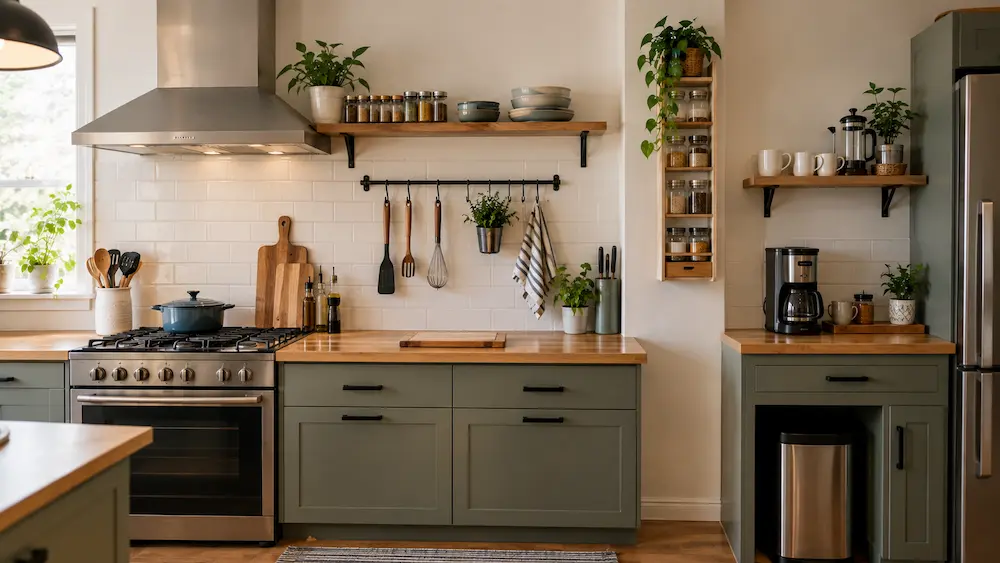
A wall organizer may create plenty of storage, but if you have to walk across the kitchen every time you need something, the setup isn’t really improving your workflow.
How to Keep Wall Storage From Looking Cluttered
Open storage is useful, but everything becomes visible.
To keep the kitchen looking organized:
- Group similar items together.
- Keep frequently used items closest to the work area.
- Avoid filling shelves to the edge.
- Use matching containers when practical.
- Keep decorative items limited.
- Leave some empty space.
- Don’t hang every kitchen tool you own.
- Remove items you rarely use.
A useful test is to look at the wall from the kitchen entrance.
If the first thing you notice is a collection of unrelated objects, the storage may need simplifying.
Kitchen Wall Storage Safety and Installation
Wall storage should be secure before you start using it. A shelf or rail that is poorly mounted can fall, damaging items or injuring someone.
Before installing a shelf, rack, rail, or pegboard:
- Identify the wall type. Different wall materials require different mounting hardware.
- Follow the manufacturer’s instructions. Check the recommended mounting method and any stated weight limits.
- Use suitable fixings. Locate studs where appropriate and choose anchors or screws suited to the wall and the intended load.
- Account for the total weight. Include the storage unit itself and everything you plan to place on it.
- Check access and clearance. Make sure cabinet doors and drawers open freely and stored items do not obstruct food preparation.
- Keep items away from hazards. Position sharp or heavy utensils securely, and keep wall storage clear of cooking flames and hot surfaces. Follow the appliance and storage manufacturers’ clearance instructions.
- Inspect the installation periodically. Check for loose fixings, movement, or signs of damage, and stop using the unit if it becomes unstable.
For example, IKEA warns that its KUNGSFORS suspension rail must be securely anchored to reduce the risk of it falling. The correct screws and plugs depend on the wall, so follow the product’s installation instructions rather than assuming one mounting method works for every kitchen.
If you’re unsure whether your wall or mounting hardware can safely support the intended load, seek advice from a qualified installer.
What Not to Put on Kitchen Walls
Wall storage can free up cabinets and counters, but some items are better kept elsewhere.
Be cautious about storing:
- Heavy cookware on systems not rated for the load. Choose storage with a suitable weight rating and compatible mounting hardware.
- Sharp tools within children’s reach. Store knives and other sharp utensils in a secure, accessible location away from children.
- Items exposed to excessive heat. Keep storage and its contents clear of cooking flames and follow the appliance manufacturer’s clearance instructions.
- Fragile objects in busy areas. Avoid placing breakable items where people might bump into them or where they could fall onto a work surface.
- Bulky items in narrow walkways. Storage should not obstruct movement, food preparation, or access to appliances.
- Items that could be knocked loose. Check whether opening nearby cabinet doors or appliances could hit the storage or dislodge its contents.
Also, don’t install storage just because a wall is empty. If a setup creates more clutter, blocks access, or introduces a safety concern, another storage location may be the better choice.
Kitchen Wall Storage Buying Checklist
Before buying a wall-storage product, check these five things:
- Fit: Measure the available wall space and check that cabinet and appliance doors can still open freely.
- Purpose: Choose storage for items you actually use, rather than filling empty wall space.
- Weight and mounting: Check the product’s weight limit and confirm that your wall and mounting method are suitable for the intended load.
- Kitchen conditions: Consider heat, grease, moisture, and how easily the storage can be cleaned.
- Everyday access: Make sure frequently used items are easy to reach without obstructing food preparation or cooking.
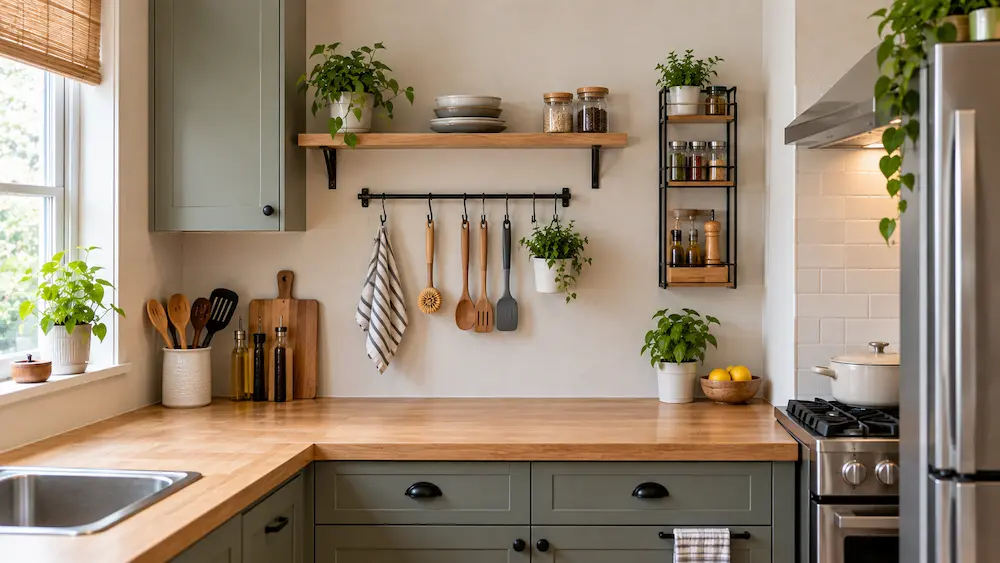
A good wall-storage solution should make everyday tasks easier, not simply add more storage. If it doesn’t solve a specific problem, you may not need it.
Final Thoughts
The most useful kitchen wall storage ideas aren’t necessarily the biggest or most elaborate ones.
A narrow spice shelf can be enough to clear a crowded counter. A simple rail can give cooking utensils a permanent home. A small pegboard can make awkward wall space flexible. A well-placed shelf can add storage without taking up valuable floor space.
Start with the items that are causing the biggest storage problem, find the wall space closest to where those items are used, and choose a solution that fits the wall, the kitchen layout, and your daily routine. If you’re organizing a compact kitchen overall, explore our guide to small kitchen organization ideas for more ways to make the most of limited space.
The goal isn’t to fill your walls.
The goal is to make your kitchen easier to use.
Frequently Asked Questions
What is the best way to use empty wall space in a kitchen?
The best approach depends on what you need to store. Rails and hooks work well for utensils, narrow shelves can hold spices or small containers, and pegboards offer flexible storage for changing needs.
How can I add kitchen wall storage to a small kitchen?
Use narrow or shallow storage, focus on vertical space, and prioritize items you use regularly. Wall sections beside cabinets and refrigerators can also provide useful storage without taking up floor space.
What can I put on a kitchen wall?
Depending on the storage system, you can organize utensils, spices, mugs, knives, cookware, small containers, towels, and other frequently used kitchen supplies.
Is wall-mounted kitchen storage good for renters?
It can be, but the installation method matters. Renters should check their lease and choose solutions that match the wall surface, weight requirements, and landlord restrictions.
How do I keep open kitchen wall storage from looking messy?
Group similar items, avoid overfilling shelves, limit decorative objects, and keep only frequently used items in the most visible locations. Leaving some empty space can also make the arrangement feel more organized.
How high should kitchen wall storage be?
There isn’t one universal height for kitchen wall storage. Position shelves, rails, and hooks so frequently used items are comfortable to reach without obstructing food preparation, cabinet doors, or normal movement. Keep storage and its contents clear of cooking flames and hot surfaces, and follow the appliance and storage manufacturers’ clearance instructions where applicable.
Are kitchen wall shelves safe?
They can be when properly installed for the wall type and intended load. Follow the manufacturer’s mounting instructions, use suitable hardware, and avoid exceeding the stated weight limits.
Can kitchen wall storage replace cabinets?
Wall storage can supplement cabinet space, but it usually isn’t a complete replacement. It works best for frequently used or smaller items that benefit from easy access.