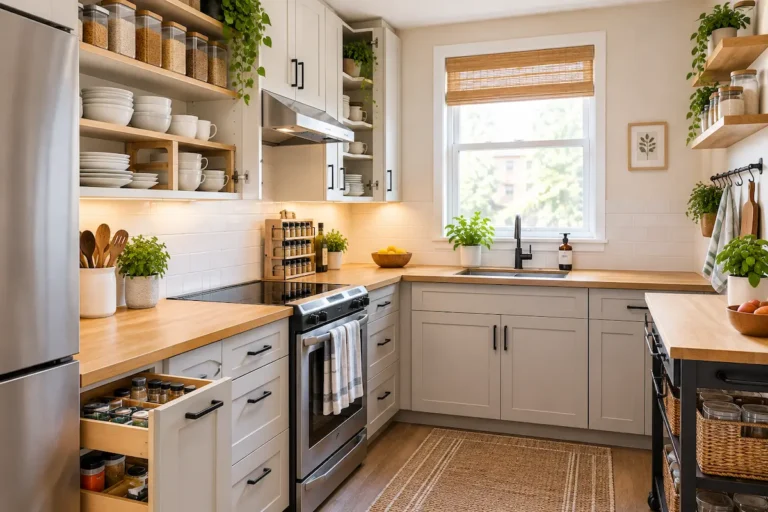
How to Organize Kitchen Cabinets: A Practical System That Actually Works
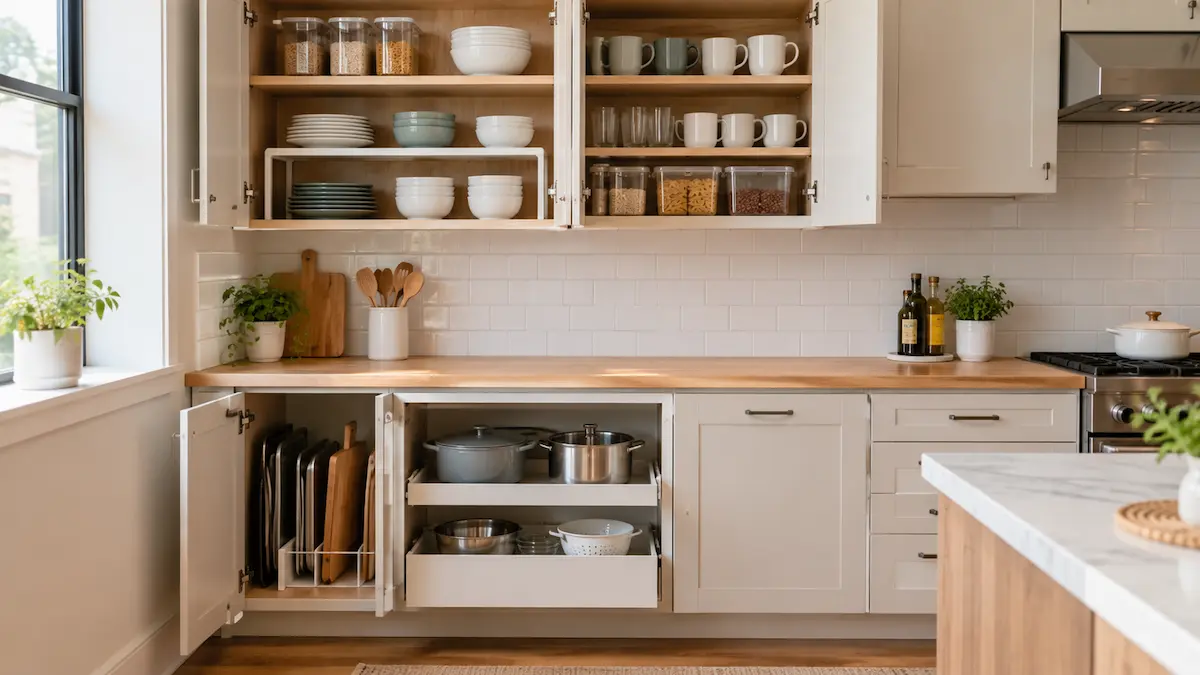
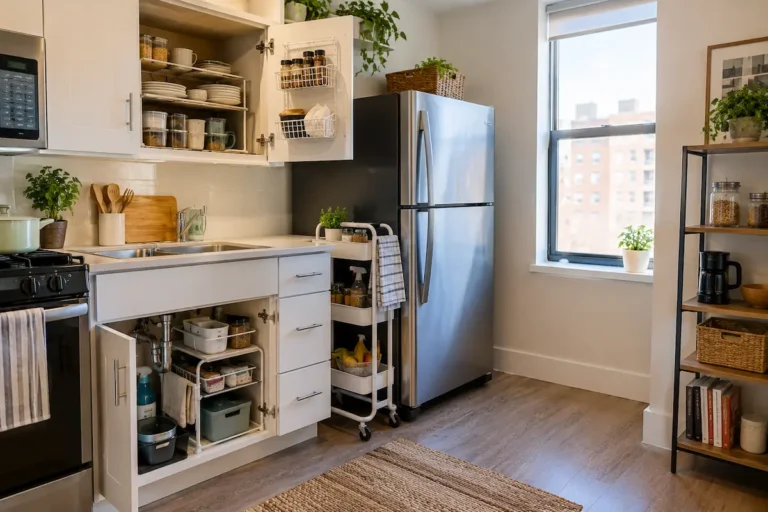
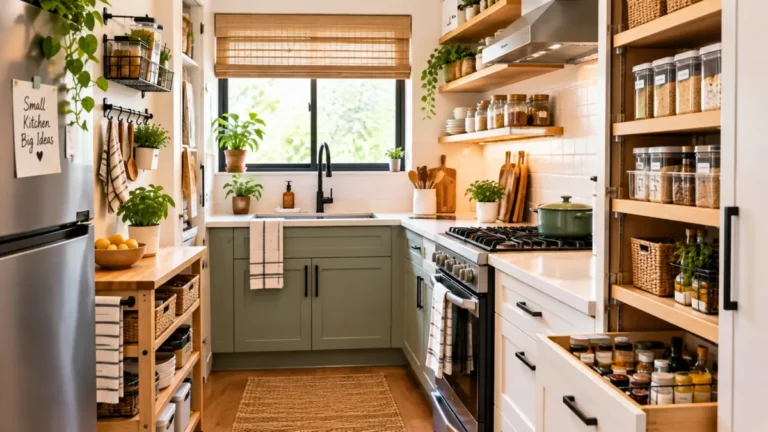
How to organize kitchen cabinets effectively is less about buying more organizers and more about creating a system that fits the way you actually use your kitchen.
Kitchen cabinets tend to get messy for a simple reason: things are often put wherever there is room, rather than where they are easiest to use.
That works for a while. Then everyday dishes end up behind less-used serving pieces, pans become difficult to separate, and the back of a deep cabinet turns into a place where things disappear.
The good news is that you usually do not need more cabinets to fix the problem.
A better approach is to organize your cabinets around how you use your kitchen. Start by removing what you do not need, group similar items, create practical zones, and then solve specific storage problems with the right type of organizer.
If you are looking for broader ways to make the most of limited kitchen space, explore our Kitchen Storage Ideas guide.
Here is the basic system:
- Declutter before organizing.
- Group similar items.
- Create zones based on how you cook.
- Keep frequently used items easy to reach.
- Measure problem areas before buying organizers.
- Use storage products only when they solve a real problem.
- Make the system simple enough to maintain.
The goal is not to make every cabinet look perfect. It is to make your kitchen easier to use every day.
Before You Organize Your Kitchen Cabinets
Before buying bins, shelf risers, dividers, or anything else, take a little time to understand what is actually making your cabinets difficult to use.
When you learn how to organize kitchen cabinets around your daily routine, it becomes much easier to decide what belongs where.
Start With One Cabinet at a Time
You do not have to empty your entire kitchen at once.
Choose one cabinet or one problem area and work through it completely. This makes the process less overwhelming and makes it easier to notice what is not working.
As you empty the cabinet, keep three questions in mind:
- Do I actually use this?
- How often do I use it?
- Is this the best place for it?
You may discover that the problem is not a lack of storage at all. You may simply have too many items competing for the same space.
Remove Items You No Longer Use
Organizing becomes much easier when you are working with only the things you actually need.
Look for:
- duplicate utensils
- broken items you keep meaning to replace
- containers without useful lids
- appliances you almost never use
- dishes that are rarely used
- cookware you no longer reach for
You do not have to get rid of something simply because you have not used it recently. The point is to make a conscious decision about what deserves valuable cabinet space.
Group Similar Items Together
Once you know what is staying, group similar things together.
For example:
- pots with pots
- pans with pans
- baking tools with baking tools
- everyday plates with everyday bowls
- food containers with their lids
- measuring tools with other prep tools
This gives you a starting point for creating cabinet zones.
Identify the Real Storage Problem
This is one of the most useful steps in the entire process.
Instead of thinking, “I need an organizer,” ask what is actually going wrong.
If you cannot see things: you have a visibility problem.
If you can see something but cannot reach it: you have an access problem.
If items keep falling over: you may have a stability problem.
If the cabinet has unused space above your stacks: you may have a vertical-space problem.
If everything is mixed together: you probably have a zoning problem.
Once you know the problem, choosing a solution becomes much easier.
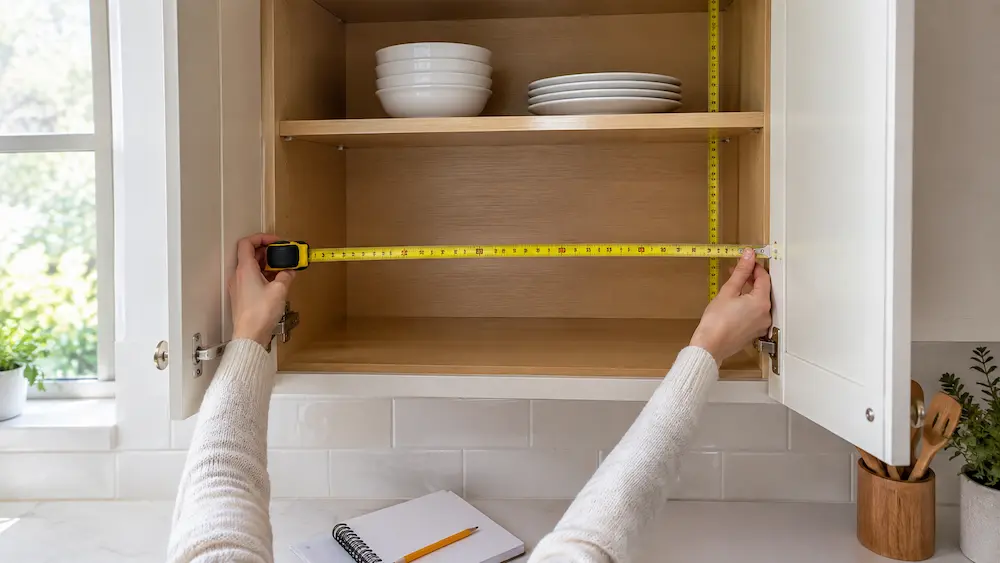
Measure Before Buying Anything
This is especially important for cabinet organizers.
Measure the available:
- width
- depth
- height
- shelf clearance
- door clearance, when relevant
Also check whether hinges, pipes, cabinet frames, or other hardware reduce the usable space.
An organizer that looks perfect online can make a cabinet harder to use if it is too wide, too tall, or difficult to remove.
How to Organize Kitchen Cabinets by Zone
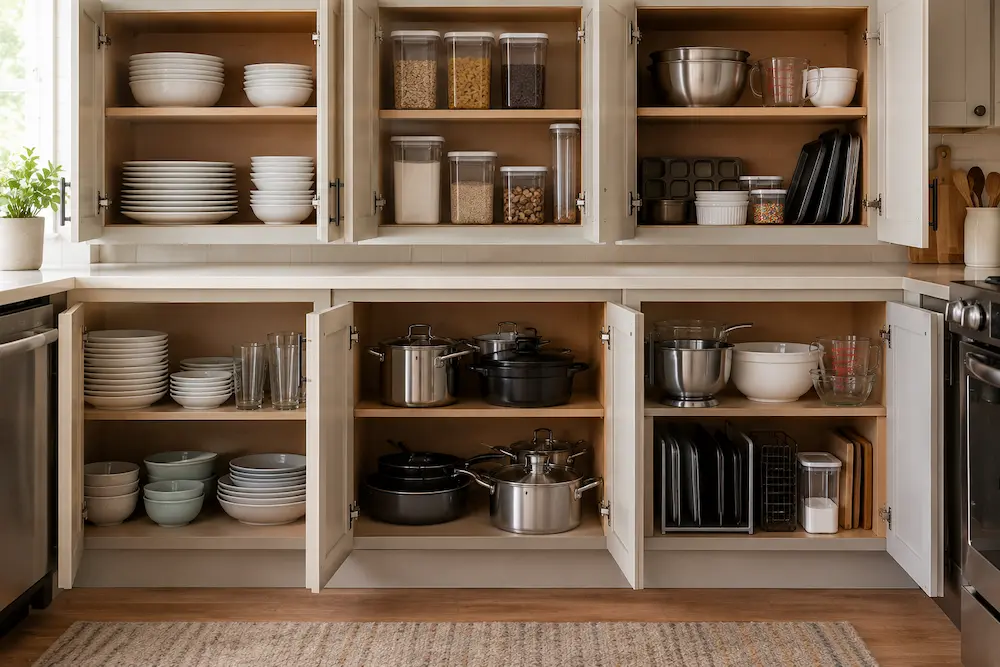
One of the most useful kitchen organization principles is to organize cabinets around how you work in the kitchen, rather than simply putting similar objects wherever they happen to fit.
Your exact zones will depend on your kitchen, but these are useful starting points.
Cooking Zone
Keep the tools and cookware you use while cooking reasonably close to the stove or main cooking area.
This might include:
- frequently used pans
- cooking utensils
- measuring spoons
- oils or spices, where appropriate
- everyday cookware
You do not need every cooking-related item in one cabinet. The goal is to reduce unnecessary movement while cooking.
Prep Zone
Think about what you reach for while preparing ingredients.
Depending on your kitchen, this could include:
- cutting boards
- mixing bowls
- measuring cups
- prep utensils
- frequently used food containers
If your main prep surface is next to a particular cabinet, that cabinet may be more useful for these items than a cabinet on the other side of the room.
Dish Zone
Everyday plates, bowls, and glasses should be easy to reach.
If your dishwasher is close to one cabinet, storing everyday dishes nearby can also make unloading easier.
The best location is the one that fits your actual routine—not necessarily the one that looks best in a storage diagram.
Baking Zone
If you bake regularly, keep the tools you use together where possible.
This could include:
- measuring cups
- mixing bowls
- baking pans
- rolling tools
- baking accessories
Occasional baking equipment does not necessarily need prime cabinet space.
Food Storage Zone
If you keep dry food in kitchen cabinets rather than a separate pantry, group those items together as much as your layout allows.
Use the easiest-to-see areas for things you reach for often.
For food storage, avoid creating deep layers that hide older items behind newer ones.
Cleaning Zone
Cleaning products and kitchen-cleaning tools should have their own clearly defined area.
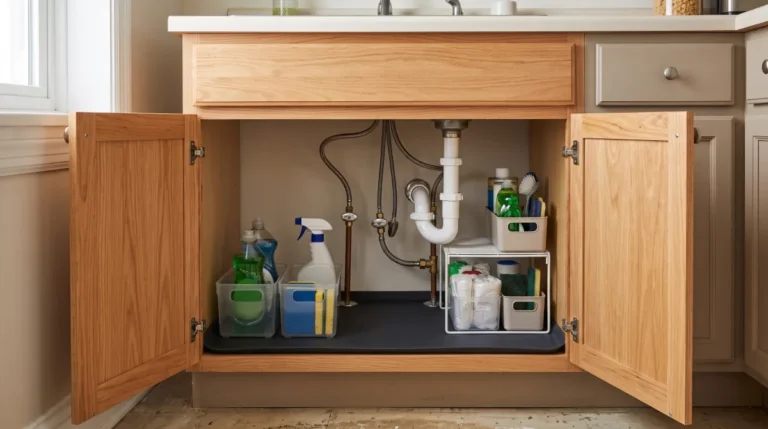
If cleaning products are stored under the sink, keep them separate from food and cooking supplies and make sure the cabinet remains appropriate for the products being stored there.
If you store cleaning supplies under the sink, see our guide to under kitchen sink organization ideas for practical ways to work around plumbing and make better use of the available cabinet space.
The important idea is simple:
Your cabinet zones should follow your routine.
How to Organize Upper Kitchen Cabinets
Upper cabinets are generally most useful for items that are relatively light and that you can comfortably reach.
Think about what you use every day before deciding what gets the easiest access.
Good candidates may include:
- everyday plates
- bowls
- cups
- glasses
- frequently used ingredients
- lighter kitchen tools
If something is used several times a day, it should not be hidden behind something you use twice a year.
You can also adjust the position of adjustable shelves when possible. A shelf that is too high or too low can leave awkward unused space.
Use Prime Space for Frequent Items
Your easiest-to-reach cabinet space is valuable.
Instead of automatically putting the prettiest dishes there, consider putting the things you actually reach for most often.
Less frequently used items can move to higher or less convenient storage.
This simple change can make an organized cabinet feel much more practical.
How to Organize Lower Kitchen Cabinets
Lower cabinets are often better suited to larger or heavier items.
Depending on your layout, they can work well for:
- pots and pans
- larger cookware
- small appliances
- food containers
- serving pieces
- other bulky kitchen equipment
Keep the items you use frequently where they are easiest to retrieve.
For heavier cookware, lower storage can also make more sense than placing it high above shoulder level.
If a lower cabinet is deep, however, simply filling it from front to back can create another problem: you may technically have plenty of storage but still be unable to reach what is behind the first row.
That is where deep-cabinet organization becomes important.
How to Organize Deep Kitchen Cabinets
Deep cabinets can hold a lot, but extra depth is not automatically useful storage.
If you have to remove several things just to reach something at the back, part of the cabinet is effectively difficult-to-use space.
1. Keep Frequently Used Items Toward the Front
If you reach for something every day, it should not live behind three layers of rarely used equipment.
Move everyday items toward the easiest-to-reach part of the cabinet.
2. Reduce Unnecessary Layers
Stacking can save space, but too much stacking creates an access problem.
If you have to remove five items to reach the sixth, the cabinet may technically be organized but it is not particularly functional.
3. Use Shelf Risers Where They Actually Help
A shelf riser can turn unused vertical space into another level of storage.
They can be particularly useful when shorter items leave a large amount of empty space above them.
But do not add a riser simply because there is one available. Check whether the new arrangement actually makes items easier to see and reach.
If you are organizing cabinets as part of a larger small-kitchen setup, our guide to Small Kitchen Organization Ideas covers the bigger picture.
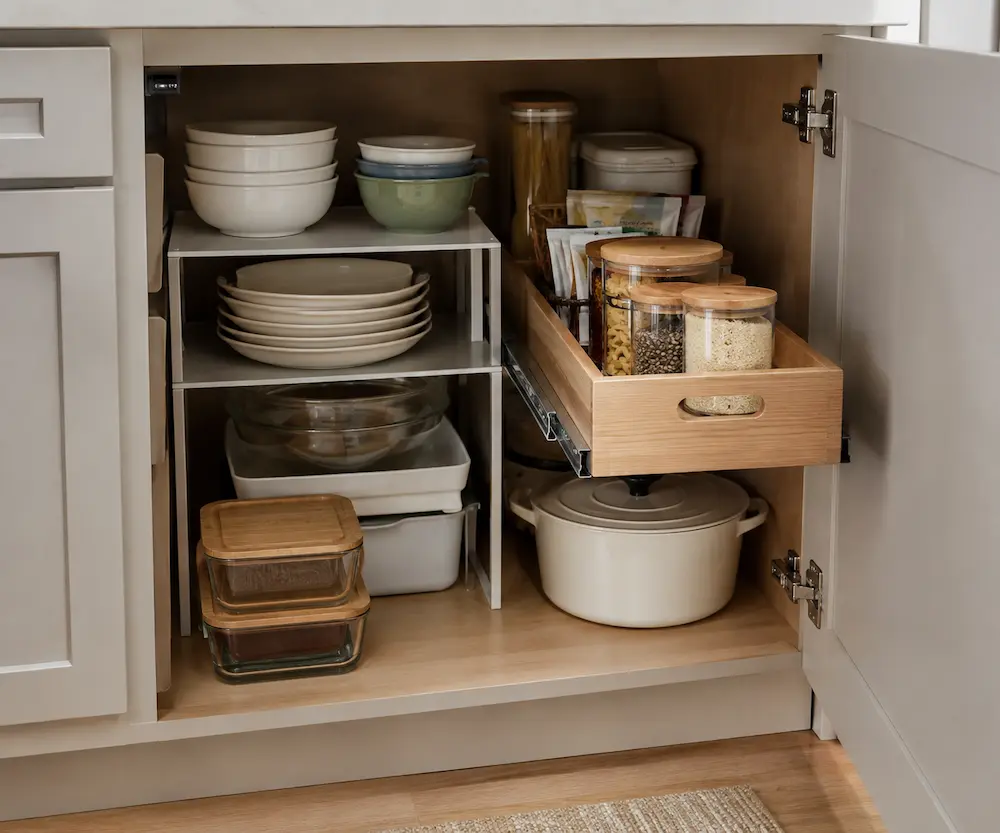
4. Consider Pull-Out Storage for Difficult Areas
A pull-out shelf or organizer can be useful when the main problem is reaching the back of a deep cabinet.
The advantage is straightforward: instead of reaching deep into the cabinet, the stored items can come forward.
The downside is that these systems require the correct dimensions and appropriate installation. Some are also more expensive than simple shelf organizers.
If you’re learning how to organize kitchen cabinets with deep shelves, the goal is to make every item easier to see and reach.
5. Reserve the Back for Less-Frequent Items
If you do not have a way to bring the back of the cabinet forward, use that space intentionally.
Rarely used serving pieces or seasonal items may make more sense there than everyday cookware.
The key is to avoid putting something you use every morning in the least accessible part of the cabinet.
Use Vertical Space Inside Cabinets
Cabinet shelves often have more vertical space than the items sitting on them actually need.
That unused space can sometimes be turned into useful storage.
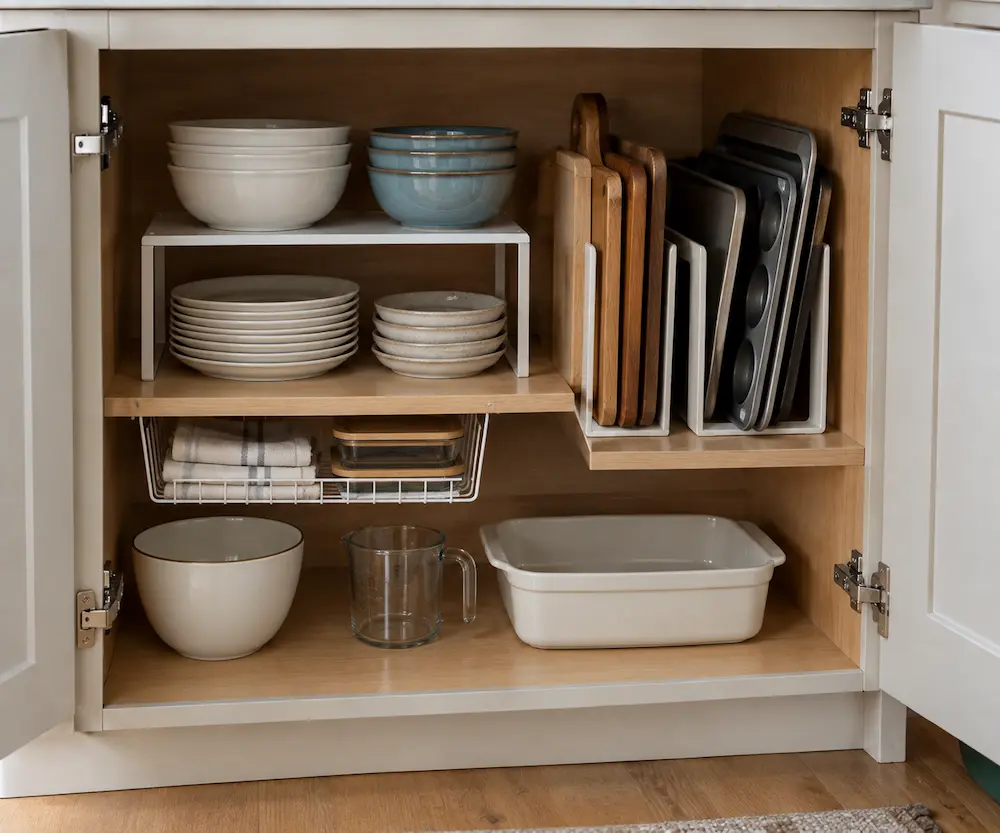
Shelf Risers
Shelf risers create a second level for smaller items.
They can work well for:
- plates
- bowls
- mugs
- cans
- small containers
The important thing is to make sure the added level does not make the items underneath difficult to reach.
Vertical Dividers
Vertical dividers can help organize:
- baking sheets
- cutting boards
- serving trays
- cooling racks
- other flat items
Instead of creating a horizontal pile that has to be lifted one piece at a time, the items can stand vertically where appropriate.
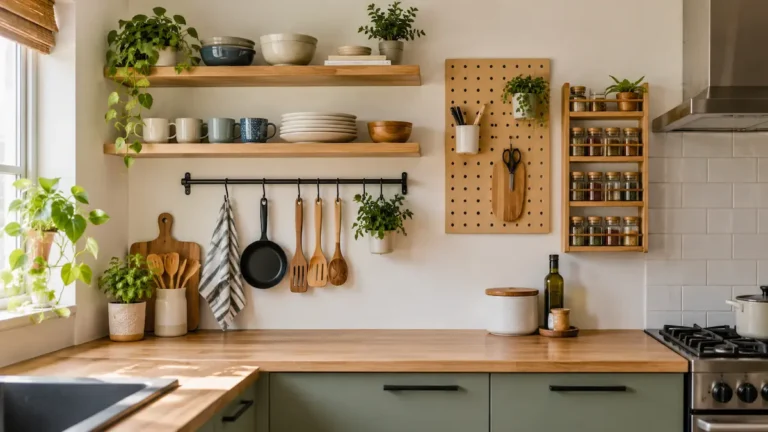
To free up even more storage space beyond the cabinet itself, see our guide to Kitchen Wall Storage Ideas
Under-Shelf Baskets
These can make use of the space underneath a shelf.
They are useful when the cabinet has enough clearance, but measure carefully before buying. A basket that hangs too low can interfere with the items stored below it.
Adjust the Cabinet Shelf
Sometimes the best storage solution is already inside the cabinet.
If your shelves are adjustable, look at the empty space above and below your current stacks.
Moving one shelf can sometimes create a more useful arrangement without buying anything.
Use Cabinet Doors Carefully
The inside of a cabinet door can provide additional storage, but it should not automatically become a place to attach another organizer.
Door-mounted storage can work for relatively light items such as:
- measuring tools
- small kitchen accessories
- wraps
- lightweight cleaning tools
Before adding anything, check:
- door clearance
- hinge position
- cabinet frame
- organizer depth
- weight
- whether the door still closes properly
A door-mounted organizer is only useful if it leaves the cabinet easier to use.
If you’re renting and want more storage without drilling, see our guide to No-Drill Kitchen Storage Ideas for Renters.
How to Organize Pots, Pans and Lids
Cookware is one of the easiest areas to make frustrating because pots, pans, and lids often have awkward shapes.
Start by separating what you use regularly from what you rarely use.
Pots
If your pots nest safely, stacking them can save space.
But if nesting makes the pot you need difficult to retrieve, consider a different arrangement.
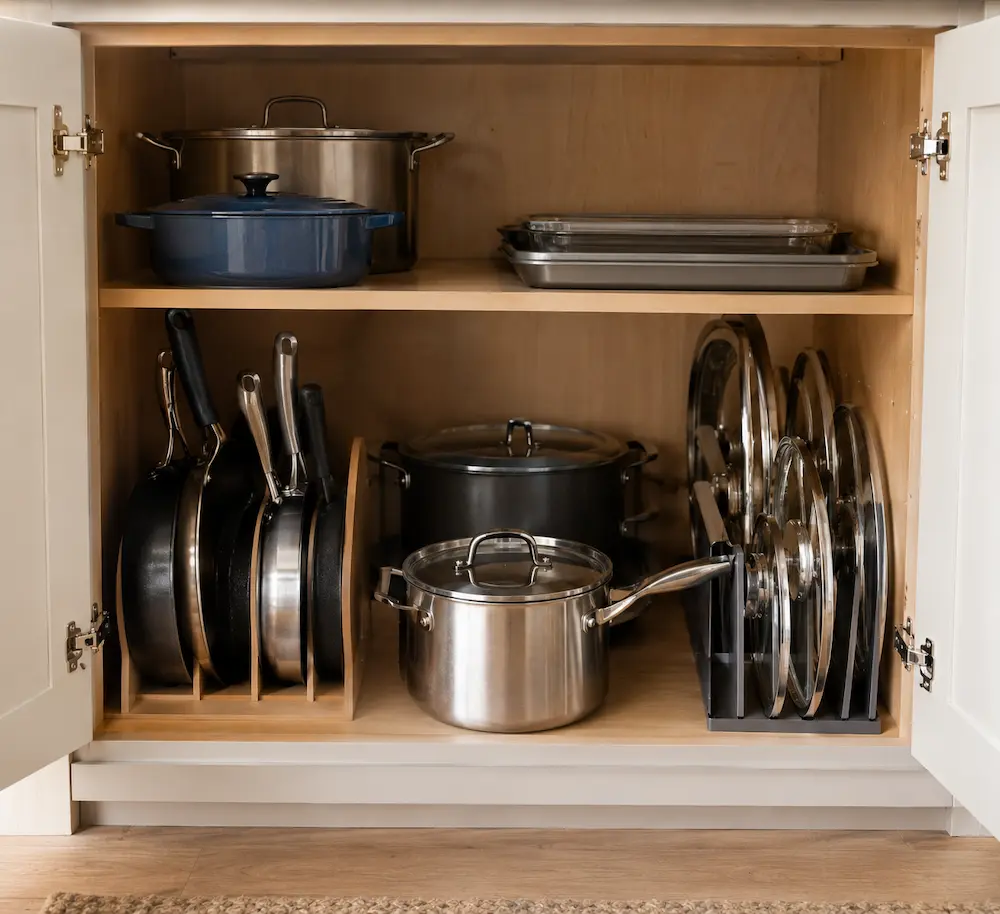
Pans
Vertical storage can be useful for pans that are awkward to stack.
A divider can help keep each pan in its own position, making it easier to remove one without disturbing the others.
Lids
Lids often become the loose pieces that make an otherwise organized cookware cabinet messy.
Keeping them together with a divider or dedicated lid storage can prevent them from sliding around.
Keep Everyday Cookware Near the Cooking Area
If you cook with the same pan several times a week, storing it close to where you cook makes more sense than giving that space to cookware you rarely use.
This is where zoning becomes more useful than simply organizing by object type.
How to Organize Plates, Bowls and Everyday Dishes
Start with frequency.
Your everyday dishes should be among the easiest items to reach.
You can group:
- everyday plates
- bowls
- occasional dishes
- serving plates
- special-occasion pieces
Shelf risers can help when a single stack leaves a lot of unused vertical space.
But avoid building stacks that are so tall that removing one plate becomes awkward.
An organized dish cabinet should let you take out one item without creating a small avalanche.
What to Do With Awkward Cabinet Space
Not every cabinet is going to be easy.
Some are narrow, some are unusually deep, and some have corners that are difficult to reach.
Corner Cabinets
Corner cabinets can become difficult because part of the storage area may sit beyond the easiest reach.
Possible solutions include:
- grouping less-used items there
- using a suitable turntable
- using a pull-out or rotating solution designed for the cabinet
- reducing the number of items stored in the difficult area
Do not assume every corner needs an expensive mechanism.
If the cabinet is rarely used, a simple organization strategy may be enough.
Narrow Cabinets
Narrow cabinets can be useful for items that fit their shape.
Think about:
- baking trays
- cutting boards
- slim bottles
- narrow kitchen tools
Vertical dividers can sometimes make these spaces easier to use.
Tall Cabinets
Tall storage can tempt you to stack everything upward.
Instead, keep frequently used items at comfortable heights and reserve harder-to-reach areas for things you rarely need.
Hard-to-Reach Areas
Ask one question:
How often do I actually need this?
If the answer is rarely, the difficult location may not be a problem.
If the answer is every day, the storage arrangement needs to change.
How to Choose Kitchen Cabinet Organizers
This is where many organization projects go wrong.
People see a clever storage product and then try to find a cabinet for it.
It is usually better to work in the opposite direction:
Find the problem → measure the space → choose the solution.
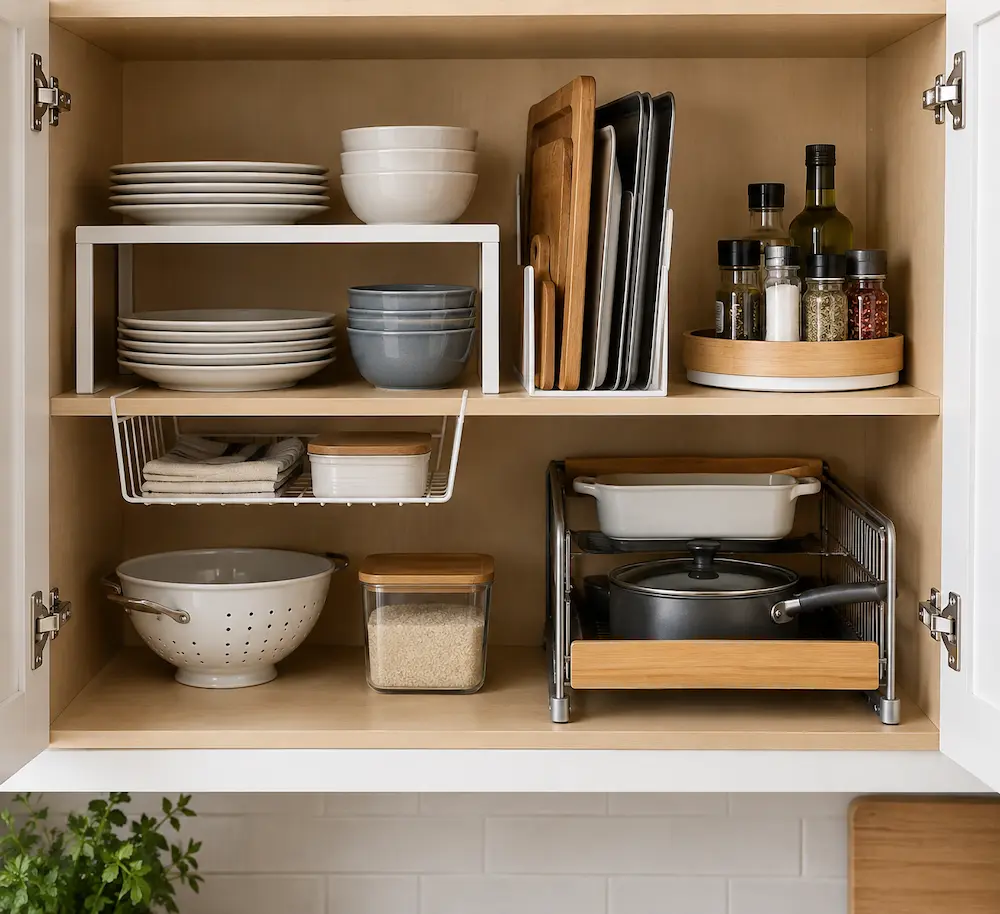
Here are some common examples:
| Cabinet problem | Possible solution |
|---|---|
| Short items waste vertical space | Shelf riser |
| Trays and boards fall into a pile | Vertical divider |
| Deep items are difficult to reach | Pull-out organizer |
| Small round containers are difficult to find | Turntable/lazy Susan |
| Empty space exists beneath a shelf | Under-shelf basket |
| Cabinet door space is unused | Door-mounted organizer |
These are starting points, not rules.
Before buying anything, check the product’s actual dimensions, installation requirements, weight capacity where relevant, and whether it will interfere with shelves or doors.
And remember: you may not need an organizer at all.
Sometimes moving a shelf, reducing duplicates, or changing where items live solves the problem more effectively.
Common Kitchen Cabinet Organization Mistakes
Buying Organizers Before Measuring
A storage product cannot fix a cabinet it does not fit.
Measure first.
Keeping Rarely Used Items in Prime Space
The easiest-to-reach space should generally go to the things you use most.
Over-Stacking Everything
Stacking saves space until access becomes frustrating.
If every item requires moving something else, reconsider the arrangement.
Ignoring Vertical Space
Look at the unused space above your current stacks before deciding you need another cabinet.
Putting Heavy Items Too High
Large or heavy cookware is usually better kept in lower, stable storage that you can access comfortably.
Using Cabinet Doors Without Checking Clearance
An organizer can interfere with hinges, shelves, or the cabinet frame.
Check the entire movement of the door before installing anything.
Organizing for Appearance Instead of Use
A cabinet can look beautiful in a photo and still be annoying to use.
The best organization system is the one that makes everyday actions easier.
Creating a System That Is Too Complicated
If putting something away takes several steps, people are less likely to do it consistently.
Simple systems are often easier to maintain.
How to Keep Kitchen Cabinets Organized
You do not need to reorganize the entire kitchen every week.
Instead, pay attention to the places that repeatedly become messy.
When something keeps ending up in the wrong cabinet, ask why.
Maybe:
- the item belongs closer to where it is used
- the current cabinet is too crowded
- the category is too broad
- the organizer is not working
- you simply have too many items
Fixing the reason is better than repeatedly fixing the symptom.
It can also help to give your cabinets a quick reset when needed. Put misplaced items back, remove things you no longer use, and adjust a zone when your cooking habits change.
A good organization system should adapt to your kitchen rather than force your kitchen to adapt to the system.
Frequently Asked Questions
How do I start organizing my kitchen cabinets?
Start with one cabinet or one problem area. Remove items you no longer need, group similar items, and decide what should be stored there based on how you use the kitchen. Measure the space before buying organizers.
What should go in upper kitchen cabinets?
Upper cabinets are often useful for lighter, frequently used items such as everyday dishes, cups, glasses, and smaller kitchen supplies. Keep the items you use most often in the easiest-to-reach areas.
What should go in lower kitchen cabinets?
Lower cabinets can be useful for heavier or larger items such as pots, pans, appliances, and bulky cookware. The exact arrangement should depend on your kitchen layout and where you use those items.
How do you organize deep kitchen cabinets?
Start by removing rarely used items from prime space. Keep frequently used items easy to reach, reduce excessive stacking, and consider shelf risers, pull-outs, or other solutions when they genuinely improve visibility and access.
How do you maximize space in kitchen cabinets?
First use the space you already have more efficiently. Adjust shelves, use suitable vertical storage, reduce unnecessary duplicates, and organize by zones. Add an organizer only when it solves a specific storage problem.
How do you organize kitchen cabinets without buying organizers?
You can make a significant difference without buying anything. Declutter, group similar items, change cabinet zones, adjust shelves, keep frequently used items accessible, and move rarely used items to less convenient storage.
Final Thoughts
Learning how to organize kitchen cabinets around your daily routine can make the storage system easier to maintain.
The best way to organize kitchen cabinets is not to make every shelf look perfect.
It is to make the kitchen easier to use.
Start by removing what you do not need. Then group what remains, create zones around the way you cook, and give your most frequently used items the easiest access.
After that, look at the specific problems left behind.
Maybe a deep cabinet needs better visibility. Maybe a shelf needs a riser. Maybe your pans need vertical storage. Or maybe you simply need fewer things competing for the same space.
That is the part worth remembering:
Declutter → Group → Zone → Prioritize access → Measure → Solve specific problems → Maintain.
When the system follows your actual routine, your cabinets are much more likely to stay organized after the first busy week—not just look organized on the day you finish.