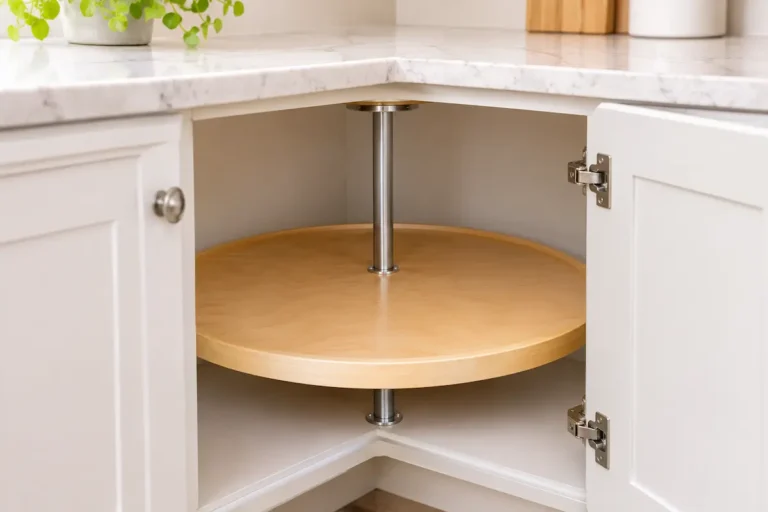
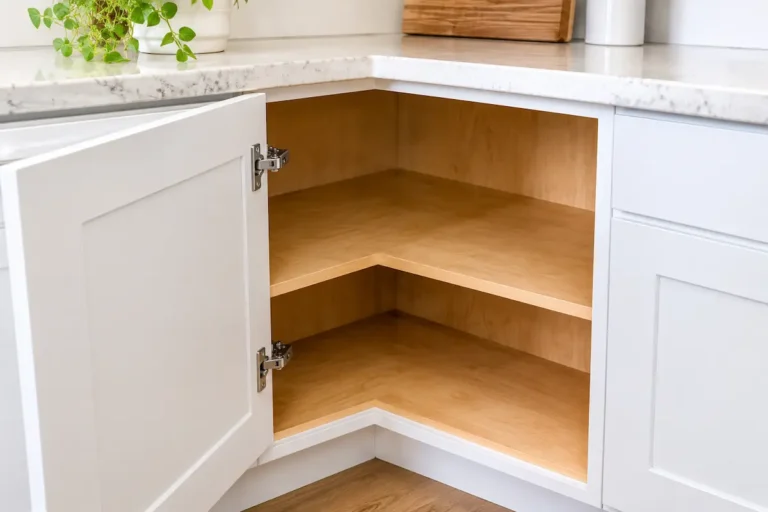
Lazy Susan Sizes: Which Diameter Fits Your Corner Cabinet?
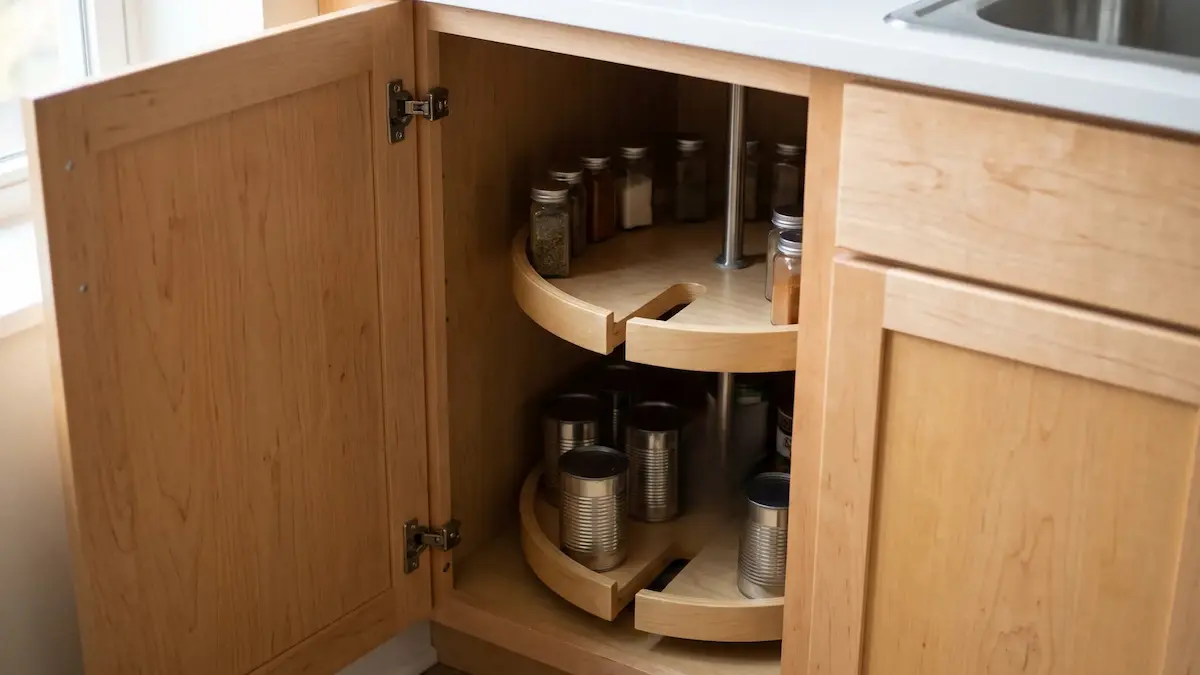
Short answer: Corner base cabinets are usually 36 inches along each wall, and sometimes 33. In the listings we checked, a 33-inch corner takes a lazy susan about 28 inches across, and a 36-inch corner takes about 28 to 30 inches, depending on the shape. To find your size, open the doors, measure from each back wall to the edge of the door opening, take the smaller number, and subtract about 2 inches. Then match the shape to your door: a door that swings open on its own hinges needs a kidney shape; doors that ride on the shelves need a pie-cut.
A lazy susan that is one size too big will rub or jam, and one that cannot pass through the cabinet opening will not go in at all. Retailer reviews describe that second problem, and both are avoidable with a tape measure and a few minutes. This guide shows you which shape your cabinet takes, how to measure for the right diameter, and what size freestanding turntable fits an upper cabinet, a base cabinet, or a fridge shelf when you can’t install anything.
Lazy susan sizes at a glance
The table below sums up what manufacturer and retailer listings show. Use it to narrow your options, then confirm with your own measurements in the next sections.
| Where it goes | Shape | Typical diameters in listings | What to check |
|---|---|---|---|
| 33-inch corner base cabinet | Kidney | About 28 in | Hinged door, pole height |
| 36-inch corner base cabinet | Kidney or pie-cut | About 28 to 30 in | Door type, opening width |
| Corner wall (upper) cabinet | Full circle | About 18 in | Opening width, pole height |
| Blind corner base cabinet | Half-moon (pull-out) | 31 to 39 in | Minimum opening width |
| Shelf, pantry, or fridge | Freestanding turntable | About 10 to 16 in | Clear depth and width |
Listings change, and cabinet makers build to their own specs. Treat these as starting points, not promises.
First, identify your corner cabinet
Diameter only matters once you know the shape. The shape depends on how your cabinet door works and where the opening sits. Once the lazy susan is in, our guide on how to organize a lazy susan cabinet shows what goes on each tray shape.
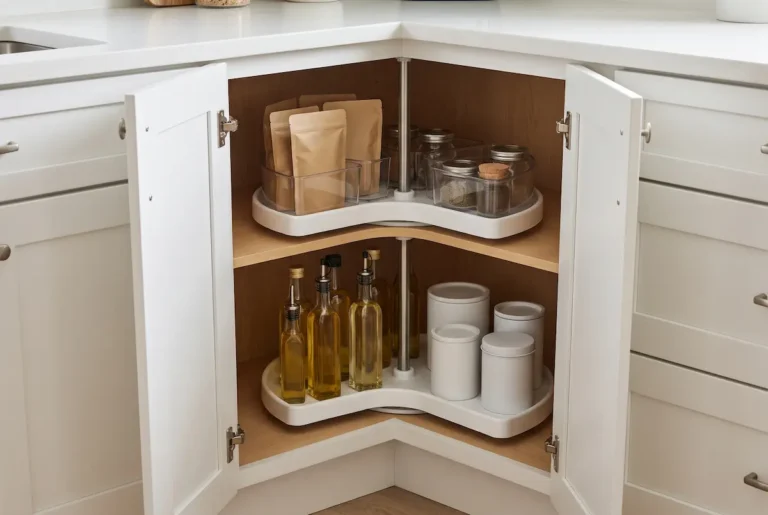
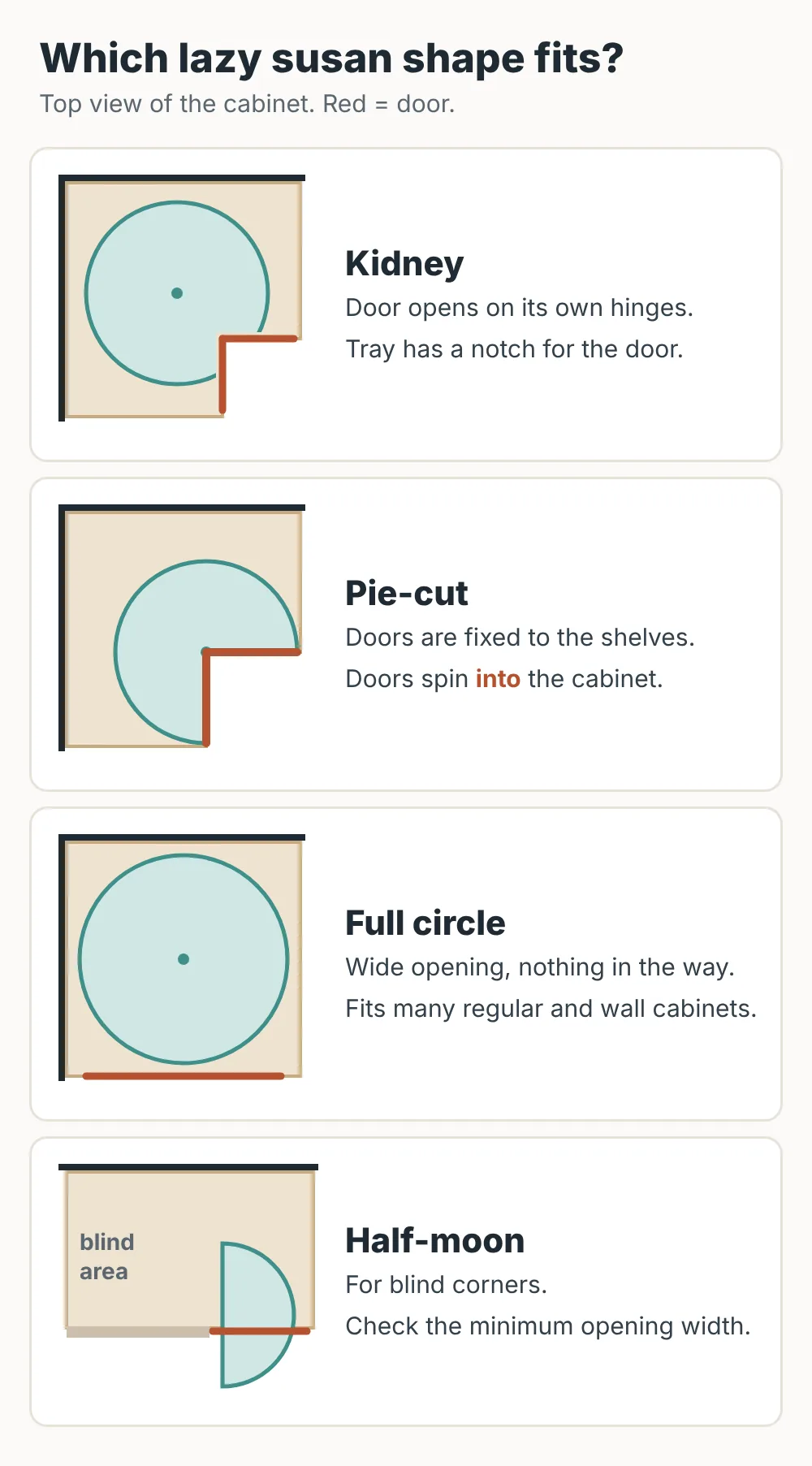
Corner base with a hinged door: kidney
A kidney lazy susan has a notch cut out of one side, so the shelves can turn past a door that stays closed in front of them. It fits corner cabinets where the door opens on its own hinges and leaves the shelves sitting alone inside. That includes many two-part folding doors. A Woodworker Express sizing guide describes it this way: when the door swings open, the kidney stays behind in the cabinet by itself.
If you open the door and it moves on its own, you most likely need a kidney shape. One Rev-A-Shelf pie-cut listing says the same thing: if your door is hinged, you may need kidney-shaped shelves instead of pie-cut ones.
Doors attached to the shelves: pie-cut
A pie-cut lazy susan has a sharper 90-degree notch, and the cabinet doors are fixed to the shelves. When you spin the shelves, the doors turn into the cabinet with them. The same Rev-A-Shelf listing notes that most pie-cut units go into new cabinets, because the door has to be made for that model and cabinet. If you are replacing a worn pie-cut unit, match the old diameter and the door hardware closely, and see how to replace a lazy susan shelf for matching the part.
Square opening with full access: full circle
A full-circle lazy susan is a plain round shelf. It works where nothing blocks the turning circle, such as a corner wall cabinet with a wide opening or any regular cabinet deep and wide enough for the tray. For example, one Rev-A-Shelf full-circle set for corner wall cabinets has three shelves on an adjustable pole.
45-degree diagonal corner: D-shape
A D-shape lazy susan has one flat side. The Woodworker Express guide lists it mainly for corner base and wall cabinets set at a 45-degree diagonal.
Blind corner: why most lazy susans won’t work
A blind corner cabinet runs behind the cabinet next to it, with a narrow door at one end. A round shelf can’t pass through that opening, so blind corners use half-moon units that pivot or slide out instead. These list a minimum opening width that matters more than the diameter. Rev-A-Shelf half-moon listings, for example, call for a minimum opening of 13¼ inches for a 31-inch unit, 16⅛ inches for a 33-inch unit, and 19¼ inches for a 39-inch unit. If your opening is narrower than the listing, that unit will not fit, no matter how deep the cabinet is. To match a pull-out or swing-out to your opening, see our blind corner cabinet organizer guide.
Blind corners also take swing-out and pull-out units; our guide to corner cabinet lazy susan alternatives compares their fit numbers.How to measure for a lazy susan in 5 steps
You need a tape measure, a pencil, and a flashlight. Empty the cabinet first so nothing hides the walls or the floor.
1. Measure the inside, with the doors open
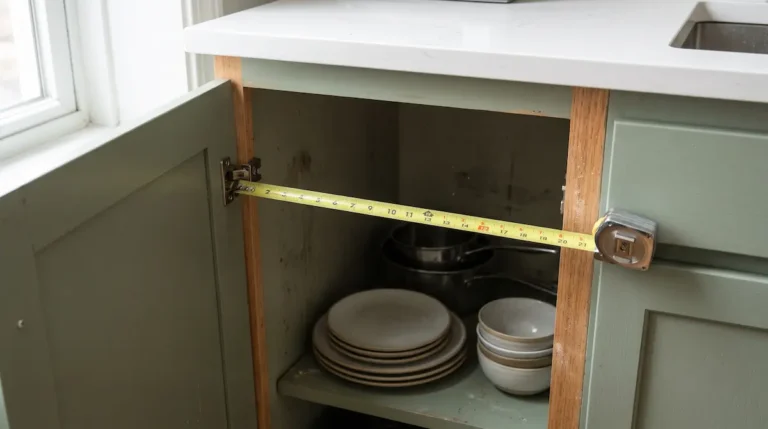
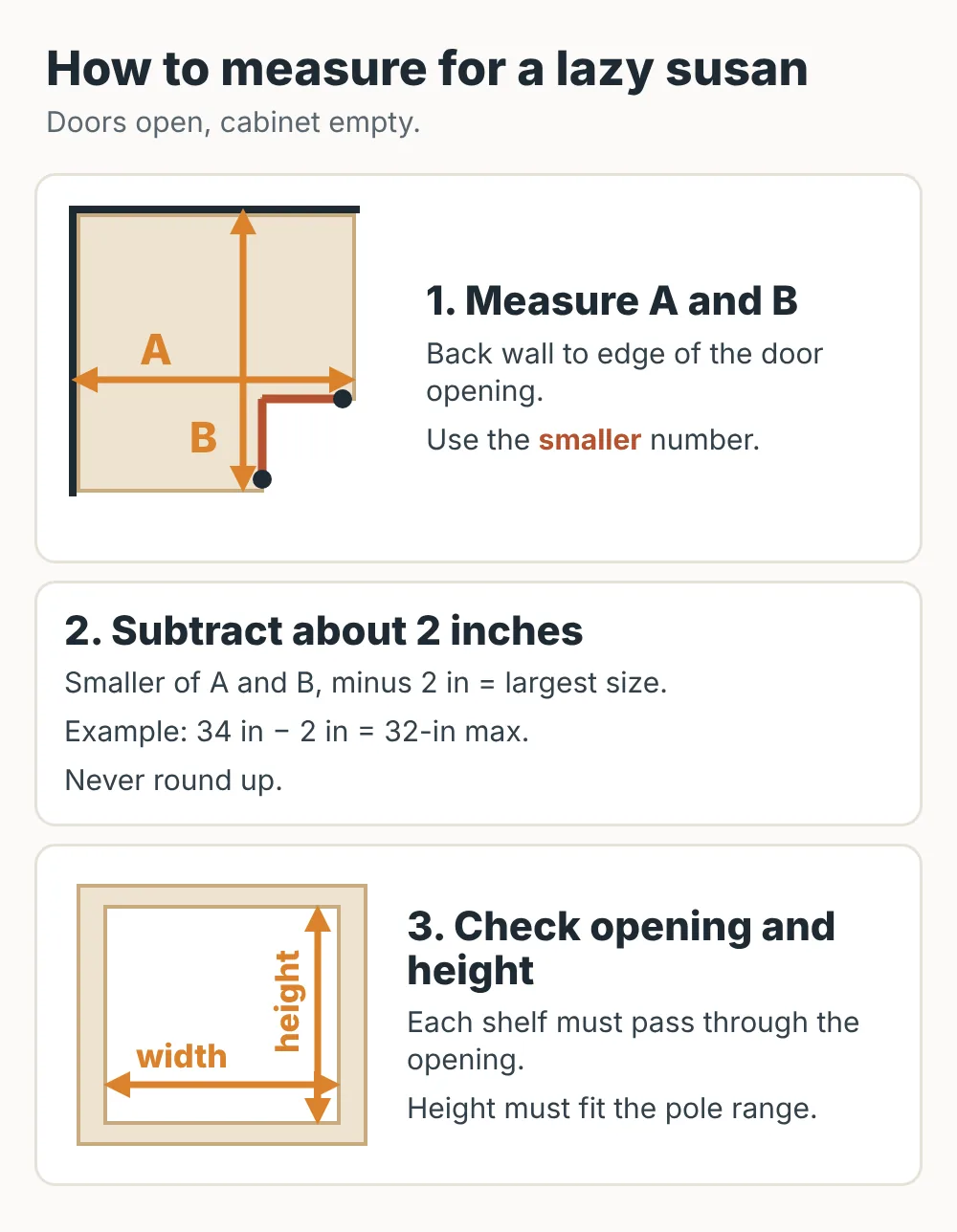
For a kidney or pie-cut unit, open the doors and measure from the right-side back wall to the inside edge of the door opening. Write it down as A. Repeat from the left-side back wall and write it down as B. Measure inside the cabinet box, not the outside of the cabinet or the countertop.
For a full-circle unit, measure the inside from left to right and from front to back.
2. Take the smaller number and subtract
Use the smaller of your two measurements. For kidney and pie-cut shapes, the Woodworker Express guide says to subtract about 2 inches. Its example: about 34 inches each way gives a maximum of a 32-inch lazy susan. For a full circle, the same guide says to subtract 1 or 2 inches from the smaller of width and depth.
The result is your largest possible diameter. Choose the closest size at or below it. Never round up.
3. Check the opening width
The tray has to get into the cabinet before it can spin. Rev-A-Shelf listings note that their two- and three-shelf corner sets are put together inside the cabinet, so each shelf has to pass through the door opening. Look for “minimum opening width” in the listing and compare it with your narrowest point, measured between hinges, face frame edges, or anything else that sticks into the opening.
On framed cabinets, the face frame (the wood border around the opening) is often about 1½ inches wide and narrows the opening compared with the box behind it. Our guide on measuring cabinet openings and usable depth covers framed and frameless cabinets step by step.
4. Measure the interior height
Measure from the cabinet floor to the underside of the top, inside the cabinet. Then compare it with the pole or height range in the listing. Kidney sets for base cabinets commonly list ranges such as 26 to 32 inches. One 18-inch full-circle set for corner wall cabinets lists an adjustable pole of 31 to 38 inches. If your height falls outside the range, look for a different model or a single shelf that mounts on a bearing instead of a pole.
5. Note what’s in the way
Look for plumbing, hinge plates, a fixed middle shelf, drawer slides from the next cabinet, and screws or cleats on the cabinet floor. Any of these can shrink the space below your measurement. One customer review on a CabinetParts listing describes trays that could not fit through the front opening because a fixed shelf could not be removed. Measure around obstacles, not past them.
33-inch vs 36-inch corner cabinets: which diameter?
Corner base cabinets are named by how far they run along each wall from the corner. Bob Vila’s guide to standard kitchen cabinet sizes lists base cabinets at 24 inches deep and 34½ inches tall, and corner and lazy susan cabinets usually at 36 by 36 inches. Smaller 33-inch corner cabinets are also sold.
Here is what current listings pair with each size:
| Cabinet | Example listing | Shape | Diameter |
|---|---|---|---|
| 33-inch corner base | Hardware Resources banded wood | Kidney | 28 in |
| 36-inch corner base, bi-fold doors | Vauth-Sagel COR Pro | Kidney | 30 in |
| 36-inch corner base, 2 doors | Hafele wire | Pie-cut | 28⅛ in |
A few things stand out. A 36-inch cabinet does not always take a bigger tray than a 33-inch one; the shape and the mounting system matter as much as the box. Two cabinets with the same outside size can also have different inside space, depending on the maker and how old they are. That is why step 2 above uses your own numbers, not the cabinet’s name.
Freestanding turntable sizes by spot (renter-friendly)
Built-in lazy susans screw into the cabinet floor, sides, or a shelf. If you rent, that counts as changing the cabinet, so check your lease or ask your landlord first. A freestanding turntable needs no tools at all. You set it on the shelf and lift it out when you move. For more ideas that leave the cabinets untouched, see our no-drill kitchen storage ideas for renters.
Freestanding turntables are sold by overall diameter. Common listings include 10-inch, 11-inch, and 16-inch sizes. Keep in mind that the rim takes up room: one 11-inch OXO turntable lists a usable inner surface of 9¼ inches.
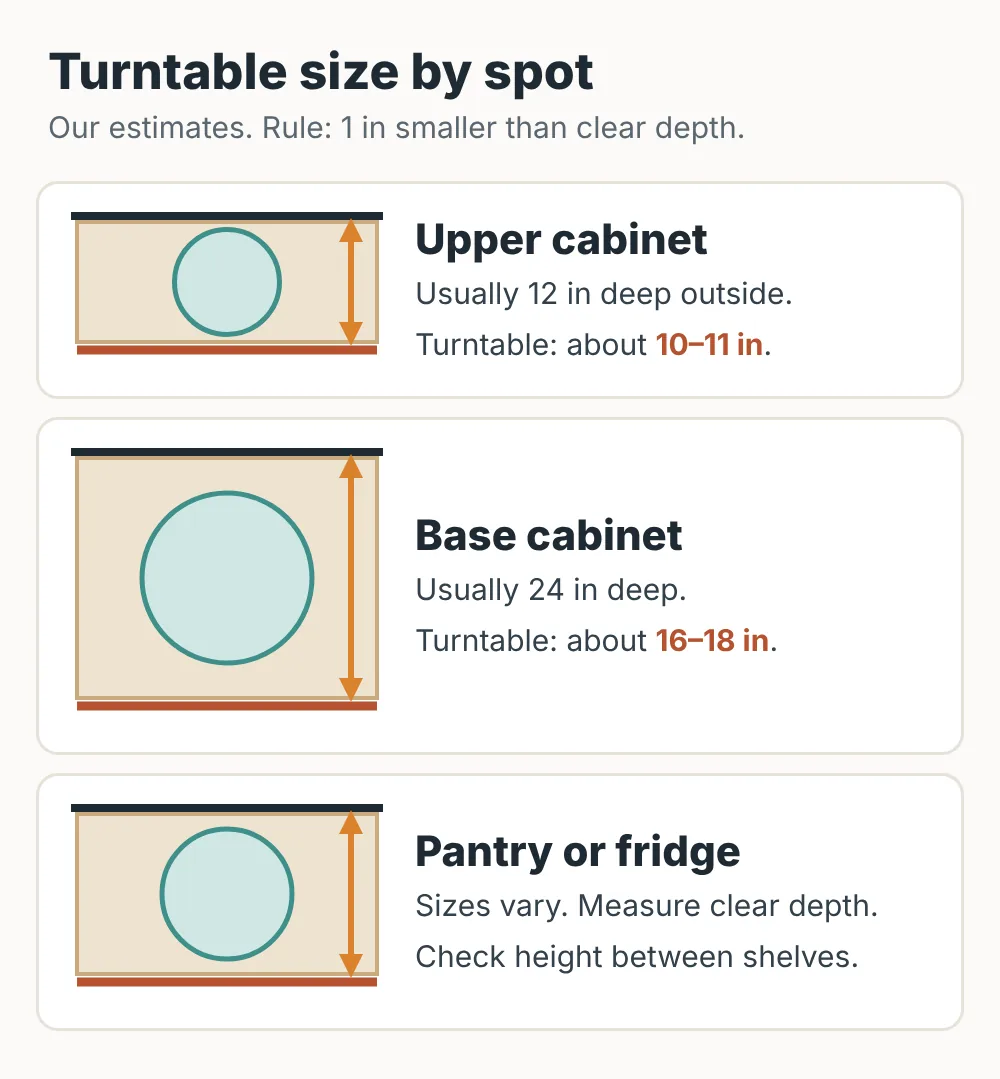
Our rule of thumb: pick a turntable at least 1 inch smaller than the clear depth and the clear width of the shelf, so it can spin without rubbing the door or the side walls. This is our own guideline, not a manufacturer standard.
Upper cabinets
Upper cabinets are most commonly 12 inches deep, according to Bob Vila’s sizing guide. The space you can use is less, because the door, hinges, and back panel take some of it. By our estimate, a 10- or 11-inch turntable is the upper limit in many 12-inch uppers, but measure your own clear depth before you buy.
Base cabinets
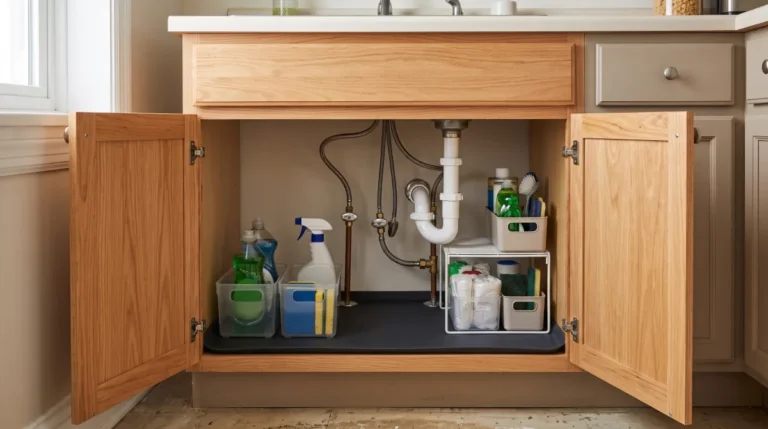
Standard base cabinets are 24 inches deep, which leaves room for larger turntables. By our estimate, 16 to 18 inches fits many of them once you allow for the door and back panel. Two smaller turntables side by side can work better than one large one in a wide cabinet. If the base cabinet is the sink cabinet, plan around the pipes; our guide to organizing under the kitchen sink shows how to map that space.
Pantry and fridge shelves
Measure the shelf depth from the back wall to the front edge, then check the height between shelves so bottles do not hit the shelf above. For bins, can rows and risers on deep shelves, see our guide on how to organize a pantry with deep shelves. Fridge shelves vary a lot by model, so there is no standard size to rely on. For cabinet-wide planning, our guide on how to organize kitchen cabinets explains how to decide what goes where before you add organizers.
Common sizing mistakes
- Measuring the outside of the cabinet. The cabinet’s name (33-inch, 36-inch) describes the outside. The tray lives inside, where the walls, frame, and back panel take up space.
- Rounding up. If your math says 29 inches, a 30-inch tray will rub or jam. Go down to the next size.
- Ignoring the opening width. A tray that fits the inside can still fail to pass through the door opening. Retailer reviews describe trays that would not go through the opening.
- Buying pie-cut for a hinged door. If your door opens on its own hinges, a pie-cut unit has nothing to attach to. Choose kidney instead.
- Forgetting the height. A pole that is too long or too short will not lock in. Check the listed range against your interior height.
- Skipping obstacles. Pipes, hinge plates, and fixed shelves can cut the usable space by an inch or more.
FAQ
What is the standard size of a lazy susan cabinet?
Corner base cabinets for lazy susans are usually 36 by 36 inches along the walls, with 33 by 33 inches as a smaller option. Like other base cabinets, they are typically 24 inches deep and 34½ inches tall before the countertop.
What size lazy susan fits a 36-inch corner cabinet?
The listings we checked for 36-inch corner bases range from about 28 to 30 inches, depending on shape and mounting. Measure from each back wall to the opening, take the smaller number, and subtract about 2 inches to find your limit.
What size lazy susan fits a 33-inch corner cabinet?
The listing we checked for a 33-inch corner base is a kidney tray 28 inches across. Confirm with your own measurements, since inside space varies between cabinet brands.
How do I measure for a lazy susan?
Open the doors, measure from each back wall to the inside edge of the opening, and use the smaller number minus about 2 inches. Then check the opening width, the interior height, and any obstacles such as pipes or hinges.
Can I put a lazy susan in a blind corner cabinet?
A round lazy susan usually won’t fit through a blind corner’s narrow door. Half-moon pull-out units are made for blind corners, and each one lists a minimum opening width you need to meet. Our blind corner cabinet organizer guide shows how to measure it.
What size turntable fits an upper cabinet?
Most upper cabinets are about 12 inches deep, so a 10- or 11-inch turntable is often the largest that spins freely. Measure your clear depth and choose a turntable at least 1 inch smaller.
How we put this guide together
We built this guide from published sources, not from hands-on testing. Sizing methods come from the Woodworker Express guide to choosing and measuring for a lazy susan. Standard cabinet dimensions come from Bob Vila’s standard kitchen cabinet sizes guide. Diameters, cabinet sizes, pole ranges, and minimum openings come from manufacturer specs shown on retailer listings, including CabinetParts, Build.com, Ferguson Home, Walmart, and WebstaurantStore, checked on October 30, 2026. The 1-inch turntable clearance is our own rule of thumb. Listings change, so always check the spec sheet for the exact model you plan to buy. We do not sell lazy susans, and this page contains no affiliate links.