No-Drill Kitchen Storage Ideas for Renters: 20 Renter-Friendly Solutions
Renting a home can make kitchen storage tricky.
You may have a tiny cabinet, almost no pantry space, a narrow gap beside the refrigerator, or a countertop that disappears under everyday appliances. And when you cannot drill into the walls or cabinets, some of the usual storage ideas are simply not practical.
The good news is that you can make a rental kitchen much easier to use without installing permanent storage.
The key is to work with what is already there. Cabinet doors, vertical space, narrow gaps, the back of doors, and unused areas inside cabinets can all become useful storage zones with removable or freestanding solutions.
These no-drill kitchen storage ideas for renters focus on practical ways to add storage without turning your rental kitchen into a renovation project.
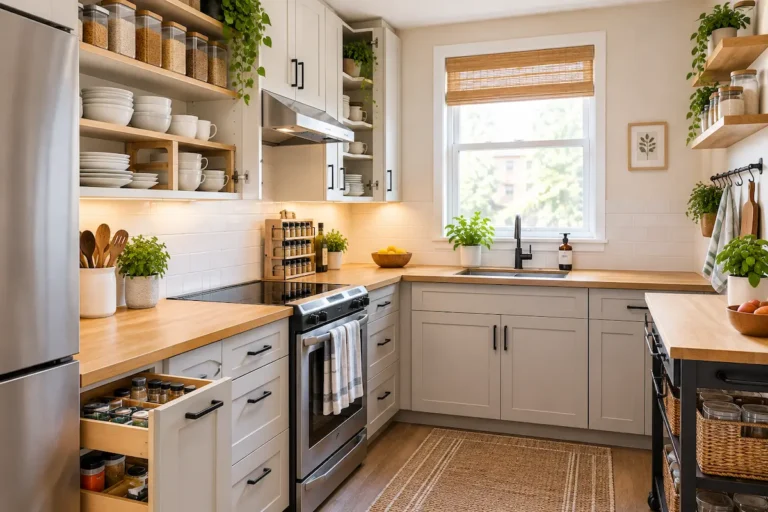
Before you start: Check your lease and the manufacturer’s instructions before using adhesive products. No-drill does not automatically mean damage-free on every surface.
If you want broader storage ideas beyond rental-friendly solutions, see our guide to 35 Smart Storage Ideas for the Kitchen That Actually Save Space.
1. Use Stackable Shelf Risers Inside Cabinets
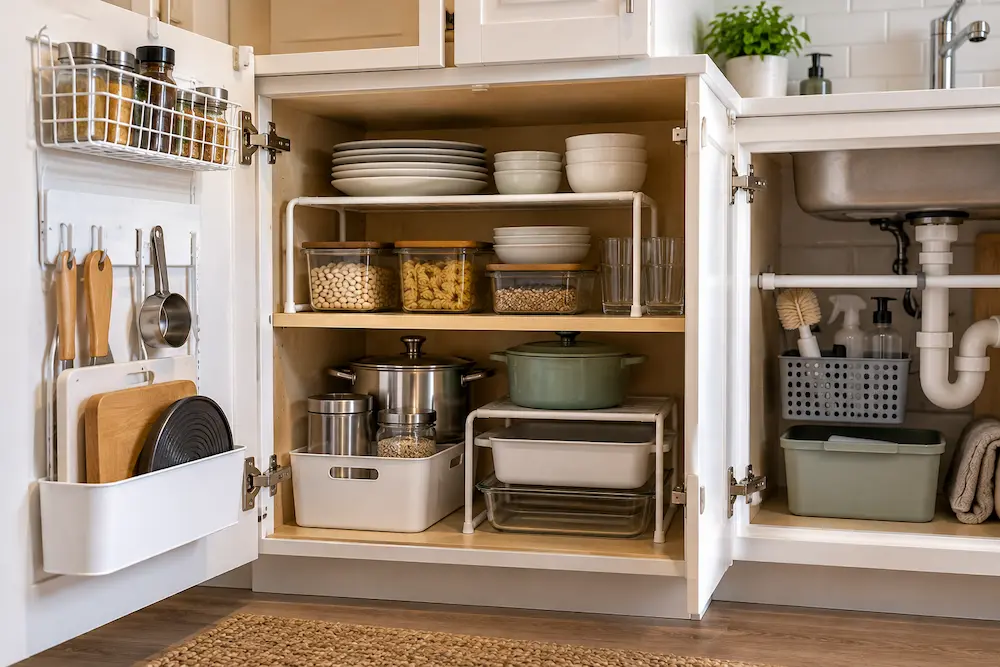
Tall cabinet shelves often have more vertical space than you actually need for the items sitting on them.
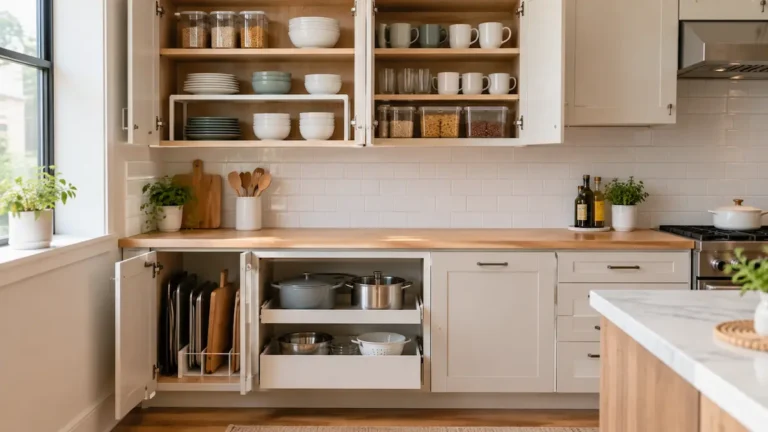
A stackable shelf riser can divide that empty height into two usable levels. You might use one for plates and bowls, canned goods, mugs, or small pantry containers.
Measure the cabinet first. Make sure the riser fits comfortably and leaves enough room to remove the items underneath.
Why it works for renters: It simply sits inside the cabinet, so there is no drilling, adhesive, or permanent installation.
For a more complete approach to planning cabinet zones and organizing everyday kitchen items, see our guide on how to organize kitchen cabinets.
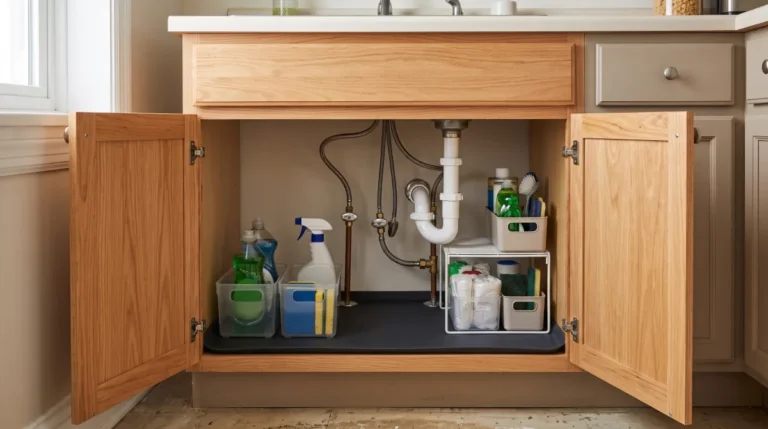
2. Add a Tension Rod Under the Sink
The cabinet under the sink is often difficult to organize because plumbing takes up valuable space.
A tension rod can create a hanging area for lightweight cleaning bottles with suitable spray handles. This leaves the bottom of the cabinet available for sponges, trash bags, cleaning cloths, or other supplies.
Do not overload the rod, and make sure it fits securely between the cabinet sides.
Renter tip: Because the rod uses pressure rather than screws, you can remove it when you move.
3. Put Removable Hooks Inside Cabinet Doors
The inside of a cabinet door is easy to ignore, but it can hold several small items.
Removable adhesive hooks can be useful for measuring spoons, lightweight brushes, dish towels, or other small kitchen tools.
Use products that are specifically designed for removable hanging and follow the manufacturer’s surface and weight instructions.
Important: Test the door before committing to the setup. The hooks and anything hanging from them should not interfere with the shelves or stop the door from closing.
4. Try an Over-the-Cabinet Door Basket
If you do not want to use adhesive at all, an over-the-cabinet door organizer is another option.
These baskets hang over the top edge of a cabinet door and can provide a convenient place for wraps, small cleaning supplies, sponges, kitchen towels, or other lightweight items.
Before buying one, check the thickness of your cabinet door and the clearance around the hinges.
Why renters like it: You can lift the organizer off when you move without leaving holes in the cabinet.
5. Use an Over-the-Door Organizer on a Pantry or Kitchen Door
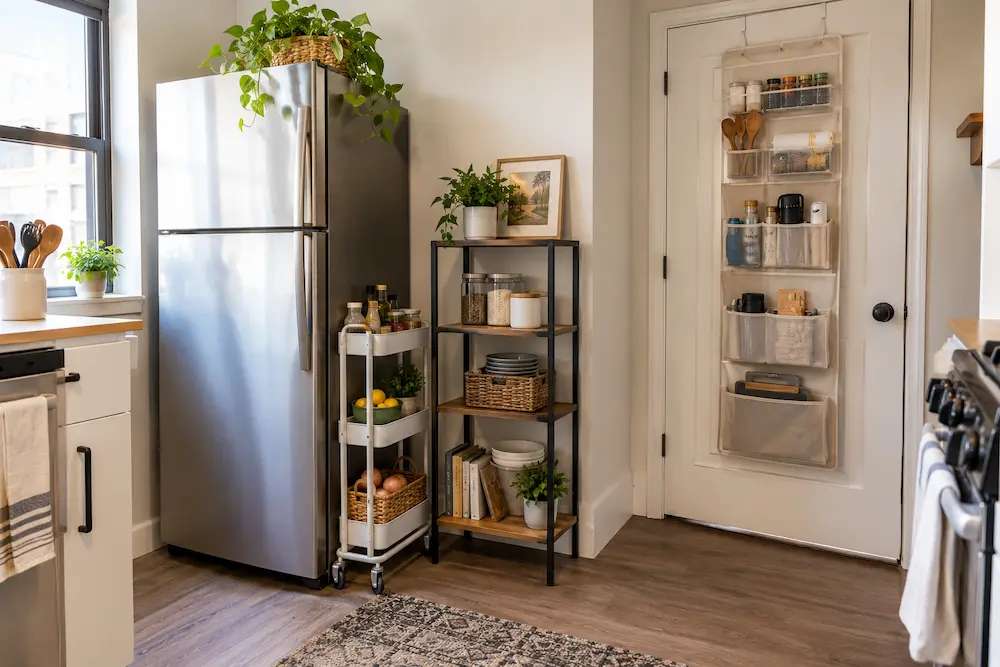
A full-size over-the-door organizer can turn the back of a suitable door into a storage zone.
Depending on its design and load rating, it can hold small pantry items, wraps, cleaning supplies, or other lightweight kitchen essentials.
This can be particularly useful in an apartment kitchen without a traditional pantry.
Watch for: Make sure the door still closes properly and that the organizer does not interfere with the frame or nearby cabinets.
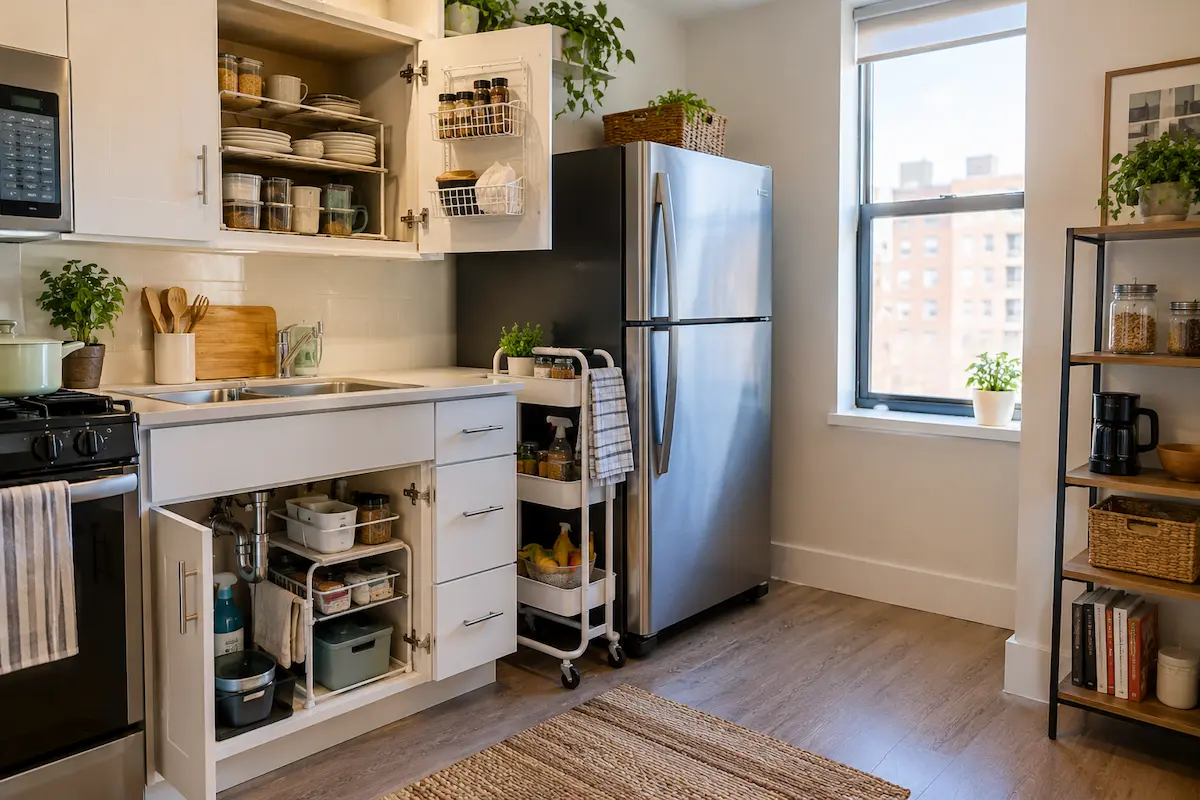
6. Add a Slim Rolling Cart to an Unused Gap
Look beside the refrigerator, between cabinets, or in another narrow area of the kitchen.
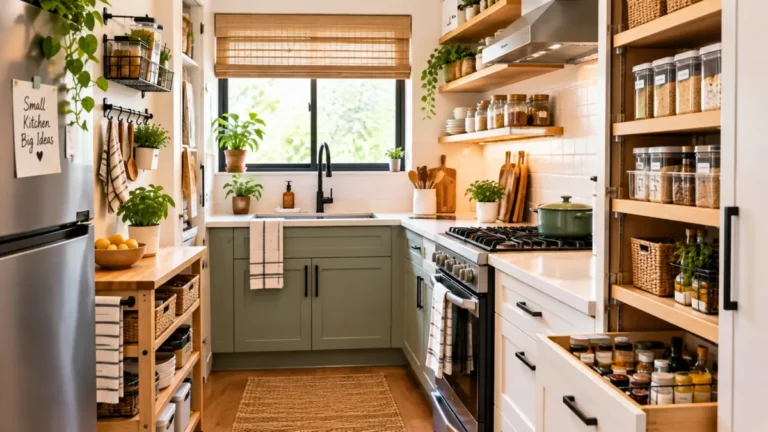
If there is enough clearance, a slim rolling cart can turn that awkward gap into useful storage for pantry items, bottles, coffee supplies, or cleaning products.
Measure the narrowest point of the gap before shopping. Also check that the cart will not block doors, drawers, vents, or the normal walking path.
Renter advantage: It is furniture rather than a permanent fixture, so you can take it with you.
7. Use a Freestanding Shelf Instead of Wall-Mounted Shelving
A small freestanding shelf can provide extra storage without attaching anything to the wall.
Use it for pantry overflow, small appliances, dishes, coffee supplies, or other items that need a home.
The important part is choosing a size that does not make the kitchen harder to move around in.
For a very small kitchen: Look for a narrow unit that uses vertical space rather than taking up a large section of the floor.
8. Try Clip-On Shelf Baskets
Some cabinet shelves have unused space underneath them.
A clip-on or under-shelf basket can create a small second storage area for lightweight items such as wraps, napkins, tea towels, or small packets.
Because the basket attaches to an existing shelf rather than the wall, it can be a useful renter-friendly option.
Check the shelf thickness and basket clearance before buying.
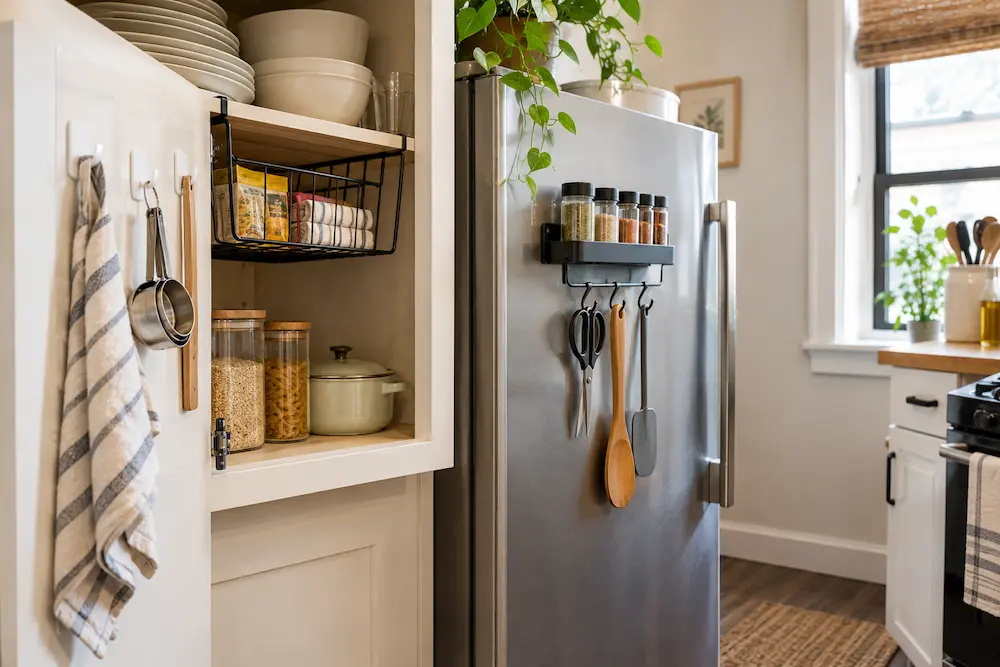
9. Use a Magnetic Rack on a Suitable Metal Surface
The refrigerator can sometimes provide useful storage space without drilling.
A magnetic rack or magnetic container can hold suitable lightweight kitchen items on a compatible metal surface.
This can work well for small spice containers, kitchen notes, or lightweight accessories.
Do not assume every refrigerator door will hold every magnetic organizer. Check the product’s weight rating and whether the surface is suitable.
Renter tip: Magnetic storage is particularly useful because it does not require holes, screws, or adhesive.
10. Hang Lightweight Kitchen Tools With Removable Hooks
If a small section of wall is sitting unused, removable hooks may help you get everyday tools off the counter.
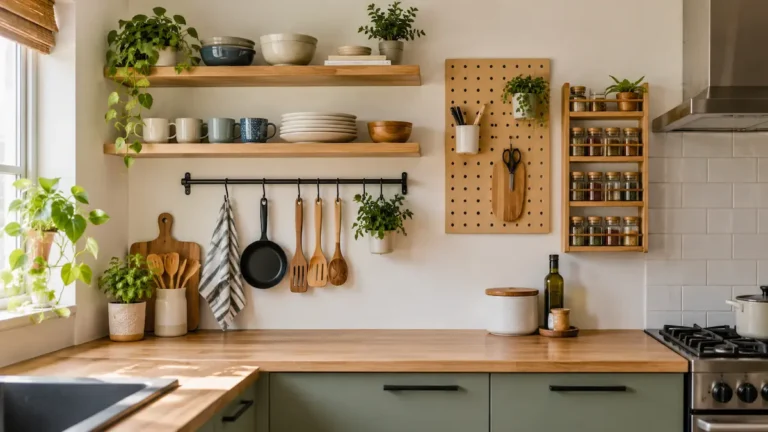
You could use them for lightweight measuring tools, oven mitts, towels, or other accessories that you reach for regularly.
Keep heavier cookware in a more suitable storage solution rather than treating an adhesive hook like a permanent wall-mounted rack.
The rule: Match the item to the hook’s rated capacity and surface requirements.
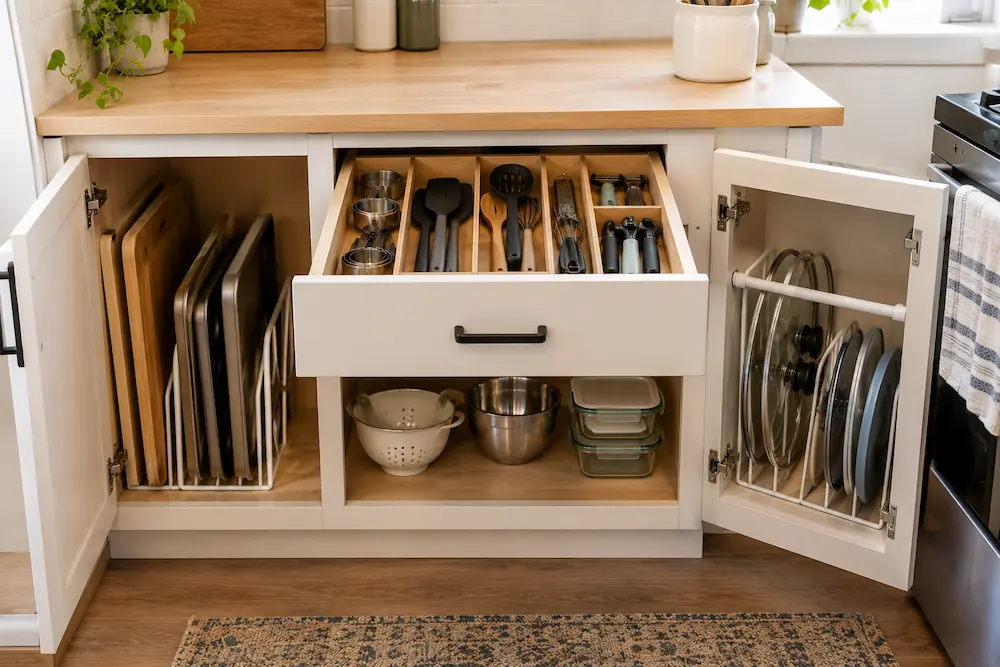
11. Create Vertical Storage for Cutting Boards and Baking Sheets
Flat stacks of cutting boards and baking sheets can consume more cabinet space than necessary.
A freestanding vertical divider can allow these items to stand upright instead.
This makes individual pieces easier to remove and avoids digging through a large horizontal stack.
Why it works in a rental: The divider sits inside the cabinet and does not require screws or modifications.
12. Add a Drawer Organizer Instead of More Furniture
When drawer space is messy, the problem may not be a lack of storage.
It may simply be that everything is mixed together.
A drawer organizer or adjustable divider can separate measuring tools, peelers, cooking utensils, and other small items.
Measure the inside of the drawer before buying.
A good organizer should make things easier to find without taking up so much room that the drawer becomes harder to use.
13. Use a Small Tension Rod to Organize Cabinet Lids
Food-container lids can quickly turn one cabinet into a frustrating pile.
A small tension rod can sometimes be used as a divider inside a suitable cabinet, allowing lids or lightweight flat items to stand more neatly.
The setup needs to fit securely between the cabinet sides.
For renters: No screws are needed, and the arrangement can be changed later if your storage needs change.
14. Give the Space Under Upper Cabinets a Job
The area underneath upper cabinets can sometimes provide useful storage without adding another piece of furniture.
Depending on your kitchen, removable hooks, a suitable tension-mounted solution, or a freestanding rack may work for lightweight mugs, utensils, or towels.
Keep enough clearance for food preparation.
You do not want to solve a storage problem by making the countertop harder to use.
For more ideas for making use of kitchen walls and vertical space, see our guide to kitchen wall storage ideas.
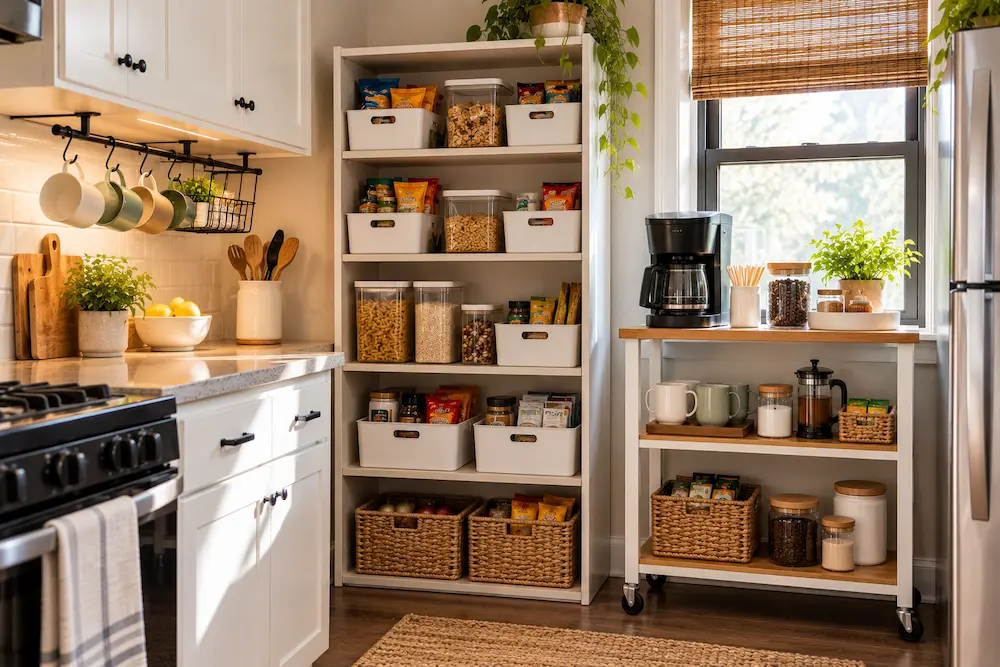
15. Use Bins to Control Pantry Categories
You do not need a large pantry to benefit from bins.
Use small baskets or bins to group categories such as:
- Snacks
- Breakfast foods
- Baking supplies
- Pasta and grains
- Tea and coffee
- Small packets
Instead of searching through an entire cabinet, you can pull out one category at a time.
Renter advantage: Freestanding bins require no installation and can move to another cabinet if your layout changes.
16. Create a Coffee Station Without Adding a Cabinet
If your coffee maker, mugs, filters, and coffee supplies are scattered around the kitchen, give them one defined zone.
A single shelf, cabinet section, rolling cart, or small freestanding unit can become a compact coffee station.
Keep only the supplies you use regularly in the main area.
This can free other cabinets while making your morning routine easier.
For renters: You can build the entire setup from movable pieces rather than installing a permanent coffee bar.
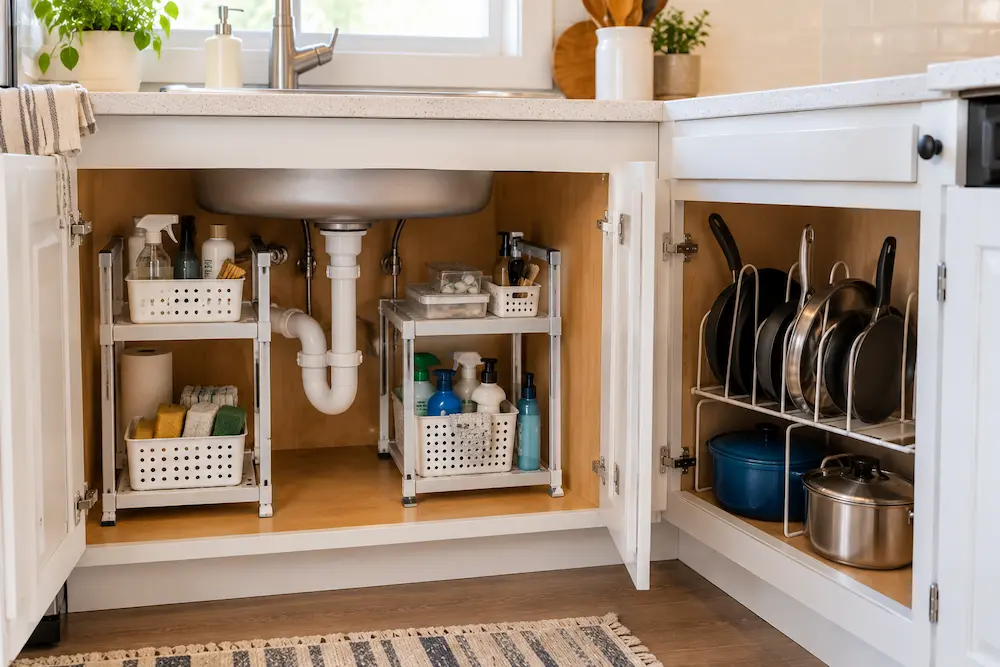
17. Use a Freestanding Under-Sink Organizer
Under-sink cabinets often need more structure, but plumbing makes standard shelves difficult.
A freestanding or expandable under-sink organizer can create another level around the pipes.
Measure the plumbing before buying. Pay attention to the cabinet opening as well as the space inside.
Keep enough room around shutoff valves and plumbing connections so you can inspect or access them when necessary.
Renter tip: Choose an organizer that can be lifted out rather than one that requires drilling into the cabinet.
For more ways to organize this tricky area, see our guide to under kitchen sink organization ideas, including practical ways to work around plumbing and use the available cabinet space.
18. Store Pots and Pans With a Freestanding Rack
If pans are stacked on top of each other, the one you need is often at the bottom.
A freestanding pan organizer or vertical rack can separate cookware so individual pieces are easier to grab.
This is especially useful when you cook regularly with only a few pans.
You do not need to reorganize every piece of cookware at once. Start with the cabinet that causes the most frustration.
19. Turn the Top of a Rolling Cart Into a Work Zone
A rolling cart does not have to be just another place to pile things.
Give it a specific job.
For example, the top can hold coffee supplies or food-prep items while the lower shelves hold pantry goods, cookware, or small appliances.
When you need more floor space, roll it out of the way.
For renters: This is one of the easiest ways to add storage and a little extra workspace without changing the kitchen itself.
20. Use Removable Storage in the Order That Makes Sense
Before buying several organizers, look at the kitchen as a whole.
Start with the areas causing the biggest problems:
- Crowded cabinets
- Unused vertical space
- Overloaded drawers
- Under-sink clutter
- Narrow gaps
- Back of doors
- Countertop clutter
Then choose the simplest renter-friendly solution for each problem.
You may only need a shelf riser in one cabinet, a rolling cart beside the refrigerator, and a few suitable hooks.
The goal is not to fill every empty space with an organizer.
It is to make the kitchen easier to use.
How to Organize a Rental Kitchen Without Drilling
The easiest way to organize a rental kitchen is to think in terms of removable storage first.
Look for places where storage can sit, hang, stack, or use existing pressure or magnetic surfaces.
That includes:
- Inside cabinets
- Cabinet doors
- The back of kitchen doors
- Narrow gaps
- Under the sink
- Inside drawers
- Above existing shelves
- Suitable refrigerator surfaces
- Open floor space
This approach also helps prevent unnecessary purchases.
Instead of asking, “What organizer should I buy?” ask, “What problem am I trying to solve?”
If the problem is wasted cabinet height, you probably need a shelf riser.
If it is a narrow gap, a slim cart may make more sense.
If it is a messy drawer, a drawer organizer is more useful.
The storage product should follow the problem—not the other way around.
If you’re organizing a small kitchen beyond renter-friendly storage, our Small Kitchen Organization Ideas guide covers how to organize cabinets, counters, drawers, and other kitchen zones as a complete system.
What to Avoid in a Rental Kitchen
Not every no-drill product is automatically safe for every rental.
Do not ignore your lease
Your lease may have specific rules about wall attachments, adhesives, or modifications.
Do not exceed product weight limits
An adhesive hook that works for a lightweight towel is not automatically suitable for a heavy pan.
Do not use adhesive products on unsuitable surfaces
Check the manufacturer’s instructions before applying anything to wallpaper, textured surfaces, rough walls, or other surfaces that are not approved.
Do not block cabinet doors
An over-door basket is only useful if the door can still open and close normally.
Do not forget about plumbing
Under-sink storage should work around pipes rather than forcing them into an awkward position.
Do not buy before measuring
A product that is one inch too wide can turn a useful storage idea into another problem.
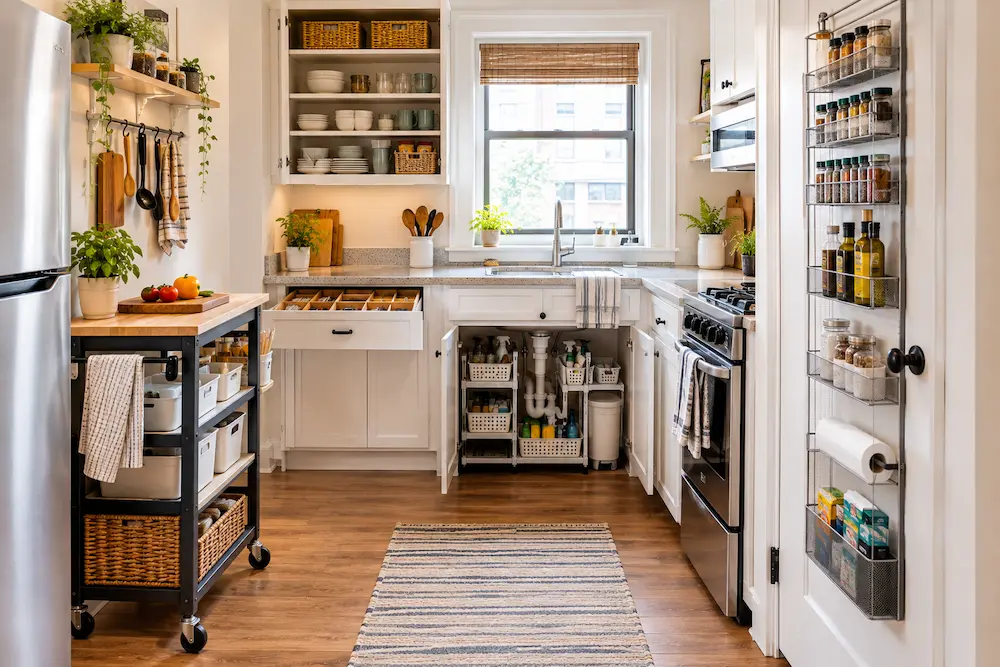
A Simple No-Drill Kitchen Setup for a Small Apartment
If you are starting from scratch, you do not need to buy 20 different products.
Start with the problem areas.
For crowded cabinets, try stackable shelf risers.
For a messy drawer, use adjustable dividers.
For the space under the sink, try a freestanding under-sink organizer.
For a narrow gap, measure for a slim rolling cart.
For lightweight items, consider removable hooks where the surface and product instructions allow them.
For a pantry door or kitchen door, consider an over-the-door organizer.
For extra vertical space inside a cabinet, look at tension-mounted storage or shelf inserts.
This gives you a flexible system without turning the rental into a permanent project.
Frequently Asked Questions
What are the best no-drill kitchen storage ideas for renters?
Useful options include shelf risers, tension rods, removable hooks, over-the-door organizers, drawer dividers, freestanding under-sink organizers, slim rolling carts, and freestanding shelves. The right choice depends on the specific storage problem and the dimensions of your kitchen.
How can I add kitchen storage without drilling?
Start with storage that sits, stacks, hangs over a door, uses tension, or works on a suitable magnetic surface. Freestanding furniture and cabinet inserts are also useful because they can usually be removed without changing the kitchen itself.
Are adhesive hooks safe for rental kitchens?
They can be useful on suitable surfaces when installed and removed according to the manufacturer’s instructions, but they are not guaranteed to be safe on every wall or finish. Check the product’s approved surfaces, weight limit, and removal instructions first.
How do I organize a small apartment kitchen with no pantry?
Use cabinets by category, add shelf risers where there is unused vertical space, use suitable door storage, and consider a narrow rolling cart or freestanding shelf if you have floor space. You can also group pantry foods into removable bins so smaller items do not disappear at the back of a cabinet.
What can I use instead of drilling into kitchen cabinets?
Depending on the situation, you can use shelf risers, tension rods, clip-on baskets, over-the-door organizers, removable hooks, drawer dividers, and freestanding organizers. Always check the product and cabinet dimensions before installation.
How can renters create more counter space?
Move rarely used appliances off the counter, group frequently used items into one zone, and use vertical or freestanding storage where possible. A slim rolling cart can also provide additional storage and, depending on its design, another small work surface.
Final Thoughts
A rental kitchen does not have to stay cramped just because you cannot drill into the walls.
Start with the storage you already have. Use the empty height inside cabinets, the backs of doors, narrow gaps, drawers, and the space under the sink. Then add removable or freestanding organizers only where they solve a real problem.
For renters, flexibility matters.
The best setup is one that makes everyday cooking easier now and can still come with you when the lease ends.
You do not need to change the kitchen itself.
You just need to make better use of the space that is already there.