How to Organize Pot Lids by the Space You Have
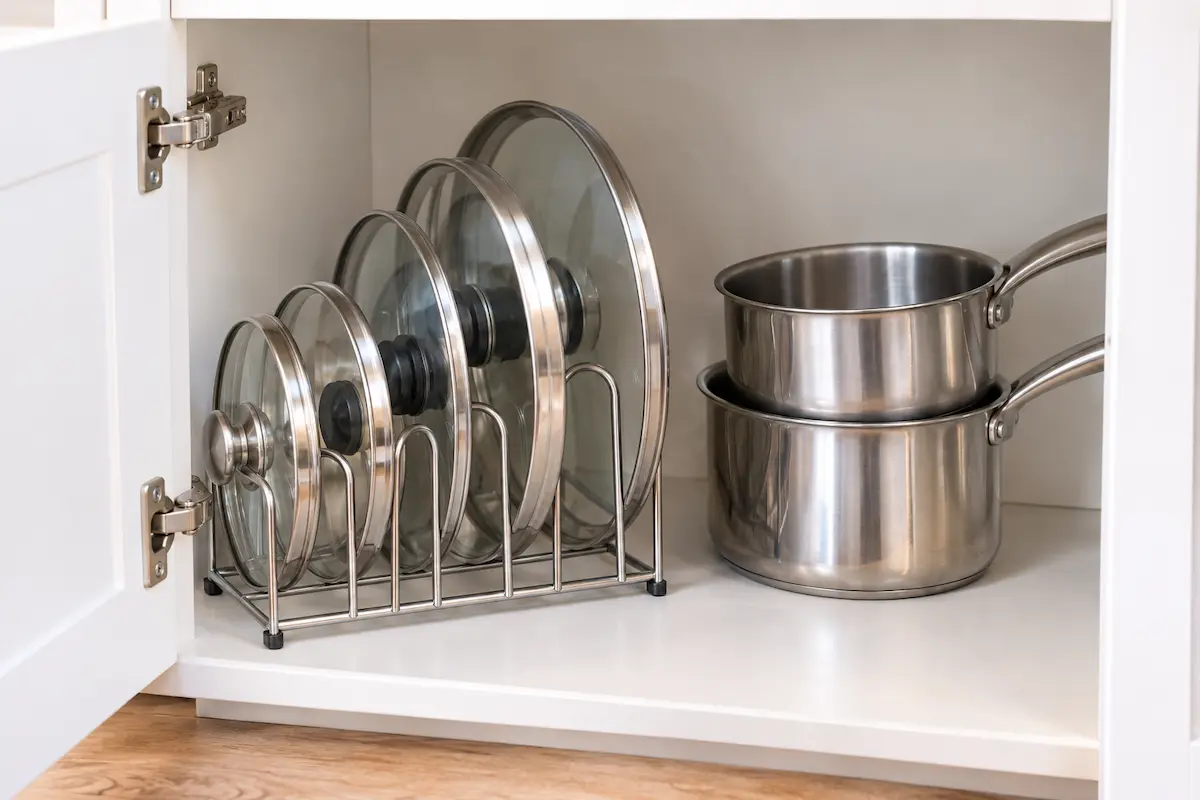
Short answer: Pick the spot before you buy an organizer. Lids you use every week belong in a drawer lane or an upright rack on the shelf next to the pots. The back of a cabinet door only works if each lid fits through the cabinet opening and the door still closes, so check both first. Renters can do all of it without screws: a freestanding rack, drawer dividers, a tension rod, or adhesive hooks rated above the lid’s weight.
Pot lids don’t stack. The knob on top tips each one sideways, no two sizes match, and a loose pile ends up on top of the pans you need. Learning how to organize pot lids is mostly about choosing the right spot for them: a drawer, a shelf, the back of a cabinet door, or a wall. This guide compares those spots, shows three checks that keep a door rack from jamming the door, and matches each holder to the kind of lids you own.
Pot lid storage options compared
| Option | Best for | Skip if |
|---|---|---|
| Keep each lid on its pot, flipped upside down | A few pots with room above them; pots you don’t nest | You nest pots inside each other to save space |
| Upright lid rack on a cabinet shelf | Most kitchens; lids you grab every week | Your largest lid, standing on its edge, is taller than the space under the shelf above |
| Lid lane in a drawer | A wide drawer near the stove | The drawer is shallow and you have more than a few large lids |
| Rack or hooks inside a cabinet door | Small and medium lids; cabinets with shelves set back from the door | The lid is wider than the cabinet opening, or the door hits the shelf |
| Wall rack or pot rail | Owners, or renters with landlord approval, who have open wall space | You can’t drill, or the only free wall is right above the burners |
| Own fewer lids | Mixed sets with lids that match nothing | You often cook several covered pots at once |
Most small kitchens end up with two of these: an upright rack or drawer lane for everyday lids, plus door or wall storage for the odd sizes.
Will lids fit on the cabinet door? Check these three things
Door storage shows up in most of the pot lid guides we read, and it is the option most likely to fail, because the door has to close with the lids on it. Do these checks before you stick or screw anything to a door.
1. Measure the opening, not the door
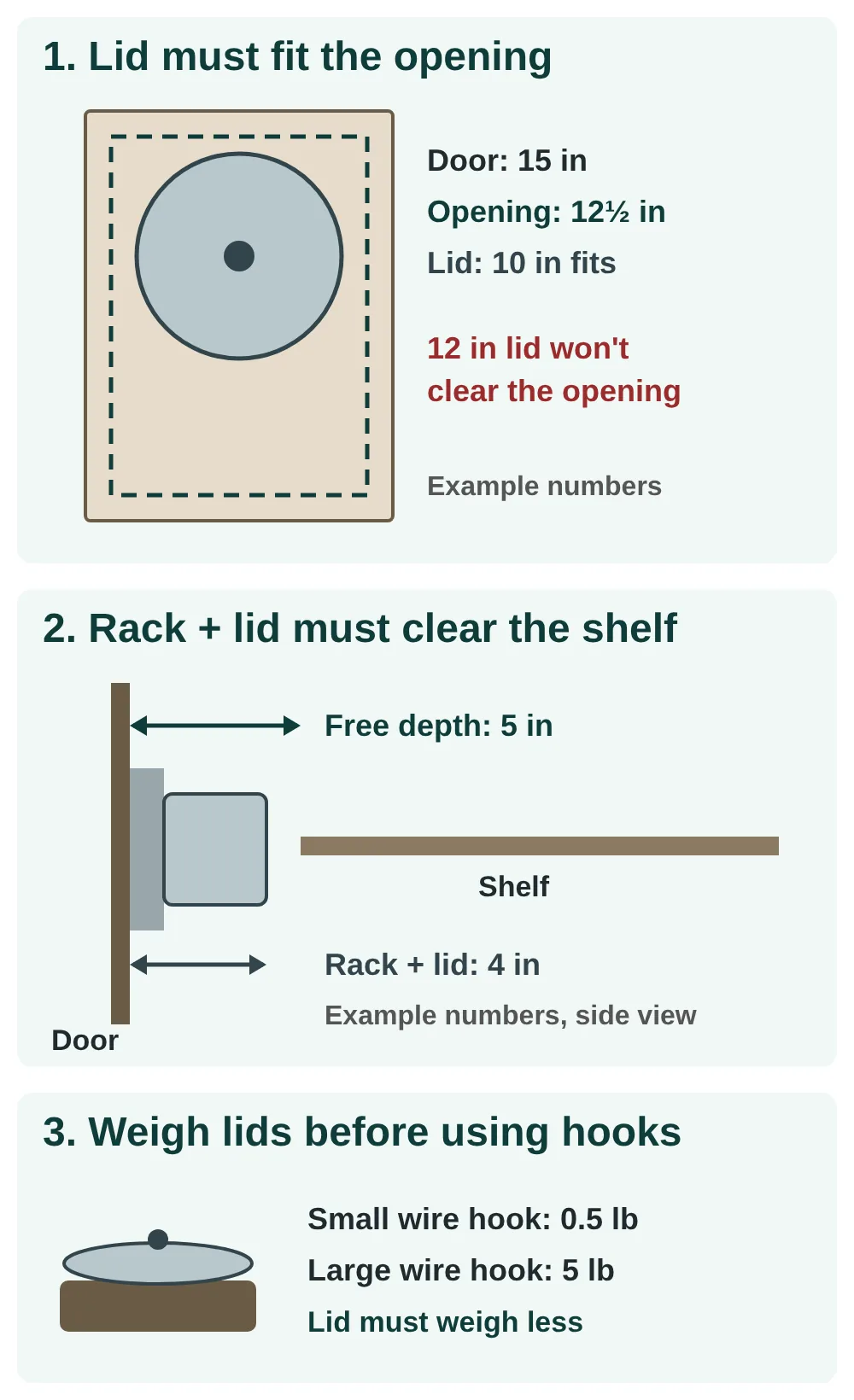
On most cabinets the door overlaps the frame, so the door is wider than the hole behind it. Anything mounted on the back of the door has to pass through that hole when the door closes. Open the door and measure the inside width and height of the opening, then take off anything that sticks into it, like hinges or a door bumper. Each lid’s diameter has to be smaller than what’s left. We leave at least ½ inch of slack (our rule of thumb).
Example with illustrative numbers: a base cabinet opening measures 12½ inches wide once you allow for the hinges. A 10-inch lid fits with room to spare. A 12-inch lid doesn’t, even though the door itself might be 15 inches wide.
2. Measure the depth the door can take
With the door open, hold a ruler against the front of the cabinet frame and measure back to the front edge of the shelf, or to the front of whatever sits on it. That space has to hold the rack plus the lid. Lay the lid on a table and measure from the table to the top of the knob; add the rack’s depth from its listing. Example with illustrative numbers: a rack and lid that stick out 4 inches fit in 5 inches of free depth, but not in 3.
One door-mount lid rack listing we checked asks for at least 5 inches of interior depth and a door at least 22 inches tall. Upper cabinets are most commonly 12 inches deep, according to Bob Vila, so a door rack in an upper cabinet takes a large share of the shelf. If you’re also buying shelf organizers for that cabinet, see how to measure cabinets for organizers first.
3. Weigh the heaviest lid if you use adhesive
Put your heaviest lid on a kitchen scale and compare it with the hook rating on the package. 3M rates the Command Large Wire Hook at 5 pounds per hook, while the Command small wire hook is listed at 0.5 pound per hook by WebstaurantStore. Glass lids and cast iron lids are the ones to check. If a lid is close to the rating, store it somewhere else.
Match the holder to the lid type
The shape of the lid matters as much as the space. A holder that grips one kind of lid can drop another.
| Lid type | Works with | Watch out for |
|---|---|---|
| Round knob on top (most saucepan and stockpot lids) | Upright racks, drawer lanes, door racks that cradle the knob | The knob adds depth, so include it in the door depth check |
| Raised or rolled edge | Upright racks, drawer lanes, hooks set under the rim | Peel-and-stick holders whose opening sits close to the door (Hunker notes they may not fit these lids) |
| Flat lid with no lip at the edge | Drawer lanes, upright racks | Hooks, because there is no rim for them to catch |
| Heavy glass or cast iron lid | A single layer in a drawer, or a sturdy rack on a shelf | Small adhesive hooks; weigh the lid first |
| Side “ear” handles instead of a knob (Dutch ovens) | Stored on the pot itself | Door racks; one listing warns that short ear handles may not stay in place |
Renter-friendly pot lid storage without screws
You don’t need to drill to get lids under control. These options come out without leaving holes:
- Freestanding upright rack. It sits on a shelf or the cabinet floor and holds lids on edge between dividers.
- Drawer dividers or an expandable lid organizer. See the drawer section below.
- A tension rod as a divider. Set between the straight side walls of a cabinet, it gives lids something to stand against, and nothing is attached. Our renter guide shows how to use a small tension rod for cabinet lids.
- Adhesive hooks on the inside of a door. Two or three hooks under the rim of each lid, rated above the lid’s weight. Clean the surface and follow the package directions.
Adhesive strips are sold as removable, but paint and cabinet finishes vary. Test one hook in a spot nobody sees, wait the time on the package, and check your lease. The door-mount lid rack listing we checked is screwed on, and wall racks and pot rails need screws too, so ask your landlord before installing either.
How to organize pot lids in a drawer
A drawer is the easiest place to find a lid quickly, and it works for glass lids too. Pick the drawer closest to the stove or right below the pots. Measure its inside width, depth and height before you buy anything.
There are two ways to fill it:
- Flat, in a single layer. Good for shallow drawers and glass lids. The Spruce suggests laying glass lids in a single layer so they don’t get damaged.
- On edge, in lanes. Holds more lids. A lid standing straight up needs inside drawer height at least equal to its diameter. If the drawer is shorter, lean the lids back like files and check that the tallest one clears the cabinet frame as the drawer closes.
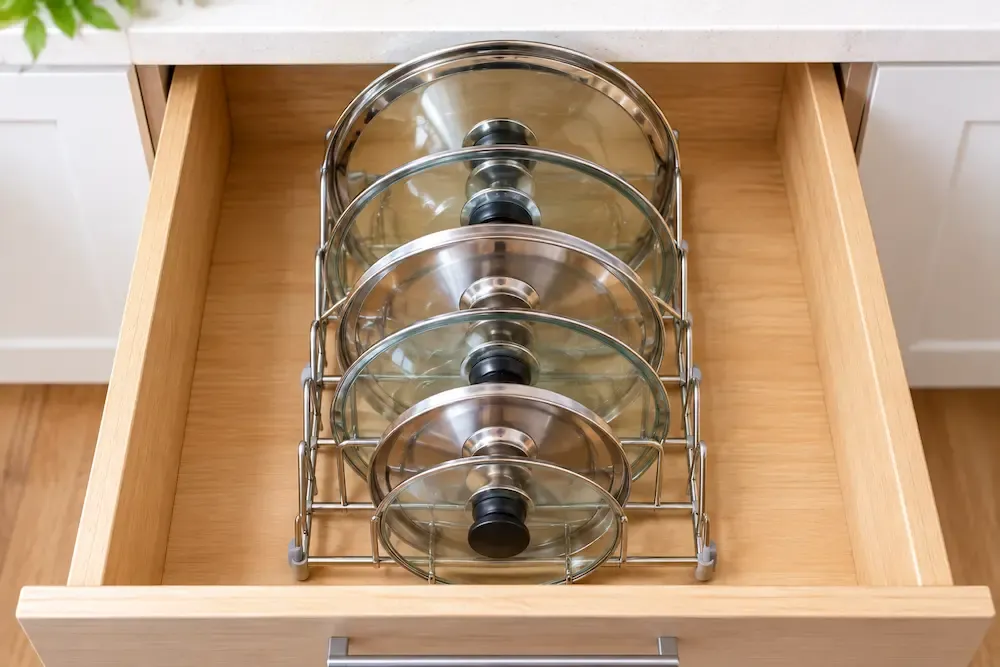
For lanes, an expandable organizer saves cutting dividers. As one example of the size range, the IKEA VARIERA pot lid organizer extends from 3¼ to 19¾ inches long and is 5¾ inches wide and 4 inches tall. Put the largest lids at the back and the smallest at the front, so you can see every knob from above. An office file sorter does the same job for small lids, an idea that comes up often in reader discussions on Reddit.
Inside a cabinet: upright racks, shelves and a lazy susan
If your drawers are full, a cabinet shelf is the next best spot.
- Upright rack next to the pots. Before you buy, stand your largest lid on its edge and measure it against the gap under the shelf above. If it doesn’t fit, use the bottom of the cabinet, where there’s no shelf overhead.
- Lids on the pots. If you don’t nest your pots, keep each lid on its own pot, flipped upside down so the next pot can sit on top.
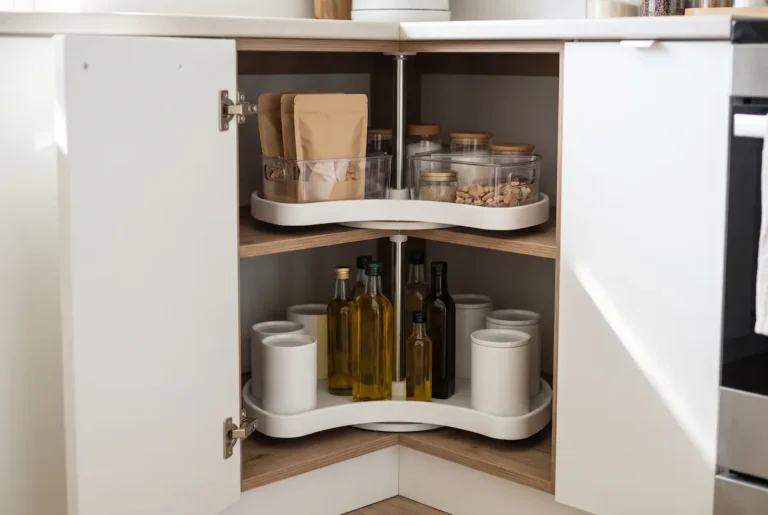
- Lazy susan corner cabinet. The Spruce suggests putting lids on the bottom tray. If yours holds pots, see what goes where on a lazy susan so heavy pieces don’t block the turn.
- Wall rack or pot rail. Mount it where the lids aren’t right above a burner. Home Depot advises leaving enough distance between the heat source and the pans and lids.
Lids are one part of a cabinet plan. For the rest, see our guide to organizing kitchen cabinets by zone.
Cut the lid count first
Fewer lids make every option above easier. Pull all your lids out and match each one to a pot you still use. Lids with no pot can go. Mixed sets can share a universal lid; retailer listings sell universal lids sized to cover a range, such as 8 to 12 inches. In the Reddit threads we read, several people solved the problem by keeping only three or four lids that cover most of their pans, or by switching to flat lids.
Food storage container lids are a different problem, with different sizes and materials; see how to organize food storage containers and their lids. Keep them out of the pot lid rack so it doesn’t overflow.
Pot lid storage FAQ
What hooks hold pot lids?
Use two or three hooks under the rim of each lid, rated above the lid’s weight. A Command small wire hook is listed at 0.5 pound and the large wire hook at 5 pounds, so weigh heavy glass lids before you choose. Lids with no rim need a rack instead.
How do you store glass pot lids?
Lay them flat in a single layer in a drawer, or stand them in an upright rack so they don’t rub against each other. Avoid stacking glass lids in a pile.
Should pot lids stay on their pots?
Yes, if you have the room and don’t nest your pots. Flip each lid upside down so the next pot can sit on top. If you nest pots to save space, store the lids separately in a rack or drawer.
How do you organize pot lids in a drawer?
Lay them flat in a single layer, or stand them on edge in lanes with the biggest lids at the back. Measure the drawer’s inside height against your largest lid first.
How we put this guide together
This guide is research-based. We did not test these products in a kitchen. Fit numbers come from manufacturer and retailer pages we opened on November 3, 2026: 3M’s Command Large Wire Hook, the Command small wire hook listing at WebstaurantStore, a door-mount lid rack listing on Walmart and the IKEA VARIERA product page. Cabinet depths come from Bob Vila. We also read the pot lid guides from The Spruce, Home Depot and Hunker, and reader discussions about pot lid storage on Reddit. The ½-inch slack and the worked example are our own rules of thumb and illustrative numbers, not standards. Product listings change, so check the current listing before you buy.