Lazy Susan Replacement Shelf: How to Find, Measure and Swap the Right One
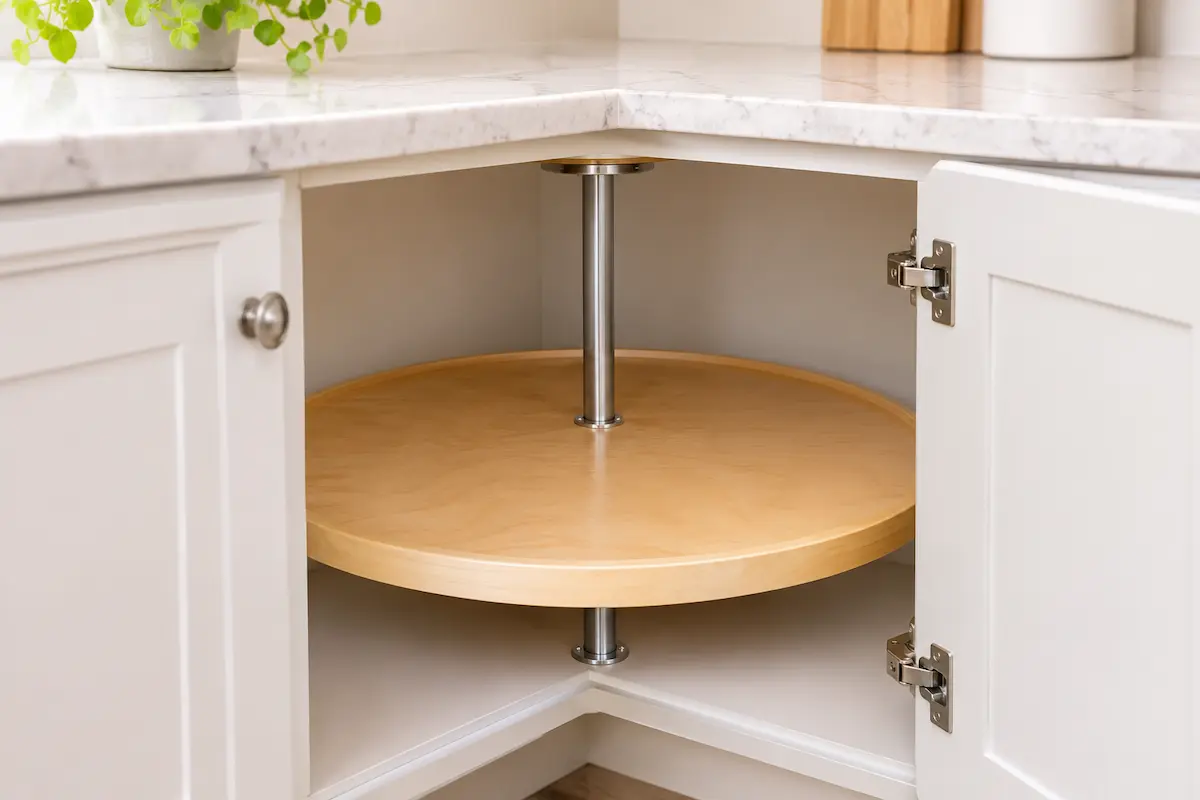
Your lazy susan shelf cracked, warped or slipped off its hub, and a search for a lazy susan replacement shelf returns listings that never say what comes in the box. “Replacement shelf” can mean a rotating tray, a flat cabinet shelf or a tabletop plate, and a wrong guess means a return.
This guide covers the rotating shelf inside a kitchen cabinet. It helps you name the part you need, measure the old shelf and decide whether to replace one shelf, the whole set or nothing. If your corner is a blind corner with no lazy susan at all, see our guide to blind corner cabinet organizers.
Short answer: matching a lazy susan replacement shelf
Measure the old shelf across its widest points, note its shape and how it attaches, then match all three. Some “shelf only” listings leave out the post and mounting hardware, so read what is included before you order. If the post, hub or bearing is worn too, a full set can be the simpler fix.
| Meaning of “replacement shelf” | What it is | In this guide? |
|---|---|---|
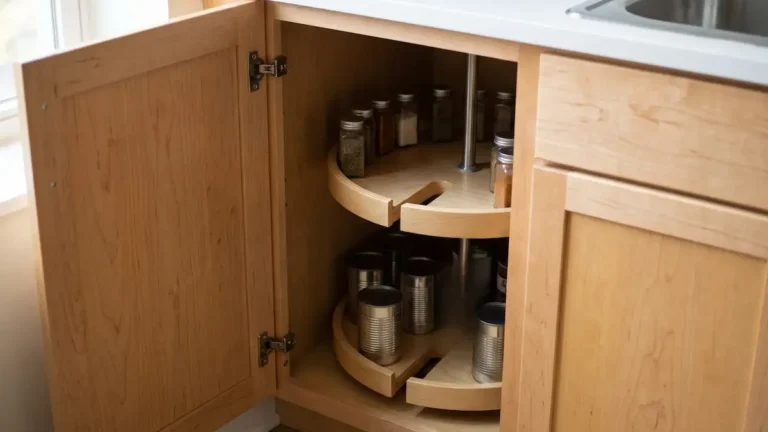
| Rotating tray | The round, kidney or pie-cut shelf that spins in a cabinet | Yes |
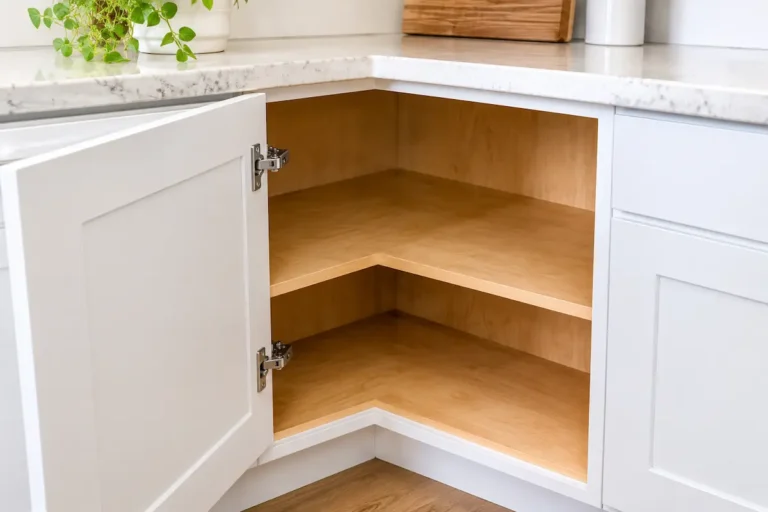
| Flat cabinet shelf | A fixed shelf on clips, such as the KraftMaid laminate shelf listed for “Lazy Susan Angle” cabinets (our reading: not a rotating tray) | Briefly |
| Tabletop turntable | A bearing plate between a base and a board | No, different part |
Cabinet lazy susan or tabletop turntable?
A cabinet lazy susan turns on a center post or shaft that is anchored in the cabinet. A tabletop turntable is a flat bearing plate that sits between a base and a board. In the search results we reviewed, “replacement parts” returned both, so the two get mixed together in listings.
If you have a tabletop turntable, this guide stops here. The fit rules below apply to cabinet shelves only.
What broke?
Pair the symptom with the likely part before you shop. These pairings are our reading of common failures, not a diagnosis of your cabinet.
| What you see | Likely part | Next step |
|---|---|---|
| Cracked, chipped or warped shelf | The shelf | Replace the shelf if the post and bearing are fine |
| Shelf wobbles or leans | Hub, pin or loose screws | Tighten or replace the hardware first |
| Shelf drags or sticks | Bearing, or a rub against the door or frame | Check for rubbing, then read why a lazy susan sticks |
| Several parts worn or bent | Shelf, post and hardware | Compare a full set |
A Hunker repair guide (last modified in 2018) treats loose screws and worn bearings as their own fixes, which fits the table: not every wobble means a new shelf.
What you can buy: shelf only, shelf plus hardware, or a full set
Rev-A-Shelf’s explainer describes single shelves and multi-shelf sets, bottom-mount and telescoping-post designs, shelves that rotate together or independently, and steel or aluminum bearings. Those differences help explain why two shelves of the same diameter can be sold as different products.
| Listing term | What it covers | Confirm before you order |
|---|---|---|
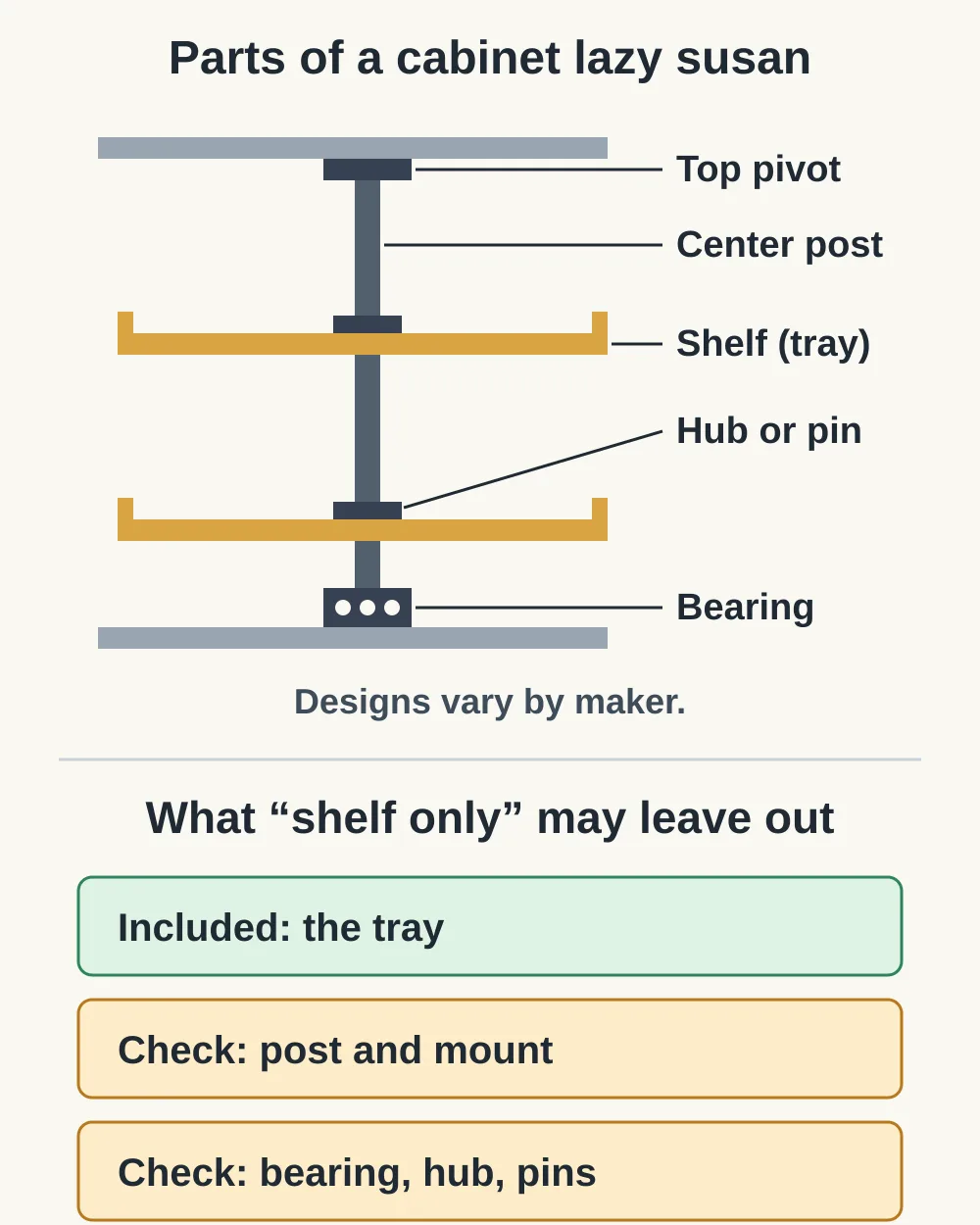
| Shelf only | The tray | Whether a post, hub or bearing is included |
| Hardware or bearing | Parts that connect shelf, post and cabinet | The shape, post type and diameter it fits |
| Set | Shelves, post and mounting hardware | Shelf count and whether the door attaches |
These are typical meanings. Makers differ, so the listing text wins over the table.
Identify your shape
Rev-A-Shelf lists five shapes: full-circle, kidney, D-shape, pie-cut and half-moon. Match the outline of your old shelf to one of them.
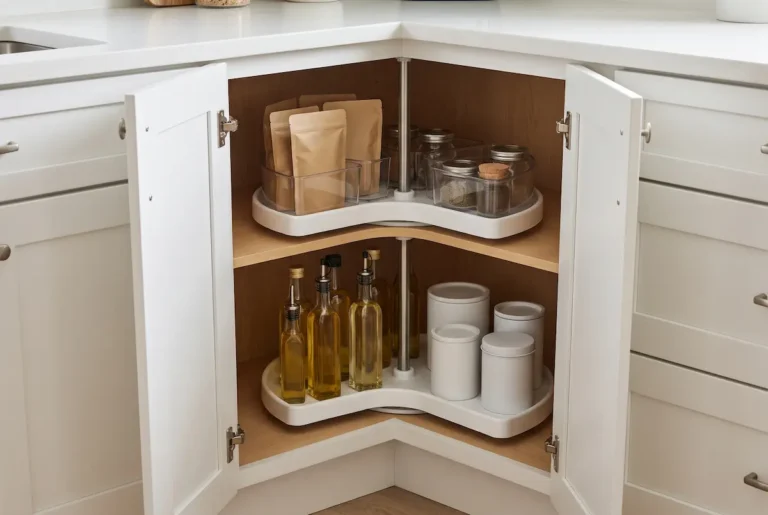
The door is the quickest clue. A pie-cut shelf attaches to the cabinet door, so the door and shelf move together. A kidney shelf does not attach to the door, according to a CabinetParts kidney guide. If you cannot tell, open the door and photograph the shelf from above before you order.
Choosing a new size instead of matching the old one is a different job. Our guide to choosing a new lazy susan size covers it.
How to measure the old shelf
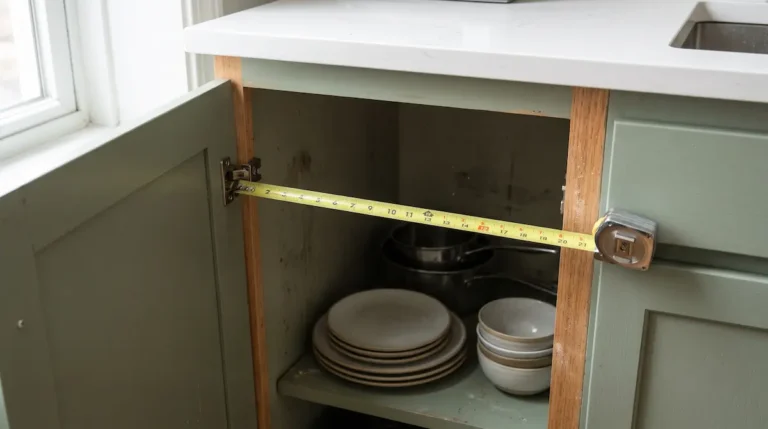
Measure the shelf itself, not only the cabinet. For kidney shelves, the same CabinetParts guide says measuring the shelf works as well as measuring the cabinet. For general cabinet measuring habits, see how to measure kitchen cabinets for organizers.
- Empty the shelf so the edge is easy to see.
- Measure across the widest points. For a round shelf, measure through the center hole. For kidney, D-shape and pie-cut shelves, measure the widest points in both directions and sketch the outline.
- Measure the center hole or hub opening. Note whether it is round or has a flat side.
- Measure the rim height. A taller rim can touch the shelf above it.
- Measure the gap between shelves and the inside height of the cabinet. Retailers list minimum and maximum cabinet heights for each series, as the CabinetParts full-circle guide notes.
- Check the space around the shelf. That same retailer suggests about 1 to 2 inches of clearance all the way around, a general rule from one source.
- Photograph the hardware before you touch it, and label which shelf is the top and which is the bottom.
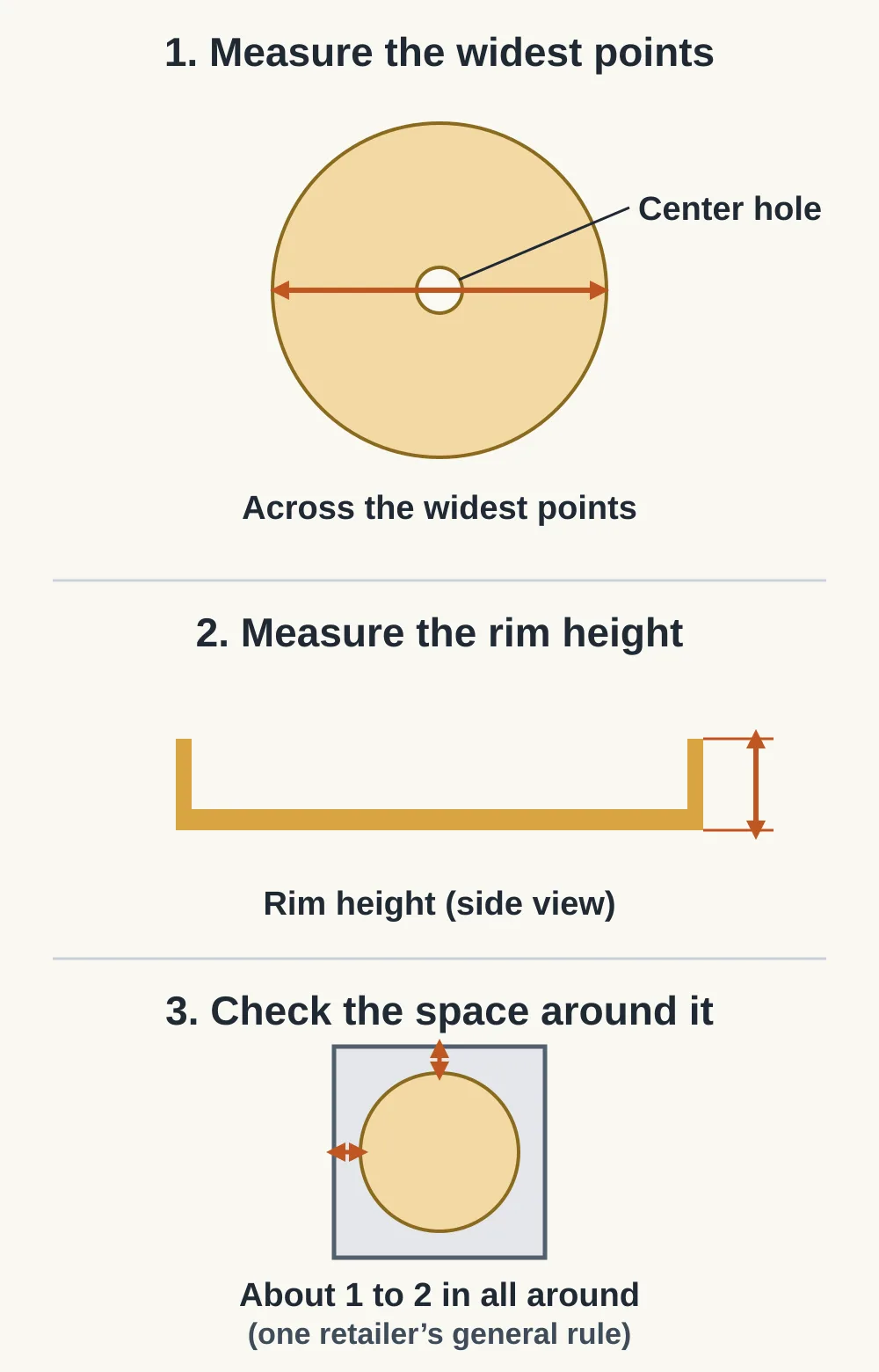
Write down the shape, the widest measurements, the hole size, the rim height, the shelf gap, whether the door attaches, and any maker name or model number stamped on the shelf or post.
What “shelf only” leaves out
One 18-inch listing at CabinetParts is labeled “No Post Included (Shelf Only)”, and the bottom-mount post is sold separately. Check for the same gaps on any listing:
- Post and mounting hardware. The listing above sells them separately.
- Bearing. A wood shelf listing from the same retailer says the bearing system is sold separately.
- Hub, pins or screws. Some listings mention a hub and some do not, so ask the seller or read the parts list.
- Door bracket. Pie-cut shelves attach to the door, so check whether that hardware is included.
We did not find a chart showing that parts from different makers fit each other. Match the maker where you can, and do not assume a shelf from one brand fits another brand’s post.
Replacing one shelf: what the post and pins mean
The installation sheets we found cover complete new installs. None describes removing or replacing a single shelf, and we are not writing a step-by-step swap we could not source. Follow the sheet for your model, or ask the seller or maker.
What the sources do agree on:
- Per Rev-A-Shelf’s kidney installation sheet, shelves ride on a shaft or post and are held with hubs and screws, with a base and a top pivot fixed to the cabinet. Another Rev-A-Shelf sheet tells installers to check clearance at the back of the shelf before drilling.
- The Hunker guide describes taking shelves off by removing a bolt near the top of the pole and the pins, then pushing the pole down. It is one example from 2018, not a method for every model.
Our inference: a shelf in the middle of a stack may only come off when the post is loosened, so plan for taking apart more than the broken shelf. Whether yours comes off alone depends on how it is built. Empty the cabinet, keep each pin and screw in a labeled bag, and stop if a part will not move without force.
Replace the shelf, the set or neither
| Option | Best for | Skip if |
|---|---|---|
| Replace one shelf | One damaged tray, with a post and bearing that turn freely and a shape and size you can match | The post is bent, the bearing is rough, or you cannot match the shelf |
| Replace the set | Several worn parts, mixed hardware, or no matching single shelf | Only one shelf is damaged and the rest works well |
| Keep what you have | Scuffs, light wobble or a sticky turn you can fix with hardware | The shelf is cracked where it carries weight |
If the real question is whether to swap the whole system, read our lazy susan alternatives for corner cabinets.
Renters and safety
Taking out a post, base or top pivot means removing screws from the cabinet. In a rental, get the landlord’s approval first and check your lease. Empty every shelf before you loosen anything, because a loaded shelf can drop when the post comes free.
Frequently asked questions
Can you replace a lazy susan shelf?
Often, yes. You need to match the shape, size, center hole and the way the shelf attaches. Rev-A-Shelf’s explainer says single shelves are sold as well as sets, though some listings leave out the post and hardware.
How do I replace a broken lazy susan shelf?
Measure the old shelf, match the shape and attachment, then follow the maker’s sheet for your model. The sources we found do not give a single-shelf procedure, so see the section above for what they do cover.
What are the replacement parts for a lazy susan?
The shelf, post or shaft, hub or pins, bearing, mounting hardware, and a door bracket on pie-cut types.
Where can I find a replacement lazy susan shelf?
Start with the shelf’s maker, your cabinet maker or a cabinet-parts retailer. A model number or a clear set of measurements makes the search faster.
How do I change a lazy susan cabinet to shelves?
That replaces the whole system rather than one part. The alternatives guide linked above covers it.
How we put this guide together
This guide is based on manufacturer pages and installation sheets from Rev-A-Shelf, retailer listings and help pages, and a 2018 Hunker article. We did not install, buy or test any lazy susan part. Sizes come from the pages below, or are marked as a general rule. Listings change, so check what is included before you order.
Sources:
- Rev-A-Shelf, Lazy Susans Info
- Rev-A-Shelf kidney installation instructions (hosted by Richelieu)
- Rev-A-Shelf 4WLS441328 installation sheet (hosted by Richelieu)
- CabinetParts, Kidney Shaped Lazy Susan Installation Information
- CabinetParts, Full Circle Cabinet Lazy Susan
- CabinetParts, 18-inch shelf-only listing
- CabinetParts, 18-inch wood shelf listing
- KraftMaid, Lazy Susan Angle replacement shelf listing
- Hunker, How to Fix a Lazy Susan Kitchen Cabinet