Blind Corner Cabinet Organizers: Which Type Fits Your Door Opening
Short answer: Blind corner cabinet organizers are listed by the minimum door opening, not by the width of the cabinet. Measure the clear opening first, then the height under any drawer above and the depth inside, and compare all three with the sheet for the exact model you want.
If your opening is below the listed minimum, or you only store a few things you rarely use, a shelf and a light can do the job with far less trouble.
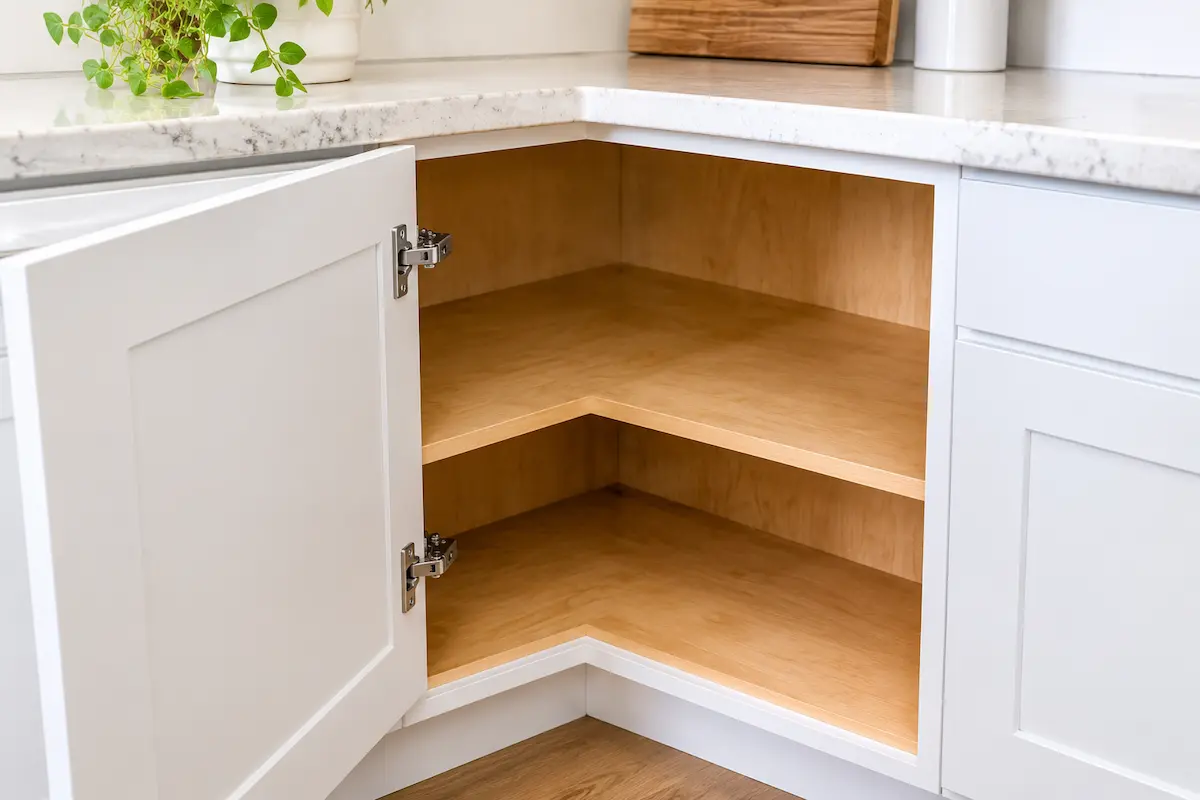
A blind corner base cabinet hides part of its space behind the cabinet next to it. The door opens onto the front section only, so the roasting pan you want is usually in the dark, behind three things you use more often. An organizer can fix that, but only if it passes through your door opening, clears the drawer above and swings without hitting the cabinet beside it.
This guide shows how to measure those things and how to read the numbers manufacturers list. If you are still deciding which corner fix suits your cabinet, our guide to alternatives to a lazy susan compares the options for every corner type.
Four ways to organize a blind corner
Not every blind corner needs a frame of trays. Here are four approaches, from the most hardware to none.
| Option | Best for | Skip if |
|---|---|---|
| Pull-out or swing-out unit | A corner you use weekly, when your opening and height meet the sheet | Your opening or height is below the listed minimum, or you cannot screw into the cabinet |
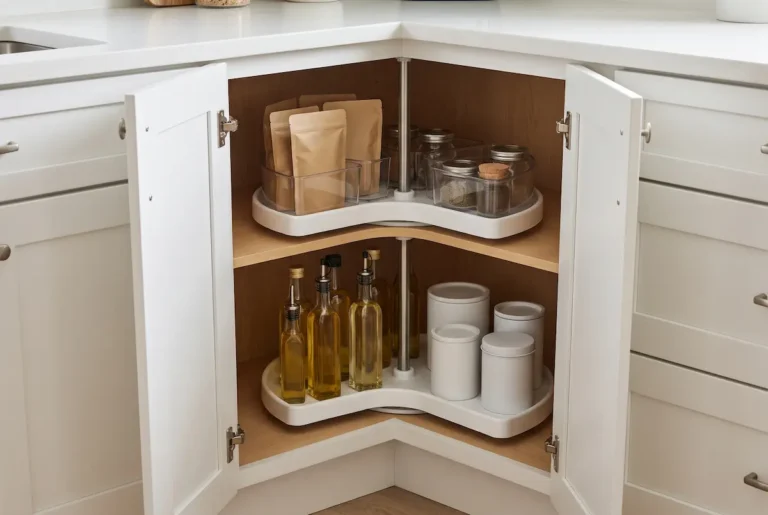
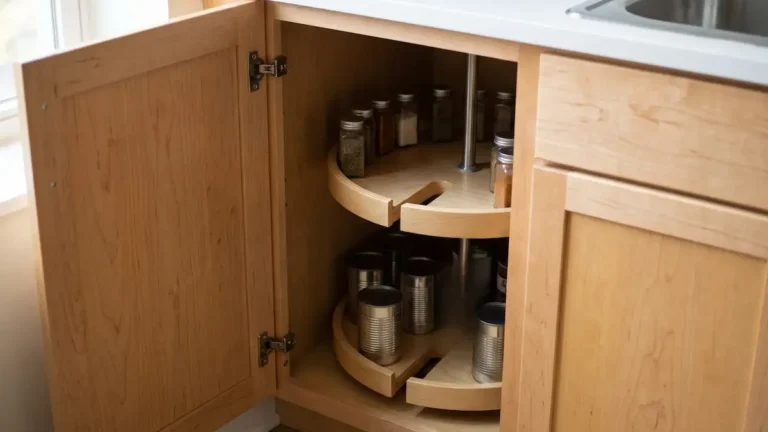
| Half-moon or kidney-shaped set | Reaching the front section of the corner with trays on a pivot | Your opening is below the minimum listed for that unit |
| Single shelf or loose slide-out tray | Light items, small openings and renters | You want to reach the full depth |
| Shelf plus light | Things you use a few times a year | You need daily access to what is back there |
Pull-out and swing-out units
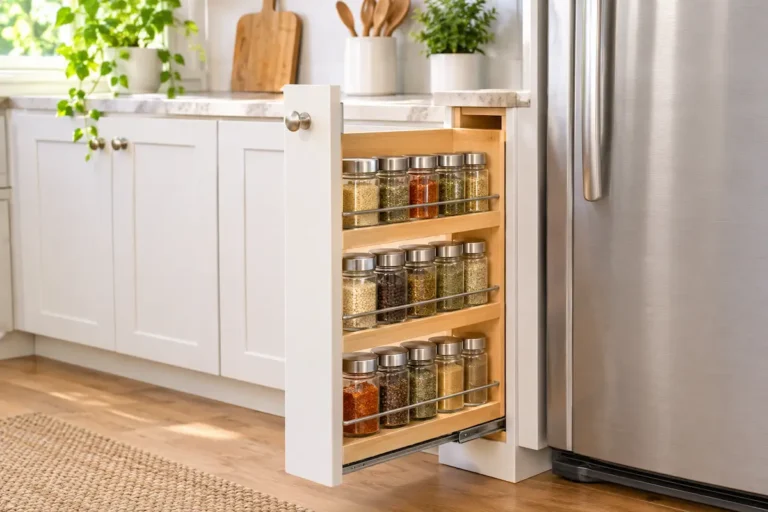
These are frames with two or more trays that come out through the door opening. Examples later in this guide include the Vadania two-tier unit and the Kesseböhmer and Häfele Magic Corner. Each one lists a minimum door opening, and most list a minimum height and depth too.
Half-moon and kidney-shaped sets
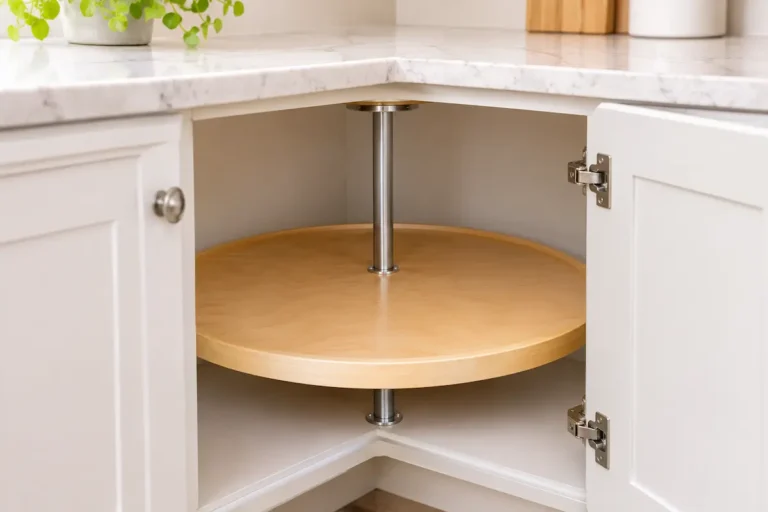
These are shaped trays on a pivot or slide. A round turntable usually cannot pass through a blind corner door, which is why they exist. Our guide to lazy susan sizes by corner type explains the difference and why the opening matters more than the diameter.
Single shelf or loose slide-out tray
A fixed shelf at a better height, or a loose tray you slide toward you, makes one layer of the cabinet easy to reach. A loose tray needs no installation, which suits renters.
A plain shelf plus a light
For things you use a few times a year, one shelf and a battery light may be enough. In one forum thread we read, a homeowner skipped pull-out hardware and chose a plain cabinet with a partial-depth shelf and a light that switches on when the door opens. That is one reader’s choice, not a rule, but it shows hardware is not the only answer.
Measure the door opening, not the cabinet
Look at a few blind corner listings and you will see two kinds of number. One describes the cabinet. The other describes the opening the unit has to pass through. They are not the same, and the opening is the one that decides whether a unit fits.
The Häfele LeMans II 541.32.146 listing shows both: a minimum cabinet length of 32¼ inches and a minimum framed door opening of 16⅛ inches. Vadania sells its two-tier unit by cabinet width (32 or 36 inches) and lists the minimum opening: 14.56 inches for the 32-inch cabinet and 15.94 inches for the 36-inch one. Those figures belong to those units only. They are not a ratio you can apply to another brand.
The method below is the one we use in this guide. It is a practical way to collect the numbers, not an industry standard. Manufacturers define “minimum opening” on their own sheets, so follow the sheet for the unit you choose. Our guide to how to measure kitchen cabinets for organizers covers the general habits: use a metal tape and write down the smallest number you find.
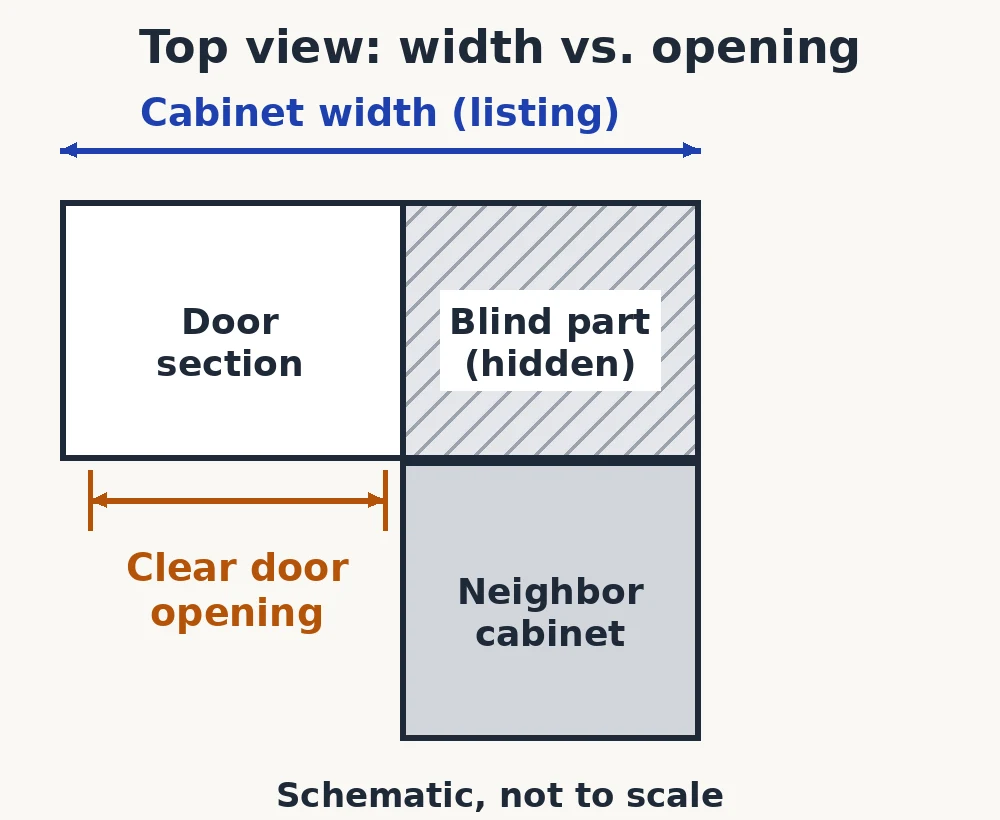
In the diagram, the door opening is the narrow clear gap at the front. The cabinet width also includes the blind part hidden behind the neighboring cabinet. The drawing is a schematic and not to scale.
Clear door opening width
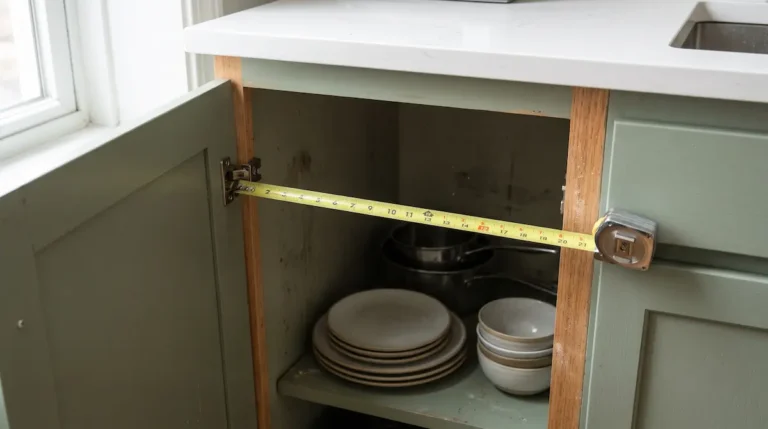
Open the door as far as it goes. Measure the narrowest clear gap at the front of the cabinet, between the two surfaces a unit has to pass: face-frame edge to face-frame edge, or side panel to side panel on a frameless cabinet. Do not use the door’s width or the cabinet’s overall width.
Opening height and the drawer above
Measure from the cabinet floor to the lowest thing above the opening: a drawer box, a drawer slide, a rail or the top of the face frame. Use the smallest number. The section on the drawer above explains why.
Usable interior depth
Measure from the front of the opening to the back wall along the floor. Note anything that could block a tray: pipes, outlets, shelf pin holes, leveling feet and the blind panel.
Hinge, door, handle and neighbor clearance
Check where the hinge sits, how far the open door swings, and whether a pulled-out unit could hit a handle, a neighboring door or a drawer. A Cabinet Joint video on designing with blind corner cabinets makes the same point about leaving clearance beside the door so drawers and knobs do not hit the next cabinet. One cabinet seller also notes that most blind corner applications need a filler so doors and drawers open properly.
Left or right, face frame or frameless
Write down which side the blind part is on, and whether your cabinet has a face frame or is frameless. Brands name left and right differently, so read how the sheet defines it. Hardware Resources, for example, says right-handed units are for openings on the right of the blind. Face frame versus frameless matters because some listings give a different minimum for each.
What each blind corner cabinet organizer lists as the minimum opening
The table shows what each listing says for the named model only. We opened these sources on November 6, 2026. Retailer listings are marked, and some manufacturers’ own sheets could not be opened.
| Brand and model | Opening listed | Source |
|---|---|---|
| Vadania VA-POB-800 (32 in cabinet) | 14.56 in (370 mm) | Manufacturer product page |
| Vadania VA-POB-900 (36 in cabinet) | 15.94 in (405 mm) | Manufacturer product page |
| Hardware Resources BCSO215PCMP-RH (15 in, right of the blind) | 15 in face frame; 16½ in frameless | Retailer listing |
| Häfele LeMans II 541.32.146 (15 in set, left swing) | 16⅛ in framed; 16½ in frameless; 21½ in minimum cabinet height | Retailer listing |
| Häfele Magic Corner I (left 546.17.408 and .908, right .417 and .917) | 15⅝ in with a 295 mm front tray; 19⅜ in with 390 mm baskets in front | Häfele catalog page (distributor copy) |
| Kesseböhmer Magic Corner II (left KE 300-0592-12K, right KE 300-0593-12K) | 19½ in; 20⅝ in minimum internal height | Manufacturer spec sheet (Würth copy) |
Rev-A-Shelf’s 5PSP series is a well-known name here, but its own product page did not show model-level numbers when we checked, so we left it out rather than quote a retailer’s figures. Its installation sheet for the 15- and 18-inch soft-close models says the frame flips and a wheel moves to set up a blind right or left door. Check the current spec page for the opening size.
Why the same size can list different openings
Two units sold as “15 inch” do not ask for the same opening. The Hardware Resources 15-inch unit lists 15 inches for a face-frame cabinet and 16½ inches for frameless. The LeMans II 15-inch set lists 16⅛ inches framed and 16½ inches frameless. The Magic Corner I changes with the tray in front: 15⅝ inches with the shallower front tray, 19⅜ inches with the deeper baskets. A size in the product name is a label, not a measurement of what you need.
Left, right or either
Handing differs by product. Vadania lists its unit as compatible with left and right opening. Rev-A-Shelf says the 5PSP installs for either left or right-handed applications. Hardware Resources sells separate left-handed and right-handed BCSO units, the LeMans II 541.32.146 is a left-swing set, and Magic Corner I and II are sold as left or right units. Order the hand that matches your cabinet, using the sheet’s own definition.
If your opening is small
Look back at the table. The lowest minimums for the models shown are 14.56 inches (Vadania, 32-inch cabinet) and 15⅝ inches (Magic Corner I with the shallower front tray). If your clear opening is below the number on the sheet for the unit you want, that unit will not pass, and forcing it is not a plan. The Hardware Resources category page offers a 12-inch minimum-opening filter, but we did not verify a specific model, so check any unit’s sheet before you rely on it.
With a smaller opening, three options work at almost any size: a loose slide-out tray in the front section, a fixed shelf at a better height, and a light.
The drawer above: what it does to shelf height
Many blind base cabinets have a drawer above the door. The drawer box and its slides take up the top of the opening, so the clear height under them is lower than the cabinet’s inside height. One vendor page for a two-tier pull-out says that with a door and drawer base, the top shelf height is limited by the space the drawer takes.
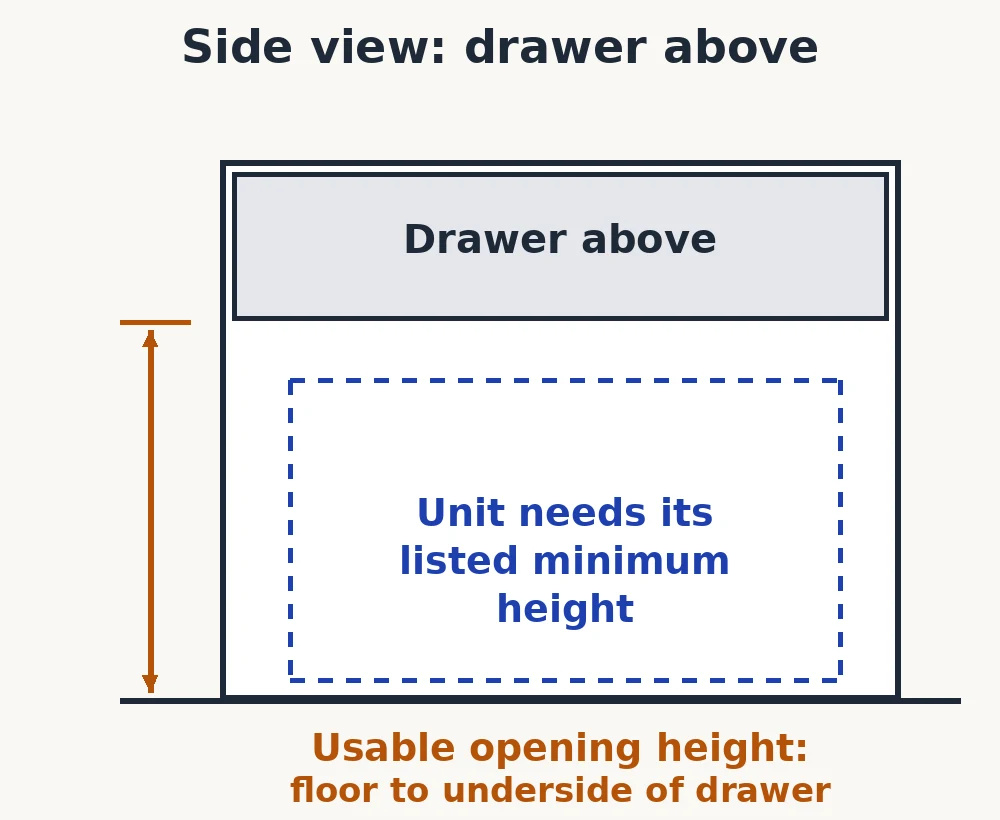
Listings give the height a unit needs: a 20⅝ inch minimum internal height for the Magic Corner II, and a 21½ inch minimum cabinet height on the LeMans II 541.32.146 listing. They do not tell you how much height your drawer leaves. That is why we measure from the floor to the underside of the drawer and compare that number with the sheet.
If the number comes up short, look for a unit whose sheet lists a lower height or fewer tiers, or use a shelf or tray instead.
What to store and what to skip
A blind corner is deep storage. It suits things you reach for weekly or less: a big stockpot, a roasting pan, a slow cooker, serving bowls and seasonal items. Daily items belong somewhere easier. As a rule of thumb (ours, not a standard), if you want to grab something with one hand, keep it out of the corner. For the rest of the kitchen, our guide to how to organize kitchen cabinets sorts items by how often you use them.
In the two forum threads we read, readers disagreed. Some keep small appliances on corner trays by zone, while others regretted paying for hardware to hold things they rarely use, and a few found wide pans and big bowls awkward on small trays. These are reader reports, not tested results.
- Good fit: stockpots, roasting pans, a slow cooker, serving bowls, seasonal items
- Poor fit: everyday plates, spices, cutting boards, anything you use daily
No-install and renter options
Pull-out units are screwed to the cabinet. Vadania’s unit, for example, is listed as bottom mount. Screwing into cabinets, or removing a door or shelf, usually needs your landlord’s approval, so ask first.
No-install choices include a loose tray or bin you slide forward, a shelf riser that stands on its own, and a battery light with adhesive. Test the adhesive on a hidden spot first and follow your lease. More ideas are in our guide to no-drill kitchen storage ideas for renters.
Is a pull-out worth it?
It depends on how often you use the corner and whether your numbers clear the sheet. A pull-out earns its place when you reach into that corner weekly, your opening, height and depth meet the listed minimums, and you are allowed to install it. It is harder to justify for a few seasonal items, an opening below the minimum, or a rental where you cannot drill.
We do not list prices because they change; compare a unit’s current price with what you would store there. A shelf and a light is a fair choice, and so is keeping what you have.
FAQ
What is the best organizer for a blind corner cabinet?
There is no single best one. The right one has a listed minimum opening, height and depth that fit your measurements, in the hand that matches your cabinet. Use the table above to see how listings differ, then check the sheet for the exact model.
What can I do with a blind corner cabinet if I do not want hardware?
Add a shelf, use a loose slide-out tray and put a light in. Keep daily items elsewhere.
Does the drawer above a blind corner cabinet matter?
Yes. It lowers the clear height under it. Measure from the floor to the underside of the drawer and compare that with the unit’s listed minimum height.
Do left and right units differ?
Some are sold as separate left and right versions, and some are listed as working both ways. Check how the sheet defines left and right before you order.
How we put this guide together
We built this guide from manufacturer and retailer documents, not from installing or testing any product. We opened these on November 6, 2026:
- Vadania two-tier blind corner pull-out page (VA-POB-800, VA-POB-900)
- Rev-A-Shelf 5PSP series page and installation sheet
- Hardware Resources BCSO215PCMP-RH listing at Ferguson
- Häfele LeMans II 541.32.146 listing at Ferguson
- Kesseböhmer Magic Corner II spec sheet and Häfele Magic Corner I catalog page
- RTA Store vendor page (drawer and shelf height)
- CabinetSet blind base cabinets (filler)
- Hardware Resources blind corner category page (12-inch filter)
- Cabinet Joint video page (clearance)
Retailer listings can differ from a manufacturer’s current sheet and sometimes disagree with each other. Where they did, we left the figure out. Dimensions here are for the named models only, so check the current sheet for yours before you order. The measuring method is ours. We do not list prices.