Spice Drawer Organizer Guide: Which Type Fits Your Drawer?
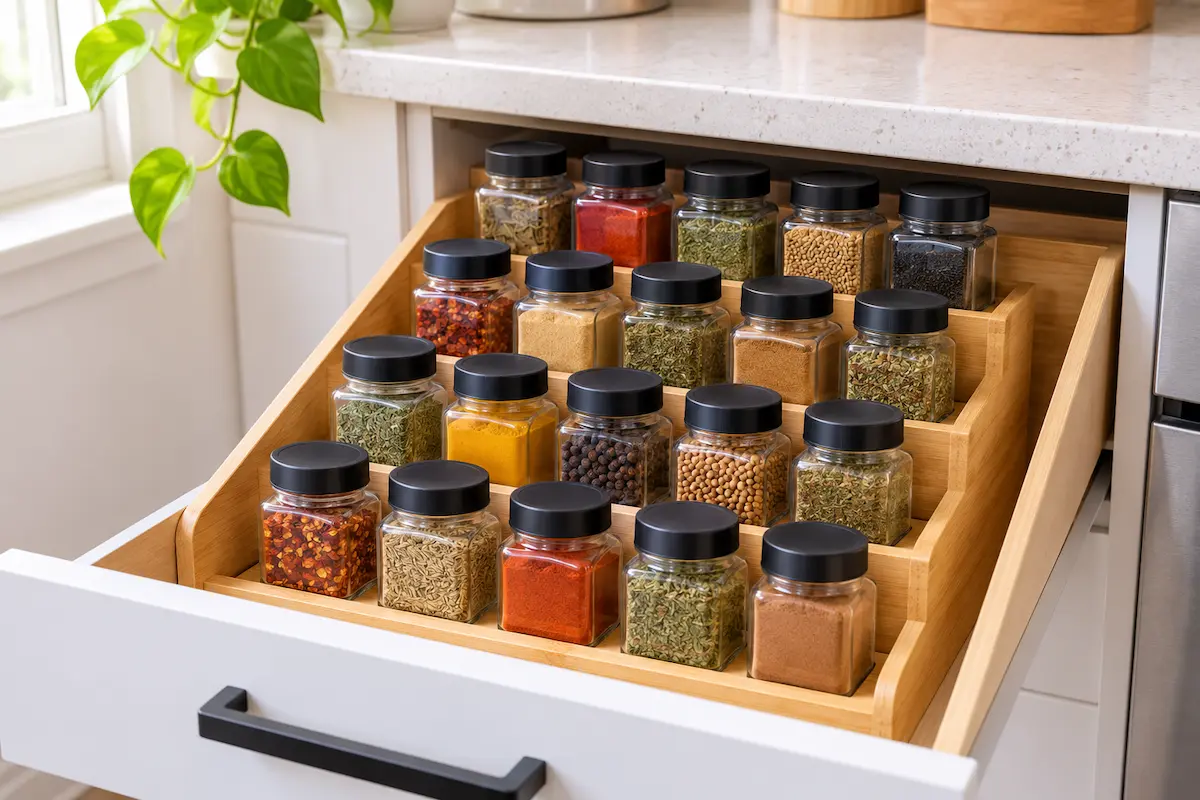
Short answer: Choose a spice drawer organizer by the drawer’s clear height and your tallest jar, not by how it looks in photos. If your jars only fit lying down, use a flat liner or flat tray. If they fit tilted, a tiered tray or a wood insert works, as long as the tallest bottle clears the cabinet frame when the drawer closes. If the drawer is deep enough to stand jars up with about ½ inch to spare, upright jars with labeled lids hold the most. Measure inside width, inside depth and clear height before you buy.
A spice drawer can hold a whole collection out of the light and right next to where you cook. It can also turn into a drawer that sticks halfway because one tall bottle on an angled tray catches the frame. That problem comes up in buyer reviews and kitchen forums, and most product listings never mention it.
This guide compares the main types of in-drawer spice rack, shows the three measurements that decide the fit, and works out how many jars one drawer can hold.
Spice drawer organizer types compared
Most spice organizers for drawers fall into four types, plus one fallback when no drawer is free. The table shows where each one fits. The sections below explain the measurements behind it.
| Type | Best for | Skip if |
|---|---|---|
| Flat liner or flat tray (jars lie down) | Shallow drawers, jars you already own, renters who want a no-tool fit | Your drawer is deep enough to stand jars up, which fits more |
| Tiered angled tray (plastic, acrylic, bamboo or steel) | Standard drawers where jars fit tilted; drop-in, no tools | Your tallest bottle hits the frame at the tray’s tilt |
| Trim-to-fit wood insert | Owners who want a fitted look in a drawer about 21 in deep | You rent and cannot cut it, or you change jar brands often |
| Upright jars in a grid or wells | Deep drawers and large collections, labels on the lids | Clear height is less than your tallest jar plus about ½ in |
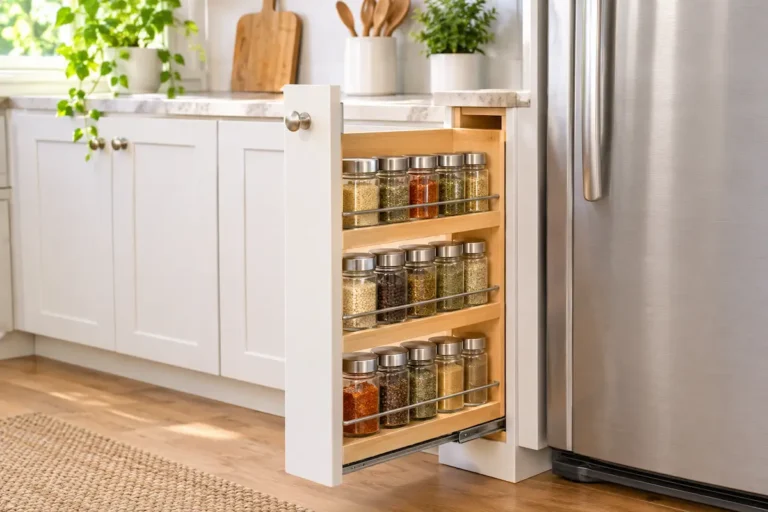
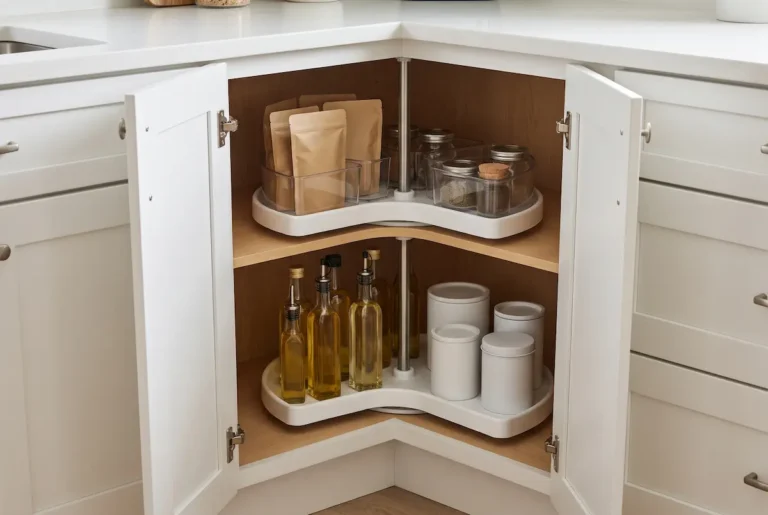
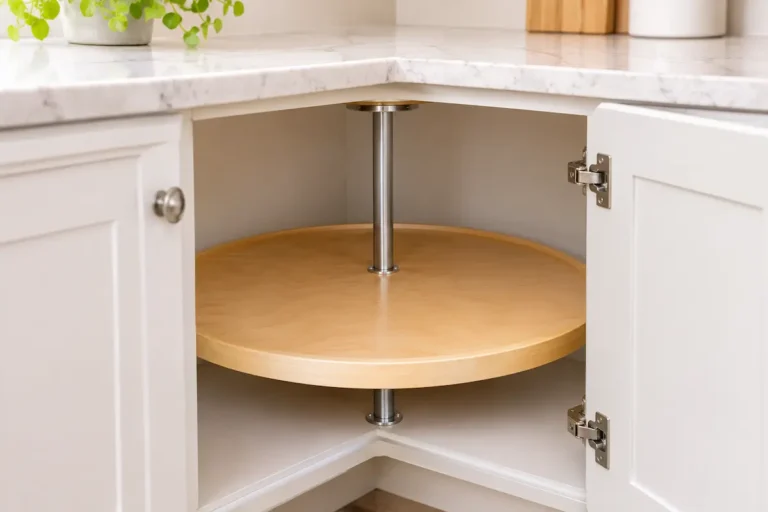
| Not a drawer: pull-out rack, door rack or turntable | Kitchens with no free drawer near the prep area | You have a free drawer away from the oven and dishwasher |
Material matters less than fit, but sturdiness does show up in reviews. In its spice storage review, America’s Test Kitchen preferred solid models, reported that flimsy ones broke during its testing, and named an expandable steel tray as its favorite drawer insert. Wood inserts from cabinet makers such as KraftMaid are solid wood and sold as trimmable kits.
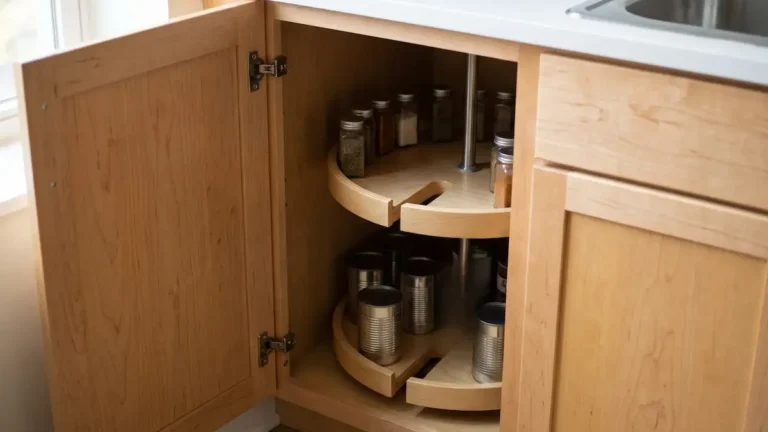
If no drawer is free, a turntable in a cabinet is another option. Our guide to organizing a lazy susan cabinet shows how to set one up so small jars do not fall off the back.
How to measure a drawer for a spice organizer
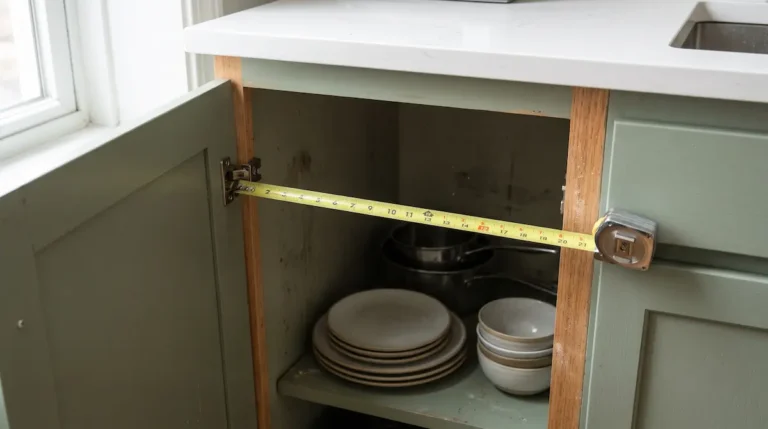
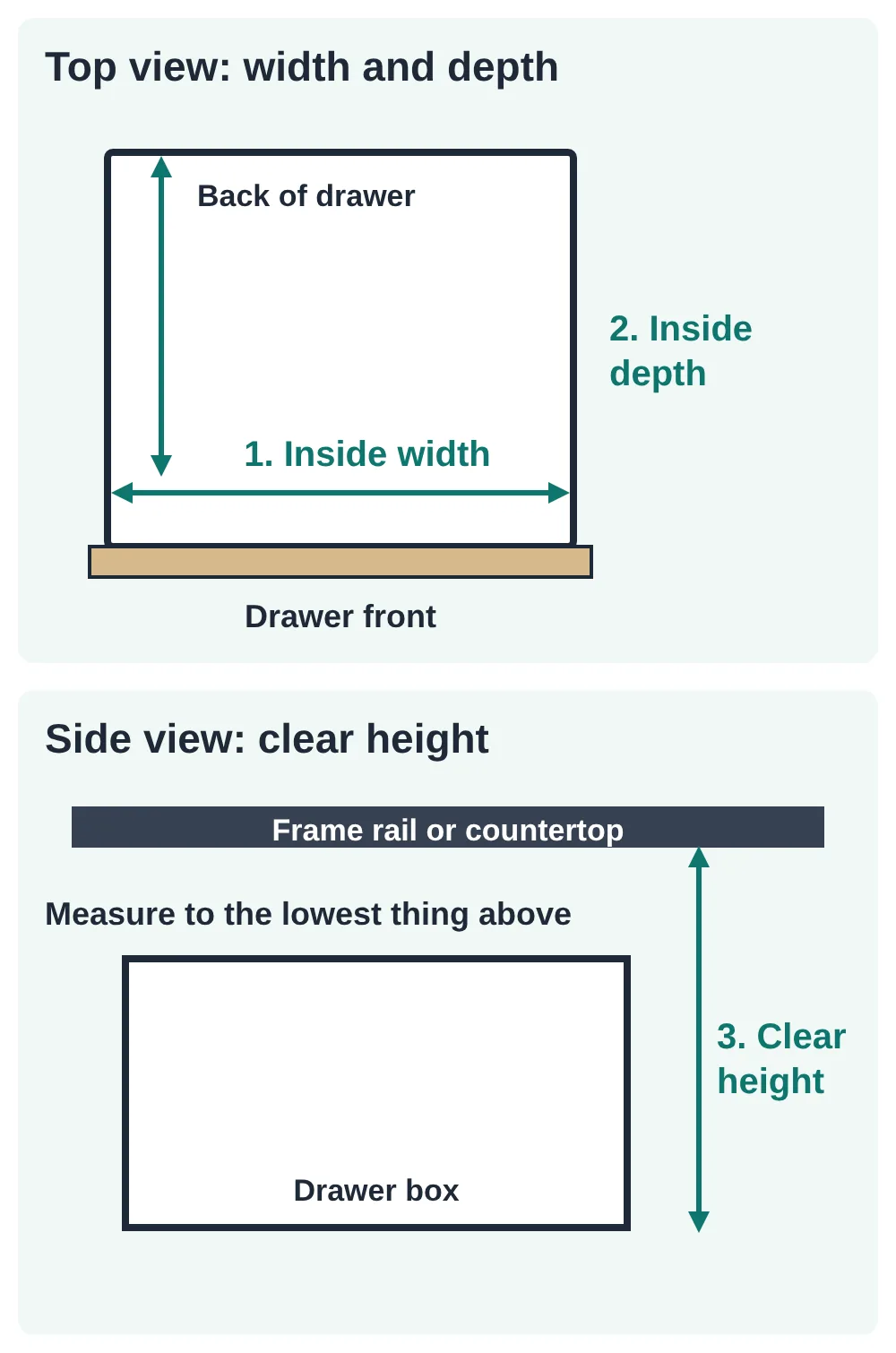
Three numbers decide the fit. Take them with the drawer pulled out and the tape inside the drawer box, not on the cabinet front.
- Inside width: side to side, inside the drawer box. Expandable trays list a width range, and your number has to fall inside it.
- Inside depth: front to back, inside the box. Wood inserts are often close to 20 inches deep, so they need a full-depth drawer.
- Clear height: from the drawer bottom up to the lowest thing the jars pass under when the drawer closes. That is usually the cabinet frame rail, the countertop edge, or the drawer above. The height of the drawer’s own sides is not the number that matters.
Here is what a few listings ask for, as listed when we checked them on November 1, 2026:
- Rev-A-Shelf 4SDI-18T wood insert: about 13.3 in wide, 19.5 in deep and 1.95 in tall, with a listed minimum opening of 15 in wide, 22 in deep and 3 in high (Rev-A-Shelf).
- KraftMaid SDIK kits: 1⅞ in high and 19⅛ in deep, in widths from 7 to 31 in. The kit for an 18-inch cabinet is 13 in wide, so the insert is much narrower than the cabinet (KraftMaid).
- Drawer Essentials custom inserts: made for drawer interior widths of 5 to 35 in and depths up to 21 in (Drawer Essentials).
- Evermill upright modules: fit drawers at least 3.5 in tall (Evermill).
- Eagle Woodworking custom insert: typically installed in a 4-inch-high drawer, with four rows in a typical 21-inch drawer (Eagle Woodworking).
- Slide-A-Shelf spice tray: needs 5 in of vertical clearance (Slide-A-Shelf).
For drawers with odd obstructions, such as slides, rails or a center divider, our guide on how to measure kitchen cabinets for organizers covers the full method.
The height trap: why tall bottles stop the drawer closing
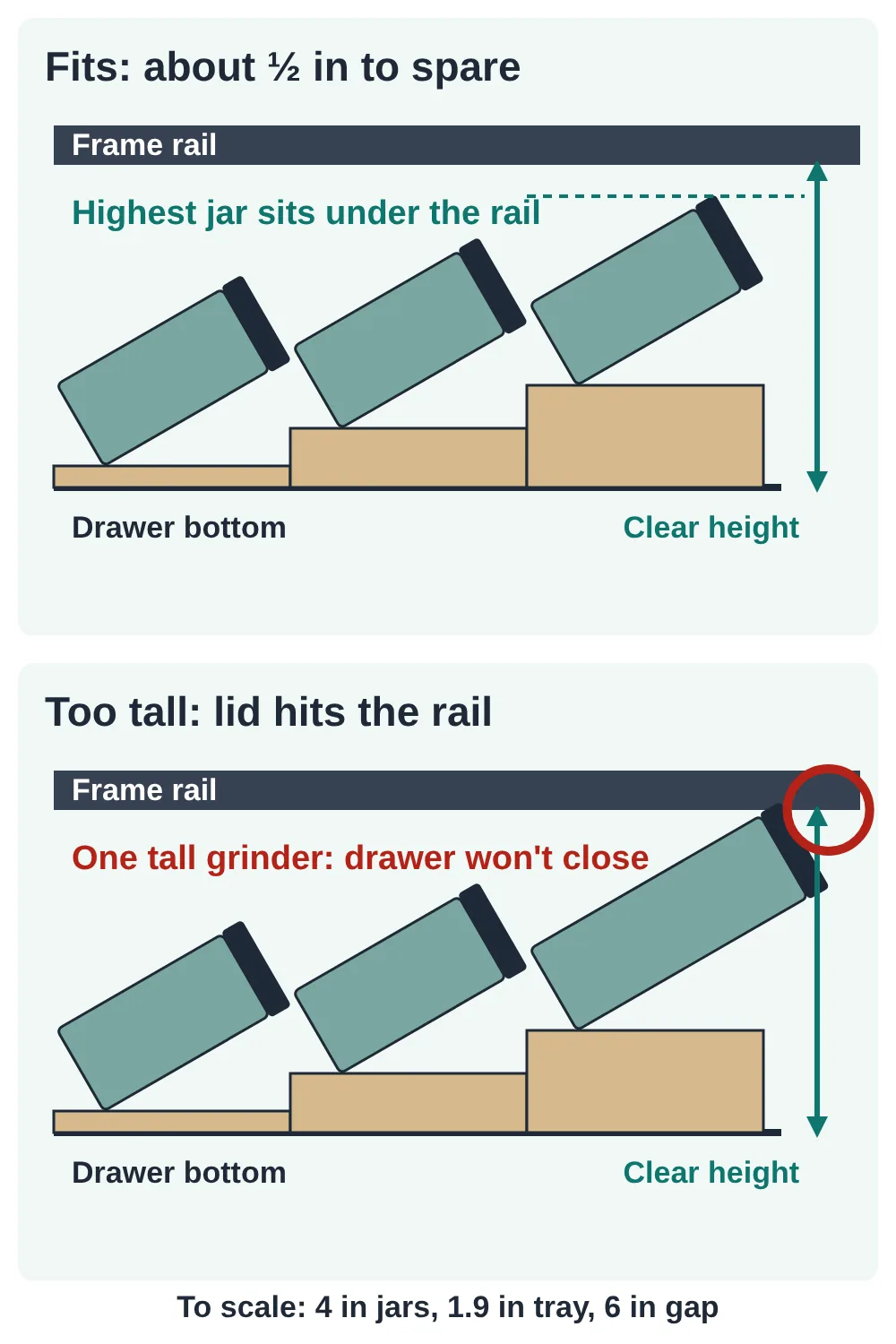
A listed minimum height usually describes the tray or insert. Your jars add height on top of it. Rev-A-Shelf’s tall wood insert is 1.95 in high and its listed minimum opening height is 3 in. The listing does not say which jar sizes that 3 inches allows for, so treat it as the minimum for the insert and check your own bottles.
KraftMaid’s insert page shows what happens when the jars are too tall. One reviewer reported that about one in six of their store-bought jars had to lie flat for the drawer to shut. Another had to trim the insert’s width by ⅛ in to fit. Forum posts describe the same problem with original bottles: the lids catch the top of the opening as the drawer closes.
Run this check before you order:
- Find your tallest bottle. Grinders and large shakers are the usual problem.
- Check the listing for a maximum jar height. Some listings give one. If yours does not, look at the questions section or ask the seller.
- If you already have a tray, test the back row. Put the tallest bottle on the highest step and close the drawer slowly. If the lid touches anything, the drawer will catch every time.
- Leave about ½ inch of slack. Our rule of thumb: the highest point of the jar should sit about ½ in below the clear height. One DIY builder used the same margin, adding about ½ in to the tallest jar when sizing their tiers (Love & Renovations).
Shallow, standard or deep drawer: what works in each
There is no single “spice drawer height.” Sort your drawer by what your own jars can do in it.
| Your drawer | Works best | Watch out |
|---|---|---|
| Shallow: jars only fit lying down | Flat liner or flat tray | Rows depend on jar length, so fewer rows fit |
| Standard: jars fit tilted, not standing | Tiered tray or wood insert | Tallest bottle in the back row; run the check above |
| Deep: clear height is at least your tallest jar plus ½ in | Upright jars in a grid, labels on the lids | Front labels are hidden from above |
A flat liner takes almost no height. The one Tasting Table described is a foam strip about 2.4 in wide and 0.3 in high that holds jars on their sides with the labels facing up. It comes as a 10-foot roll that you cut with scissors to the length of your drawer (Tasting Table).
Keep original bottles or switch to square jars?
You do not need matching jars. A liner works with the jars you already buy, which is part of its appeal (Tasting Table, linked above). Mixed bottles are the main fit risk on tiered trays, because one tall brand can block the whole drawer.
Switching to one jar size has three real benefits. You run the height check once. The count per row is predictable. And square jars sit flush side by side, while round bottles can roll on a flat surface unless ridges hold them. If you switch, America’s Test Kitchen recommends glass, because glass does not absorb flavors and odors the way plastic can.
Whichever you choose, label where you look. On a tray or liner, the label on the jar’s side faces up. In an upright grid you look down at the lids, so label the lids. Some drawer owners label both, so the jar is easy to find in the drawer and easy to put back.
How many jars fit in one drawer?
Use two numbers:
- Jars per row = inside width ÷ jar width, rounded down.
- Rows depend on the type. On a tiered tray, use the listing’s row count. On a flat liner, divide the inside depth by the jar’s length. For upright jars, divide the inside depth by the jar’s width.
Worked example (illustrative numbers): a drawer 15 in wide and 20 in deep inside, with square jars 1.75 in wide and 4 in tall. That jar size comes from one DIY build (Life with Less Mess). Jars per row: 15 ÷ 1.75 = 8.6, so 8.
| Layout | Rows in 20 in | Jars |
|---|---|---|
| Tiered tray, 4 rows | 4 | 32 |
| Flat liner, jars lying lengthwise | 20 ÷ 4 = 5 | 40 |
| Upright grid (needs 4.5 in clear height) | 20 ÷ 1.75 = 11.4, so 11 | 88 |
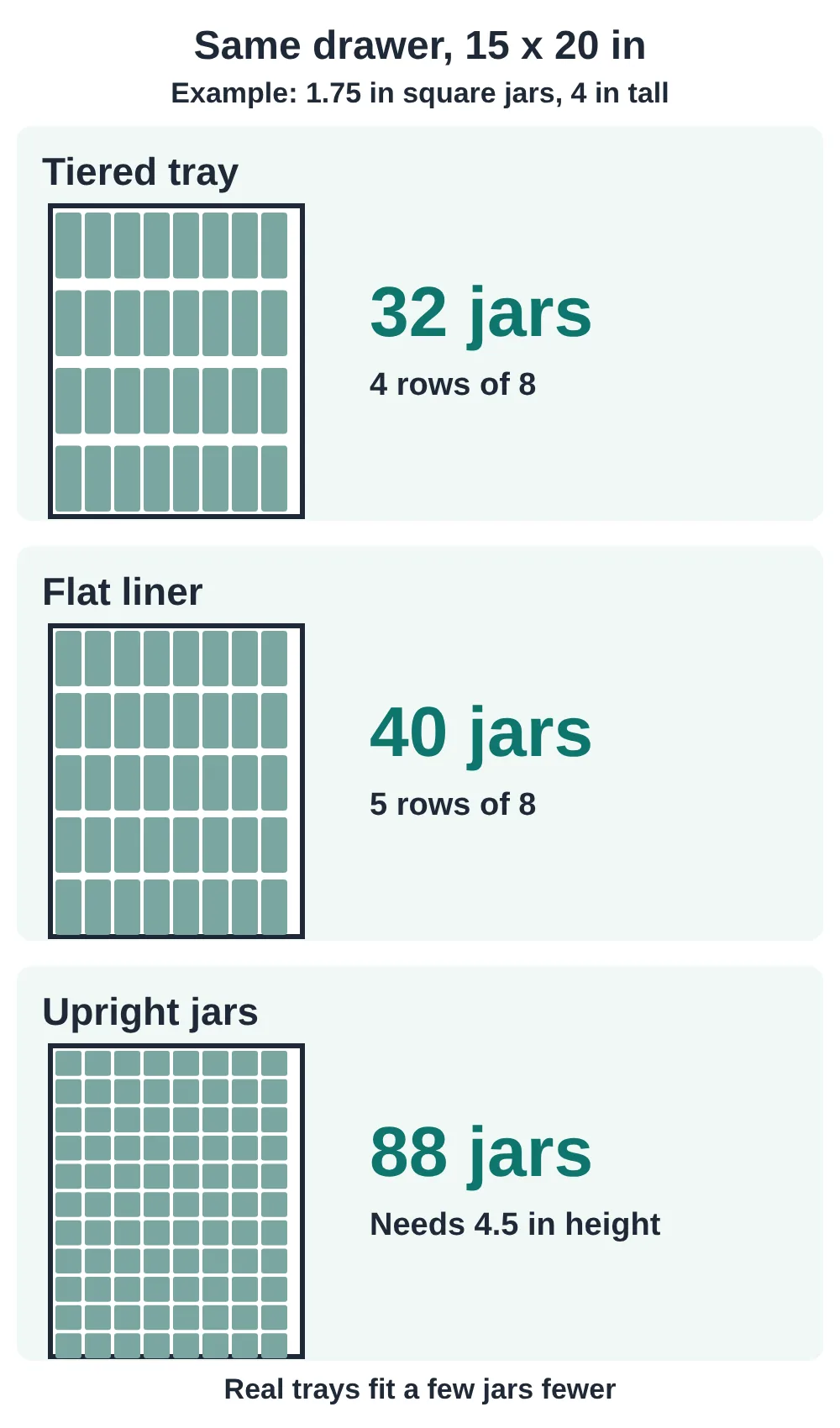
Real trays have walls, lips and gaps, so expect a few jars fewer than the math. For a large collection, America’s Test Kitchen favored organizers that hold at least 50 standard 4-fluid-ounce jars. If your count falls short, the upright layout or a second drawer usually solves it faster than a bigger tray.
How to organize spices in a drawer (including deep drawers)
Put the spices you use most in the front rows
On a tiered tray, the front row is the easiest to see and reach. Give it the spices you use every week. Baking spices and once-a-year jars go to the back.
Keep overflow and refills somewhere else
Bulk bags, backup jars and refills crowd out the jars you reach for. Keep them on a pantry shelf instead. Our guide to organizing a pantry with deep shelves shows how to zone a shelf and keep newer packages behind older ones.
In a deep drawer, stand jars up and label the lids
Upright jars read from above, so the lid is the label. Group them in rows by use (baking, everyday, blends), then alphabetize within each row if you have many.
Stop trays and jars from sliding
Expandable trays can shift when the drawer opens fast. A non-slip drawer liner under the tray helps, and it also keeps round bottles from rolling in a flat layout.
Is a spice drawer next to the stove a bad idea?
Heat is the problem, not the drawer. McCormick advises keeping spices away from heat, moisture and direct sunlight, and avoiding storage over the stove, dishwasher or sink. Texas A&M AgriLife Extension recommends a dark place such as a cabinet or drawer, but not above the dishwasher, microwave, stove or refrigerator, or near a sink or heating vent. America’s Test Kitchen goes further and suggests a cabinet or drawer that is not near the stove or oven.
In a small or galley kitchen, almost every drawer is near the range. In that case:
- Use the drawer farthest from the oven door that is still within reach of the prep area.
- Avoid the drawer directly above the dishwasher.
- Buy smaller amounts of spices you rarely use, as America’s Test Kitchen recommends, so less sits in a warm spot for months.
Practical or just pretty? A pre-buy checklist
Many spice drawer photos online show a drawer filled with matching jars. Before you buy, check the parts that decide whether it works in your drawer:
- Clear height measured to the lowest point above the drawer, not the drawer’s side
- Tallest bottle clears by about ½ in, tilted or upright
- Jars per row × rows covers your collection, with a little room to grow
- The width range matches your drawer’s inside width, not the cabinet width
- The tray will not slide, or you have a non-slip liner for it
- Rows lift out for cleaning (Eagle Woodworking, for example, sets its rows in loose)
- Renters: drop-in trays and liners cut with scissors need no tools; pull-out units that screw into the cabinet need landlord approval
For more storage that needs no tools, see our no-drill kitchen storage ideas for renters.
FAQ
How deep should a spice drawer be?
From front to back, wood inserts in the listings we checked run about 19 to 19.5 in deep, so they need a drawer around 21 to 22 in deep inside. For height, the insert alone needs about 2 to 3 in, and your tallest jar sets the rest. Upright jars need their full height plus about ½ in.
How wide should a spice drawer be?
There is no standard width. KraftMaid sells inserts from 7 to 31 in wide, and Drawer Essentials makes them for drawers 5 to 35 in wide inside. A narrow drawer still works: divide its inside width by your jar width to see how many jars fit across.
Will a spice drawer insert fit any drawer?
No. The inside width has to fall in the insert’s range, the depth has to be long enough, and the clear height has to pass your tallest jar. Wood inserts are often trimmable, but trimming takes a saw.
What is a flat spice drawer organizer?
It is a liner or tray that holds jars lying on their sides, with labels facing up. It suits shallow drawers, because it adds very little height.
How we put this guide together
This guide is based on manufacturer and retailer listings (KraftMaid, Rev-A-Shelf, Drawer Essentials, Evermill, Eagle Woodworking and Slide-A-Shelf), America’s Test Kitchen’s spice storage review, a Tasting Table article on spice drawer liners, storage guidance from McCormick and Texas A&M AgriLife Extension, two DIY build write-ups, and common questions from kitchen forums and search results. We did not install or test these products. The jar counts are worked examples, and the ½-inch slack is our own rule of thumb. Listings change, so confirm the specs for the exact model and measure your own drawer and jars before buying.